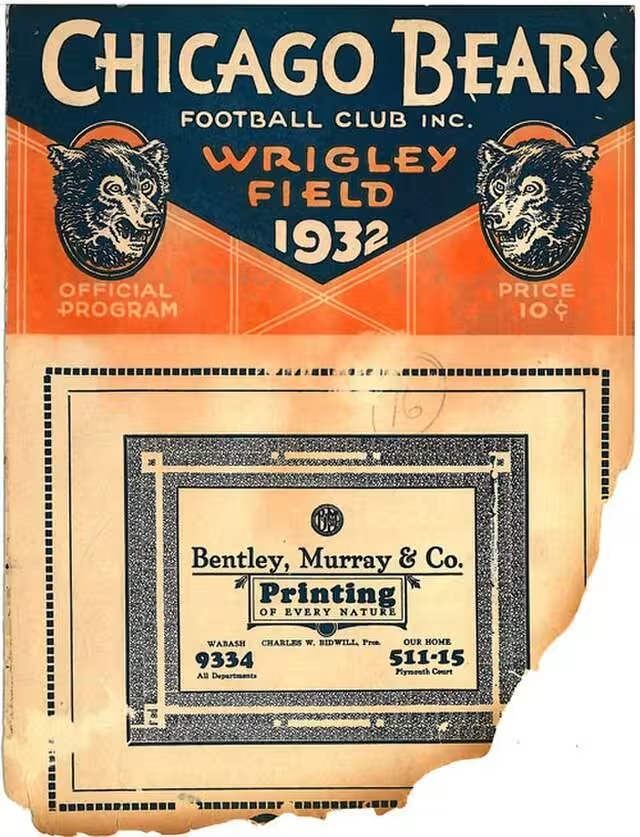
The Cold War of 1932
The history of the NFL is often defined by its iconic championships, but the foundation of modern professional football was poured on a freezing day in Chicago, December 18, 1932. This date marks not just a historic game between the Chicago Bears and the Portsmouth Spartans (the future Detroit Lions), but a crucial inflection point: it was the NFL’s very first playoff game and its first ever played entirely indoors.
The need for this sudden, high-stakes contest arose because the two teams finished the season in a dead heat, tied atop the standings. Unlike today’s complex tie-breaking scenarios, the NFL of 1932 had no formal playoff structure, meaning the champion was determined solely by regular-season record. The league decided a decisive contest was necessary to crown a winner, creating an ad hoc championship game that accidentally invented the NFL playoff.
Field of Dreams—and Boards
But the frigid, blizzard-like Chicago weather made the Bears’ home field, Wrigley, unusable. In a revolutionary move, organizers secured the Chicago Stadium, a massive indoor arena primarily built for boxing and hockey. The logistics were astounding: a makeshift football field, only 80 yards long, was carved out on the arena floor. The standard boundary lines were replaced with padded side walls, creating a tight, enclosed spectacle.
This indoor environment necessitated unique modifications that forever changed the game. Due to the proximity of the walls, teams were forced to run the ball into the end zone—forward passing from behind the goal line was banned—and when a ball carrier was tackled, the play was paused and the ball was moved back 10 yards. In a defensive struggle defined by the tight quarters, the Bears ultimately prevailed with a score of 9–0, powered by a touchdown pass from Bronko Nagurski (after a controversial rule clarification) and a safety.
Conclusion
The 1932 tie-breaker was a watershed moment. Born out of necessity, this experimental indoor contest proved the viability of a post-season tournament. Its success convinced the league to officially divide into two divisions the following year and schedule an annual championship game, permanently embedding the playoff concept into the fabric of the National Football League. This humble, indoor game laid the groundwork for the spectacle of the Super Bowl we know today.