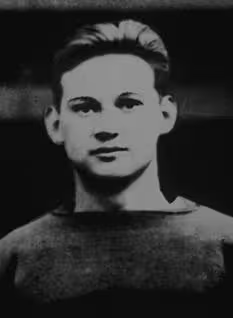
Defenders fear him, history remembers him, and statistics prove his absolute dominance. George “Tank” McLaren shatters opposing defensive lines and defies the very concept of losing yardage. As the ultimate powerhouse of the early gridiron, he punishes tacklers and ensures that every single touch of the football moves his team closer to the end zone.
Football Bio
August 29, 1896 – George “Tank” McLaren, a former fullback for the University of Pittsburgh, was born.
George was an All-American in both the 1917 and 1918 seasons under the legendary coaching of Pop Warner.
Remarkably, he never stopped for a loss on any recorded running play where he carried the ball.
He was enshrined in 1965 in the College Football Hall of Fame. [National Football Foundation]
Pop Warner’s “Tank” Formation
Pop Warner constructed an offensive machine around a fullback who simply refuses to go backward. Let’s dive into how the legendary coach utilized George ‘Tank’ McLaren to perfect his pioneering single-wing attack.
The Strategy:
Warner deploys his single-wing offense to generate overwhelming physical force at the point of attack. Instead of utilizing a traditional quarterback to hand the ball off, the center snaps the ball directly to the primary runner. For the Pitt Panthers in 1917 and 1918, that workhorse is Tank McLaren. By taking the direct snap, McLaren eliminates the vulnerable handoff phase, saves precious seconds in the backfield, and immediately builds terrifying downhill momentum.
The Execution:
To maximize this power, Warner aligns a moving wall of blockers—typically pulling guards and a blocking halfback—directly in front of McLaren’s path. When McLaren hits the off-tackle gap, he already possesses a full head of steam. Because he never dances laterally or hesitates behind the line, defenders meet a battering ram moving at top speed. This scheme guarantees that even on blown blocking assignments, McLaren’s sheer forward lean carries him past the line of scrimmage, cementing his legendary record of zero negative-yardage carries.
Pop Warner doesn’t just field a great player; he engineers a tactical system that makes his fullback mathematically unstoppable. For more deep dives into the vintage formations that built the gridiron, check out the historical archives right here at PigskinDispatch.com.
The Single-Wing “Power Sweep” Mechanics
| Offensive Element | The “Tank” Advantage |
| Direct Snap | Eliminates backfield hesitation; McLaren immediately attacks the line. |
| Unbalanced Line | Overloads one side of the defense, creating a massive rushing lane. |
| Pulling Guards | Provides McLaren with heavy lead blockers to clear out linebackers. |
| No-Nonsense Running | McLaren’s North-South running style prevents side-to-side tackles for loss. |
Conclusion
George McLaren leaves behind an unprecedented legacy of forward progress. He cements his status as a legendary figure in Pittsburgh football history by achieving a statistical anomaly—never taking a step backward on a recorded carry. He serves as the perfect instrument for Pop Warner’s physical offensive schemes, driving his team to historic victories. His 1965 induction into the College Football Hall of Fame guarantees that modern fans will always remember the sheer, unyielding power of the man they called “Tank.”
Accolades and Football Accomplishments
- College Football Hall of Fame: Inducted in 1965.
- 2× Consensus First-Team All-American: Recognized as the nation’s premier back in 1917 and 1918.
- National Championship Era: Anchored the Pitt Panthers during a dominant stretch under Pop Warner, contributing to undefeated campaigns and recognized national titles.
- The Unstoppable Streak: Never tackled for a loss on any recorded running play throughout his collegiate career.
- Collegiate Head Coach: Following his playing days, he transitioned to the sidelines, serving as the head football coach for Kansas State (1920–1921) and the University of Cincinnati (1922–1926).
- 1917 Scoring Leader: Tied for the team lead in scoring during the 1917 season, crossing the goal line 13 times.
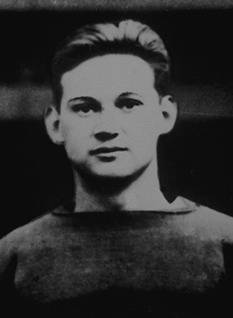
Courtesy of the College Football Hall of Fame
Historically significant fair use
Celebrate Football History With Your Collection
"Heads up: A few links in this description are affiliate links. That means if you click through and grab something, I might get a small cut that helps keep the lights on here—at zero additional cost to you!"
- Mike Ditka: Iron Man OG Tight End & Super Bowl-Winning Coach
- Chris Doleman: Vikings Defensive Hall of Famer
- Tom Davies: Pitt Panther Legend
- The Architect of the Lateral: The Gridiron Journey and Legacy of Andy Kerr
- Miracle on Cardiac Hill: Looking Back at the Legendary 1976 Pitt Panthers
- Joe Thompson: Hall of Fame Pitt Player & Head Coach
- Football History of September 25
- Dan Marino: Pitt Panthers and Miami Dolphins QB Legend
- Hands of Gold: The Legendary Career of Larry Fitzgerald
- Hugh Green: The Ultimate Pitt Panthers Defensive Legend
- The Island of Excellence: The Legendary Career of Darrelle Revis
- Bob Peck: The Heartbeat of Pop Warner’s Undefeated Pitt Panthers
- Pitt End Joe Skladany: Immovable Legend of the 1930s
- Gridiron Titan: The Unstoppable Legacy of Aaron Donald
- Johnny Majors: The Versatile Legend of Tennessee Football
- Curtis Martin: The Consistent Engine of the Gridiron
- Tony Dorsett: The Legendary “TD” and the Art of the Unbreakable Record
- The Architect of the Gridiron: The Life and Legacy of Pop Warner
- Herb Stein: The “Steel City Engine” of the Pitt Panthers
- Jimbo Covert: The Steel Anchor of Pitt and Chicago
- From Steel Mills to Surgical Suites: The Incredible Journey of Joe Donchess
- The Master of the Middle: How Joe Schmidt Revolutionized Football Leadership
- The Versatile Legend: Hube Wagner, Pittsburgh’s All-American Gridiron Star
- 🐷 Hog Heaven: Mark May, the Outland Winner Who Anchored Washington’s Dynasty
- Football History of October 27
- From “Dream Backfield” to NFL Champion: The Legacy of Marshall Goldberg
- Football History of October 24
- 1922 Pitt Panthers