
 By Darin
 Before modern specialized kickers, there was a man from Melbourne who could turn a blizzard into his personal highlight reel. Pat O’Dea didn’t just play football for Wisconsin; he imported a style of play that left American crowds in stunned silence. Known as the “Kangaroo Kicker,” O’Dea utilized his Australian Rules background to launch drop-kicks and punts that defy the physics of the 19th-century ball. From 60-yard field goals in blinding snow to punts that spanned the entire length of the field, O’Dea remains the most exotic and effective weapon in the history of the early gridiron.
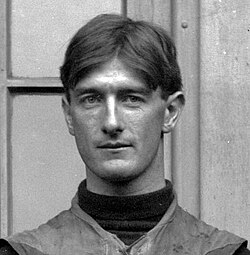
Football Bio
March 17, 1872 – Melbourne, Australia – Pat O’Dea, the University of Wisconsin fullback from 1896 to 1899. The Footballfoundation.org says O’Dea played Australian Rules Football at Xavier College and professionally for the Melbourne Football Club and Essendon Football Club in Australia before arriving in the United States in 1896.
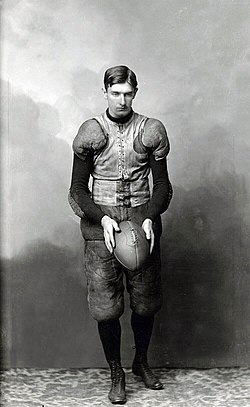
Almost as soon as he set foot on American soil, Pat headed to Wisconsin, following his brother Andy, who coached track there. The younger O’Dea enrolled at the school and not only became a star on the gridiron but also participated in track and rowing. Pat used his skills learned in his homeland with the Australian Rules running drop kick and was known as the “Kangaroo Kicker.” He was a master of punting, and drop-kicking was done on the run. His longest drop-kick went 62 yards on Nov. 15, 1898, against Northwestern during a heavy blizzard.
Article from Sep 19, 1934 San Francisco Chronicle (San Francisco, California)
His NFF bio states that he made 60-yard drop-kick field goals against the University of Chicago in 1897 and Minnesota in 1899. His place kicks included 60 yards against Minnesota and 57 against Illinois in 1899. O’Dea was credited with long punts of 110 yards against Minnesota in 1897, 100 against Yale in 1899, and 85 against Lake Forest in 1896. He made a 90-yard run against Beloit in 1899 and, in four years, made 32 field goals. Pat O’Dea was inducted into the College Football Hall of Fame in 1962.
Conclusion
Pat O’Dea was a transitional figure who proved that the “foot” in football was a primary offensive weapon. His ability to score from nearly anywhere on the field—often while running—forced opponents to fundamentally change their defensive strategies. By marrying Australian Rules techniques with the American game, he became one of the first true international superstars of the sport. Even today, his yardage totals for punts and drop-kicks stand as nearly mythical achievements from an era of heavy, leather-laced balls and brutal conditions.
Accolades and Football Accomplishments
- College Football Hall of Fame: Inducted in 1962.
- Two-Time All-American: Recognized as one of the premier players in the West.
- Legendary Drop-Kick Record: 62-yard field goal vs. Northwestern in a blizzard (1898).
- Punting Milestones: Credited with punts of 110 yards (1897) and 100 yards (1899).
- Multisport Athlete: Competed in football, track, and rowing at the University of Wisconsin.
- Career Scoring: Accounted for 32 field goals during his four-year tenure.
- Australian Rules Background: Played professionally for Melbourne and Essendon Football Clubs.
- Speed & Versatility: Recorded a 90-yard rushing touchdown against Beloit in 1899.
