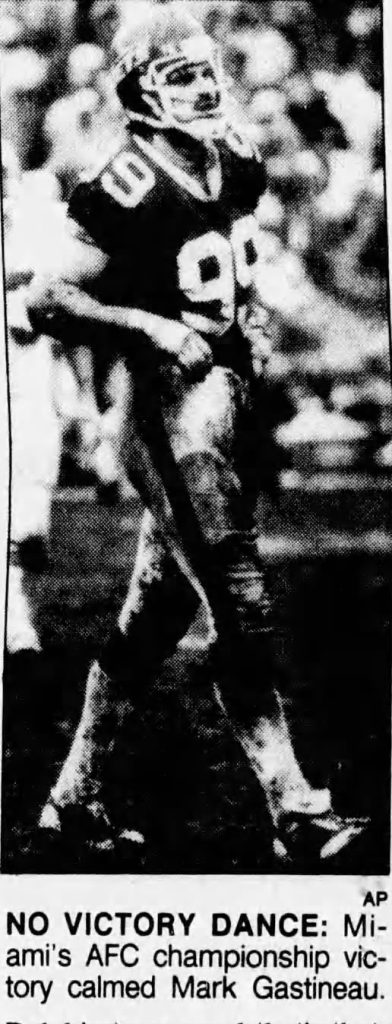
"It may take us a couple of days to get really organized before we realize the seasons over. But they (Miami Dolphins) won and that's that. You can't take anything away from Miami." ~ New York jets pass rush specialist Mark Gastineau after the Jets fell to the Miami Dolphins in the 1982 AFC Championship game 14-0.
Gastineau 1983
USA Today McLean, Virginia · Monday, January 24, 1983 via Newspapers.com
The 1982-83 NFL season was an anomaly, shortened by a 57-day player strike that resulted in a "Super Bowl Tournament." Following their 14–0 victory over the New York Jets in the infamous "Mud Bowl" on January 23, 1983, the Miami Dolphins advanced to Super Bowl XVII.
Here is the breakdown of that championship matchup and why the Dolphins’ momentum ultimately stalled.
Super Bowl XVII: Miami Dolphins vs. Washington Redskins
Played on January 30, 1983, at the Rose Bowl in Pasadena, California, the game was a clash of styles. The Dolphins featured the "Killer B’s" defense and a young quarterback, David Woodley, while Washington relied on a massive offensive line known as "The Hogs" and powerhouse running back John Riggins.
1. The Dolphins’ Fast Start
Miami actually controlled the early portion of the game. Wide receiver Jimmy Cefalo caught a 76-yard touchdown pass from Woodley in the first quarter, and Fulton Walker made history by returning a kickoff 98 yards for a touchdown—the first kickoff return TD in Super Bowl history. At halftime, Miami led 17–10.
2. The Turning Point: "70 Chip"
The most iconic moment of the game occurred in the fourth quarter. Facing a 4th-and-1 at the Miami 43-yard line and trailing 17–13, Washington coach Joe Gibbs decided to go for it.
The play, known as "70 Chip," called for John Riggins to run off-tackle. Riggins broke the tackle of Dolphins cornerback Don McNeal and galloped 43 yards for the go-ahead touchdown. That play effectively broke the spirit of the Dolphins' defense.+1
3. Offensive Stagnation
While the Dolphins' defense fought hard, their offense completely vanished in the second half.
Quarterback Struggles: David Woodley did not complete a single pass in the second half.
Total Yardage: The Dolphins were outgained by Washington 400 to 176 total yards.
Time of Possession: Washington’s "Hogs" dominated the clock, holding the ball for over 36 minutes.
The Significance: The End of an Era
The 27–17 loss was a bitter pill for Don Shula and the Dolphins. It proved that despite a legendary defense, they lacked the offensive firepower to close out elite teams when the passing game was neutralized.
Interestingly, this loss paved the way for a franchise-altering decision. Just a few months later, the Dolphins would use their first-round pick in the 1983 NFL Draft to select a quarterback from Pitt named Dan Marino, ushering in the most prolific passing era in team history.