
Long before multi-billion-dollar stadiums and prime-time television deals, the blueprint of modern professional football was being written in league meetings, bold franchise relocations, and game-changing safety breakthroughs. July 12th marks a cornerstone date in gridiron lore, capturing the pivotal moments when forgotten franchises like the Brooklyn Dodgers and Cleveland Indians laid the foundation for today’s NFL, and when a historic league meeting gave birth to the Detroit Lions. From the signing of “The Dutchman” Norm Van Brocklin to a civilization-altering college matchup that caught the eye of a President, this mid-summer calendar date holds a treasure trove of football history and legendary birthdays.
July 12 American Football History Timeline
- July 12, 1930 – The Brooklyn Dodgers franchise is established in the NFL when, according to the Pro Football Hall of Fame, Brooklyn businessman John Dwyer purchased the league’s Dayton Triangles franchise and moved it to New York. As was common in early professional football, Dwyer rebranded the team as a popular local team so that fans could feel connected to the franchise and thus attend the games. Dwyer chose the Dodgers name to connect allegiance with the baseball Dodgers fan base. The club was sold three years later to Chris Cagle and John “Shipwreck” Kelly, but after a single year of ownership by this tandem, the franchise was sold again to Dan Topping. Things really changed in 1940 when Ace Parker, the Duke All-American, was signed. The addition of Parker transformed the Dodgers from perennial losers into one of the league’s better teams, that is, until World War II sent many of the team’s stars, including Ace, off to war and sent the team to the basement of the NFL’s standings. In 1944, the team changed its nickname to the Tigers. One year later, Topping stunned the NFL when he announced he was joining the new All-America Football Conference. The NFL canceled his franchise and merged the team with the struggling Boston Yanks. Parker, who had returned from the war and rejoined the Yanks in ’45, followed Topping to the AAFC for one final season. He was one of the veteran leaders of his New York Yankees squad that won the AAFC’s Eastern Division. (Source)
- July 12, 1931 – The Cleveland Indians franchise formed after the Cleveland Tigers changed their name and subsequently folded after the 1921 season, per ProFootballHOF.com. According to the American Football Fandom site, this was the first of three different instances of an “Indians” pro football franchise in Cleveland. A second “Indians” NFL team arose in 1923. That team played as the “Indians” for the 1923 season before changing their name to the Cleveland Bulldogs in 1924. The third rendition of the Cleveland Indians came in 1931, when the League sponsored the club that played only on the road. The NFL intended to locate this team permanently in Cleveland. However, when no suitable owner was found, the franchise folded after just one season due to visiting gate revenues. The NFL views these three Cleveland teams as distinct franchises. (Source)
- July 12, 1930 – Portsmouth Spartans/Detroit Lions franchise forms. The Spartans were officially granted a franchise at the July 12, 1930, league meeting. The teams had their ups and downs in their brief span on the NFL circuit. Twice, they faced controversy, preventing them from claiming the League Championship Title. We go more in-depth on these stories and on the Portsmouth franchise in our Early Pro Teams series special on the Spartans. On June 30, 1934, the Portsmouth franchise was sold and moved to Detroit, where they have resided ever since.
- July 12, 1949 – The LA Rams sign Quarterback Norm Van Brocklin to a contract.
- July 12, 1960 – Inventor D.H. Rayburn is awarded the Football Safety Helmet with Face Guard US Patent 2944263.
July 12 Football Hall of Fame Birthdays
Happy Birthday to these legendary trailblazers! As we look back at July 12, we honor a lineup of icons whose births trace back to the Civil War era, spanning generations of evolving football rules, brutal line battles, and dominant rushing offenses.
Here is the list in chronological order:
- Hec Cowan [1863] – A legendary Princeton tackle and captain, Cowan was selected to the very first All-American Team in 1889 by Caspar Whitney. Widely regarded by his contemporaries—including icon Pudge Heffelfinger—as one of the strongest men ever to step onto a gridiron, he used his powerful, piston-like legs to carry defenders on his back before transitioning to a successful coaching career and a life as a Presbyterian minister.
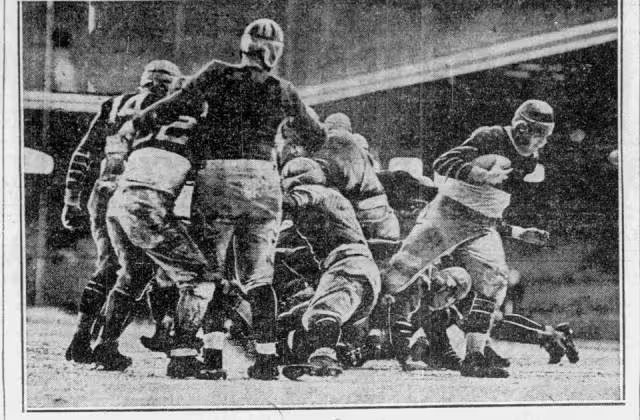
- Bob Torrey [1878] – A consensus All-American lineman and captain for the University of Pennsylvania, Torrey anchored a dominant, physical Quaker front that went 24-0-1 over his final two seasons. He famously played center opposite Swarthmore’s “Tiny” Maxwell in the brutal 1905 matchup that left Maxwell heavily battered, a historic game that ultimately caught the attention of President Teddy Roosevelt and catalyzed sweeping, civilization-altering rule changes across college football.
- Glenn Dobbs [1920] – The first All-American in Tulsa football history, Dobbs was a true “quadruple-threat” single-wing tailback who excelled at passing, punting, running, and defending. He carried his elite versatility into the professional ranks, earning AAFC MVP honors with the Brooklyn Dodgers in 1946 and later claiming MVP honors in the Canadian Western League before returning to lead his alma mater as head coach in the 1960s.
- Bill Cooper [1939] – Appropriately nicknamed “Cannonball,” Cooper was a ferocious, punishing fullback who used his direct running style to rack up 3,651 career rushing yards and 364 points at Muskingum University. After leading the Fighting Muskies to a perfect 9-0 season and earning first-team All-America honors in 1960, the hard-nosed runner advanced his career into the professional ranks with the San Francisco 49ers.
Conclusion
The milestones of July 12th remind us that the game we love is a living, breathing tapestry built on structural trial-and-error and raw grit. The early franchise migrations—shifting from Dayton to Brooklyn, or Portsmouth to Detroit—proved that professional football could thrive in major metropolitan markets if given the right foundation. When you weave together these franchise blueprints with pioneering safety innovations and the births of dominant, versatile pioneers like Hec Cowan and Glenn Dobbs, it becomes clear that today’s multi-million-dollar league was earned, block by grueling block.