
 By Darin
 Can a fifth-grade dropout become a world-class surgeon and a College Football Hall of Famer? Joe Donchess proved it was possible. After leaving school to work in the grueling steel mills of Youngstown, Donchess was “discovered” and sent to prep school, where he compressed years of education into a single season. At the University of Pittsburgh, he became a “terror on the field” and a brilliant scholar in the classroom. From undefeated seasons and Rose Bowl appearances to a distinguished career as a Chief Surgeon, the story of Joe Donchess is the ultimate testament to the power of a second chance.
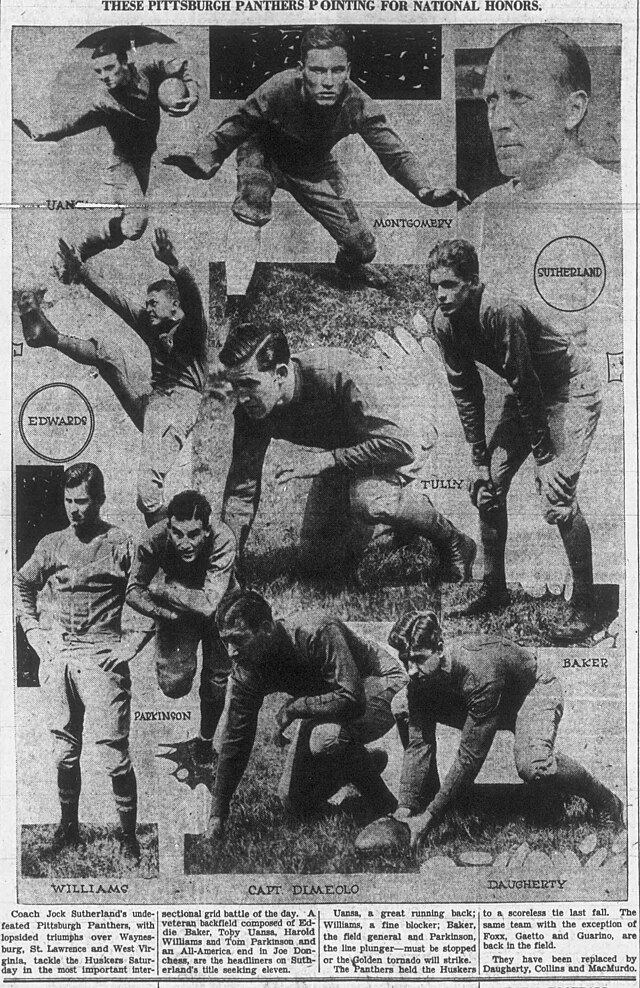
Caption text says “Coach Jock Sutherland’s undefeated Pittsburgh Panthers, with lopsided triumphs over Waynesburg, St. Lawrence and West Virginia, tackle the Huskers Saturday in the most important intersectional grid battle of the day. A veteran backfield composed of Eddie Baker, Toby Uansa, Harold Williams, and Tom Parkinson, and an All-America end in Joe Donchess, are the headliners on Sutherland’s title-seeking eleven. Uansa, a great running back; Williams, a fine blocker; Baker, the field general, and Parkinson,the line plunger, must be stopped, or the Golden tornado will strike. The Panthers held the Huskers to a scoreless tie last fall. The same team with the exception of Foxx, Gaetto and Guarino, are back in the field. – They have been replaced by Daugherty, Collins, and MacMurdo.”
Nebraska State Journal, via Wikimedia Commons.
Football Bio
March 17, 1905 – Youngstown, Ohio – The University of Pittsburgh’s great end from 1927 to 1929, Joe Donchess, was born. The NFF says Donchess quit school in the fifth grade to earn money working in a steel mill. That could have been the end of this student-athlete’s story right there, but it’s thankfully not.
Some five years later, an alumnus of Wyoming Seminary learned of Donchess’s story and promptly sent Joe off to that famous prep school. Donchess turned out to be an excellent student and a fast learner, and made up three grades in one year. After graduating from Wyoming Seminary, Joe attended Pitt and excelled academically and athletically.
The Panthers were undefeated in 1929, and that coincided with the year Donchess was chosen as a consensus All-American. The Panthers were highly touted and went to the Rose Bowl that season, sporting four All-Americans and a label as one of the great teams in the history of Eastern football. It may have all gone to the team’s heads as Pitt was dominated by the University of Southern California, in a 47-14 thumping. Donchess played in the Rose Bowl again in 1928 against Stanford, and, despite a powerful Pittsburgh team, the Cardinal defeated the Panthers 7-6. Joe Donchess received the honor for his great legacy, which was enshrined in the College Football Hall of Fame in 1979.
Conclusion
Joe Donchess’s life was a masterclass in perseverance, transitioning from the heat of the steel mills to the intensity of the operating room. His athletic dominance at Pitt was matched only by his academic drive, eventually leading him to serve as the Chief Surgeon at U.S. Steel. By the time he was inducted into the College Football Hall of Fame in 1979, he had long since proven that his legacy was not just about the yards he gained, but the lives he saved and the barriers he broke. Today, he remains one of the most respected figures in the history of the Pittsburgh Panthers.
Accolades and Football Accomplishments
- College Football Hall of Fame: Inducted in 1979.
- Unanimous All-American: 1929.
- First-Team All-American: 1928.
- Second-Team All-American: 1927.
- Two-Time Rose Bowl Participant: 1928 (vs. Stanford) and 1930 (vs. USC).
- Eastern Championship: Helped lead Pitt to an undefeated regular season and the Eastern title in 1929.
- Wyoming Seminary Legend: One of five alumni from the school to reach the College Football Hall of Fame.
- Academic Excellence: Earned his M.D. from the University of Pittsburgh while competing at a high level.
- Distinguished Professional Career: Served as Chief Surgeon for U.S. Steel from 1943 until 1965.
