
 By Darin
 What does it take for a rival fan base to coin their most famous slogan just to stop you? In 1955, the Texas Longhorns were so terrified of Jim Swink’s elusive running style that they created the phrase “Hook ’em, Horns” as a defensive rallying cry. Known as “Ol’ Swivel Hips,” Swink didn’t just run through the Southwest Conference—he danced through it. From leading TCU to back-to-back Cotton Bowls to becoming a Heisman finalist, Swink remains the gold standard for Horned Frog greatness and a foundational figure in Texas football lore.
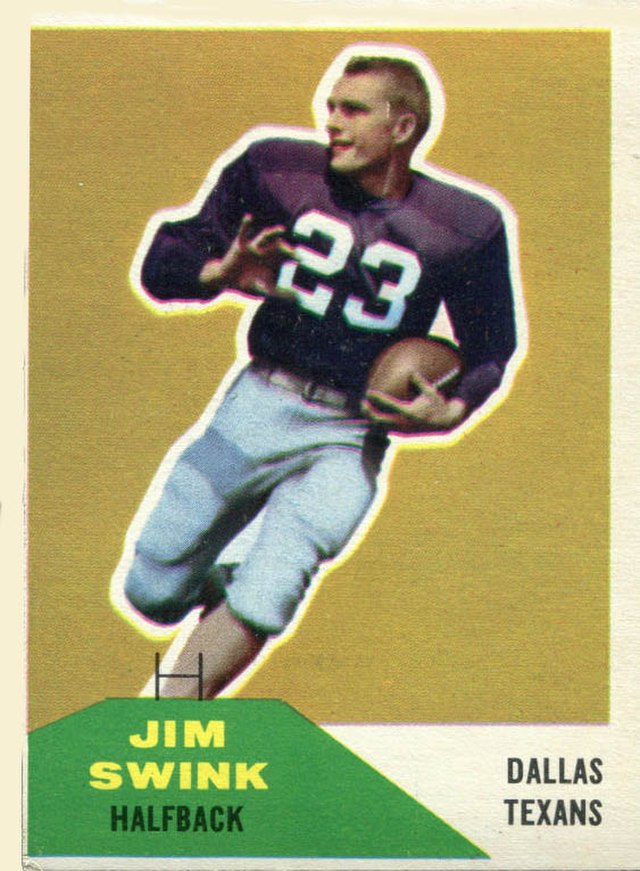
Football Bio
March 14, 1936 – Sacul, Texas – Jim Swink, Texas Christian University’s outstanding halfback, was born. According to the 2015 winter edition of TCU Magazine, Swink’s running style, especially in the open field, made him one of the most acclaimed halfbacks in Southwest Conference history.
His abilities contributed to the Horned Frogs winning a SWC crown in 1955 and making back-to-back Cotton Bowl appearances in 1956 and 1957 under coach Abe Martin. The article notes Swink’s colorful nicknames, such as “Ol’ Swivel Hips” and “The Rusk Rambler,” awarded in admiration of his uniquely shifty running style.
Hook-Em Horns from a Horned Frog?
Swink is also remembered as the inspiration for the famous University of Texas expression, “Hook ’em, Horns.” Before a November 12, 1955, matchup in which eighth-ranked TCU was set to battle the Longhorns, Texas students, wary of Swink’s elusive running, coined the slogan to motivate and symbolize their defense’s resolve.
“They had a guy in their student body who knew our team and spread the word that they needed to stop me from running,” Swink shared with TCU Magazine in a 2006 interview. “The Texas players heard about our strong team, too. So, they came up with ‘hook him’ because they wanted to catch me, trip me up, slow me down. That game was the first time it was used.”
Aside from the legacy the team slogan still carries, the 1955 game against the Horned Frogs was all for not. Jim Swink had one of his best collegiate games. He pounded the turf for 235 yards on 15 carries, averaging 15.7 yards per carry, and scored a school-record 26 points. TCU dominated Texas that Saturday, winning 47-20. The National Football Foundation’s bio on Swink reports he was the nation’s leading scorer and second-leading ground gainer as a junior in 1955. That year, he totaled 125 points and rushed for 1,283 net yards, a new TCU record.
Jim was a two-time All-America selection and finished second to Howard Cassady of Ohio State in the 1955 Heisman Trophy voting. He was inducted into the College Football Hall of Fame in 1980.
Conclusion
Jim Swink was more than just a halfback; he was a cultural phenomenon of the 1950s gridiron. His ability to leave defenders clutching at air transformed the TCU offense into a national powerhouse and forced opponents to invent new ways to stay motivated. While his statistics are legendary, his true legacy lies in the respect he commanded from rivals and his induction into the College Football Hall of Fame. To this day, whenever a Longhorn fan yells “Hook ’em,” they are inadvertently paying tribute to the shiftiest runner to ever wear the Purple and White.
Accolades and Football Accomplishments
- College Football Hall of Fame: Inducted in 1980.
- Heisman Trophy Runner-Up: Finished 2nd in the 1955 voting (behind Howard Cassady).
- Two-Time First-Team All-American: 1955 (Unanimous) and 1956.
- Doak Walker Legends Award: Recipient in 2005.
- Southwest Conference Champion: Led TCU to the title in 1955.
- NCAA Scoring Leader: Led the nation in scoring in 1955 with 125 points.
- NCAA Rushing Leader: Ranked 2nd in the nation in 1955 with 1,283 yards (averaging 8.2 yards per carry).
- Cotton Bowl Legend: Led TCU to consecutive Cotton Bowl appearances (1956, 1957).
- TCU Jersey Retired: His #22 is one of the few retired numbers in Horned Frog history.
