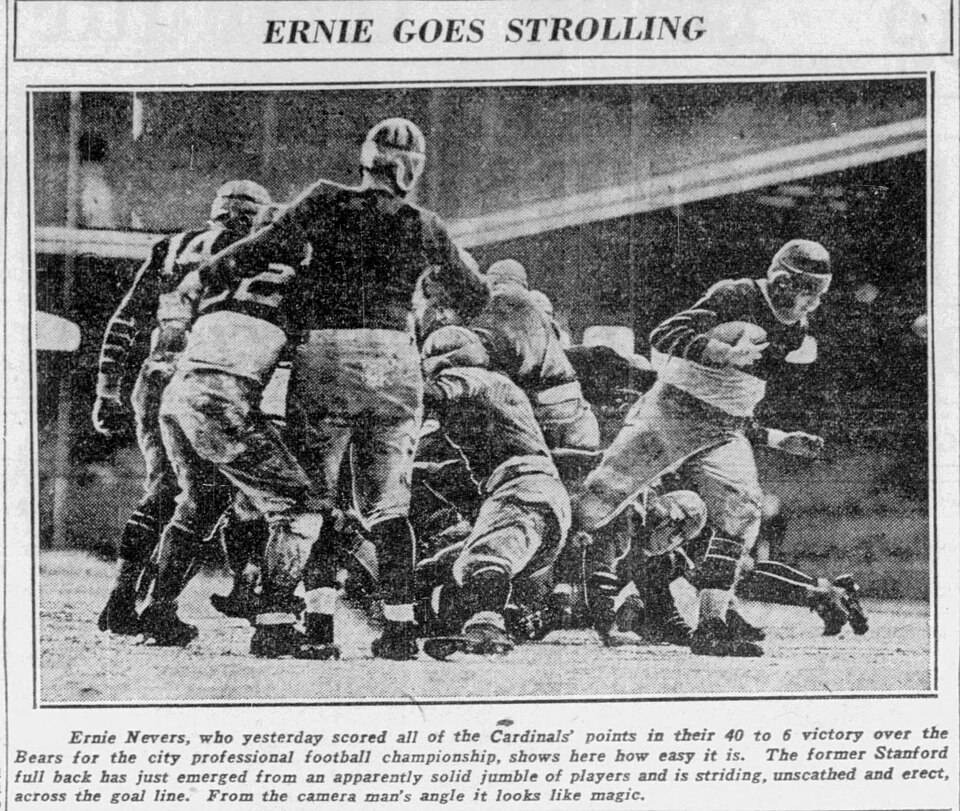
While researching a story for today’s “100 Years Ago in Football,” I came across a piece by Ernie Nevers from October 1926. You remember Big Dog Nevers, the Stanford star who, along with his fellow Indian teammates, faced Knute Rockne’ss Four Horsemen and Seven Mules in the 1925 Rose Bowl.
Had it not been for Red Grange and the previously mentioned Four Horsemen, Ernie Nevers would have had a brighter spotlight cast on his college career. At this point in 1926, Nevers was an NFL player for the Duluth Eskimos, mainly a traveling team that sold out opposing NFL venues mainly to get a glimpse of this guy play.
In his column, Nevers was writing about a new rule change, one that seems completely foreign to our modern understanding of American football rules. The concept revised was an item called the “Intentional Safety.” To clarify, what was the football Intentional Safety in the context of early gridiron history?
In the formative decades of American football, intentional safety was one of the game’s most calculated tactical loopholes—a defensive surrender turned offensive exploit that let teams trade two points for guaranteed field position and clock control. Many fans have often wondered what was the football Intentional Safety used for, and why it was such a common play during that era.
The Mechanics of the “Safety Loophole”
During the late 19th and early 1920s gridiron era, scoring rules and post-score possession differed radically from modern football. Under the prevailing code, a safety awarded two points to the opposing team, but the restart procedure rewarded the conceded team:
- Automatic Possession: After conceding a safety, the team that gave up the points got an automatic first down on its own 30-yard line (or, in earlier intercollegiate rule variations, a scrimmage snap between the 25- and 30-yard lines).
- Elimination of Catastrophic Risk: When pinned inside their own 5-yard line on late downs, teams faced disastrous scenarios: a blocked punt, a fumble in the scrum, or a defensive recovery for a touchdown (worth 6 points).
- The Mathematical Arbitrage: If a team led by three to seven points with only minutes remaining, conceding two points preserved their lead while completely erasing goal-line risk. Rather than punting from the back of their own end zone into heavy pressure, the quarterback or punter would deliberately step over the end line or down the ball behind their own goal.
- The Clock Freeze: By resuming play at the 30-yard line with a fresh set of downs, the leading team could lean on basic line plunges, keep the ball on the ground, and burn the clock without the opponent ever touching the ball again.
Key Historical Milestones
The intentional safety wasn’t an accident of poor play; it was a codified strategy taught by premier coaches of the era, including Walter Camp and Amos Alonzo Stagg.
Codification of the Two-Point Safety1882–1884The Intercollegiate Football Association standardized the safety at two points. Early rules let the team giving up the safety restart play with a scrimmage down near the 25- to 30-yard line rather than surrendering the ball. Rise of Late-Game End-Zone Tactics1910s–1920sAs defensive line play became more brutal and punt blocks proved fatal in low-scoring, field-position-heavy dead-ball eras, coaches regularly instructed punters to intentionally down the ball in the end zone to protect late multi-point leads. The NCAA Rules Committee Overhaul1925–1927Recognizing that the exploit rewarded negative play and effectively denied trailing teams an opportunity to mount a comeback, the NCAA Football Rules Committee eliminated automatic scrimmage possession following a safety. Adoption of the Modern Free Kick: The offending team had to put the ball in play with a free kick from its own 20-yard line (punt, drop kick, or placekick without a tee). Possession transferred to the receiving team unless the kicking side executed an onside kick.
The Anatomy of the Fix: Closing the Loophole
To eliminate the incentive for teams to hide behind the rulebook, the Rules Committee shifted the post-safety restart from a possession restart to a territorial penalty and turnover. In summary, what was the football Intentional Safety really addressing? It was meant to prevent teams from exploiting the rules for an undue late-game advantage.
| Factor | Pre-Reform Rule (The Loophole Era) | Post-Reform Rule (Modern Standard) |
| Possession After Safety | Offending (scoring-against) team keeps the ball | Offending team must surrender the ball via free kick |
| Ball Placement | Automatic 1st down at 30-yard line | Free kick from the 20-yard line |
| Restart Type | Scrimmage snap | Free kick (punt, drop kick, placekick) |
| Strategic Viability | Guaranteed game freeze if leading by ≥3 | High risk; opponent receives possession with favorable field position |
By requiring a 20-yard free kick, the Rules Committee ensured that an intentional safety carried severe consequences: the trailing team not only gained two points, but also received the ball near midfield with ample time to kick a game-winning field goal or score a touchdown.
While modern coaches still occasionally use an intentional safety (such as running out the final seconds of a game or creating punting room with seconds left on the clock), the automatic possession loophole that defined 1920s late-game management was permanently eliminated. Ultimately, when asking what was the football Intentional Safety, the answer lies in its unique place in football history and strategy.
Chicago Tribune