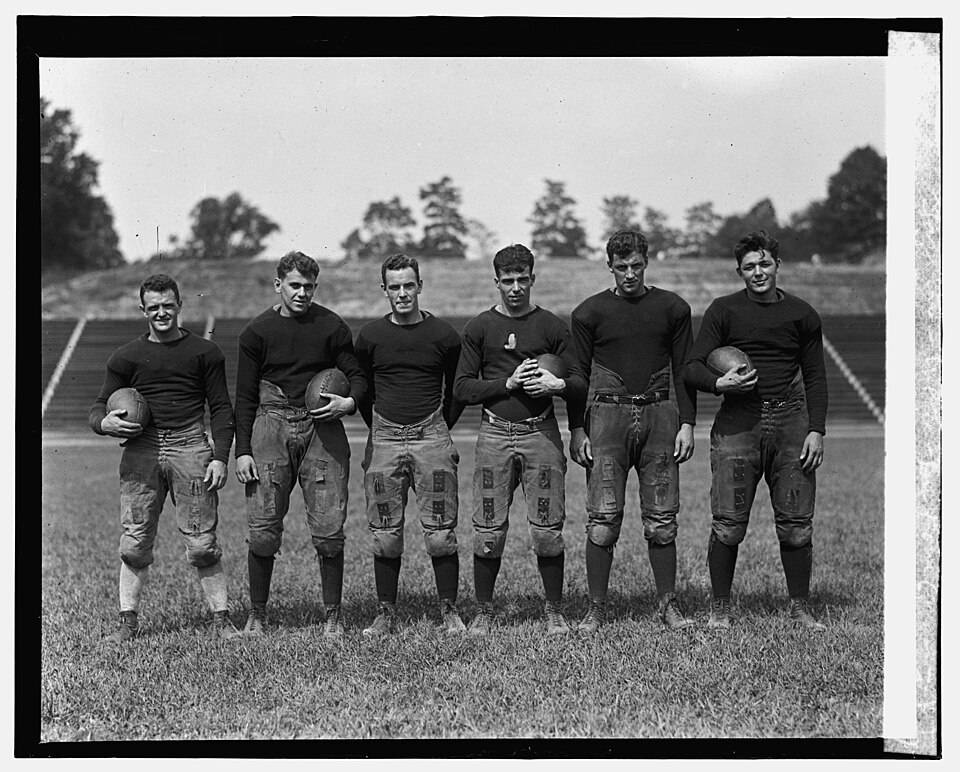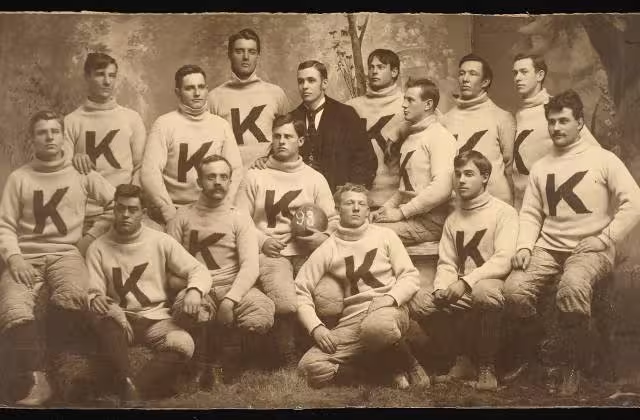
When we talk about colleges that played football from the jump, the University of Massachusetts is rarely in the conversation, but it should be. UMass, under the name Massachusetts Agricultural College, organized its first “football” team in 1879.
Now, mind you, football in that era was rugby-like, as they were a year away from Walter Camp and others introducing wide-sweeping changes of scrimmage, a snap, and down-and-distance. Needless to say, this was the start of football traditions at UMass.
UMass Football Origins
The University of Massachusetts football program traces its origins to the autumn of 1878, when the institution was known as Massachusetts Agricultural College (M.A.C.). Student Francis Codman, later honored as the “Father of Massachusetts Agricultural College Football,” organized the school’s inaugural squad. Although the team practiced throughout that first fall without scheduling an opponent, it made its intercollegiate debut on November 22, 1879. Playing as the “Aggies,” M.A.C. defeated the freshman team from cross-town rival Amherst College, 4–0. Because it was their sole contest that autumn, 1879 stands as the program’s first undefeated season.
For nearly two decades, student captains managed the team without formal coaching. That changed in 1897 when Dr. David F. Weeks, a former University of Pennsylvania quarterback, became the program’s first volunteer coach. Four years later, former team captain James Halligan took over as the first full-time seasonal coach, guiding the Aggies to a 16–8–2 record from 1901 to 1903. In 1904, M.A.C. made college football history by hiring Matthew W. Bullock. A former Dartmouth standout, Bullock became the first African American head coach at a predominantly white college, compiling a 13–8–5 mark across three seasons (1904, 1907–1908). Later, alumnus Harold “Kid” Gore—a former Aggie quarterback—became the school’s first full-time, year-round head coach in 1919, tallying 33 wins over nine seasons.
Several multi-sport standouts defined the program’s formative decades. Quarterback Harold “Kid” Gore (Class of 1913) and captain Emory Grayson (Class of 1917), a five-sport athlete who lettered in football, basketball, and baseball, anchored the pre-World War I era. In the 1930s, halfback Lou Bush emerged as the school’s premier early superstar. Debuting with a three-touchdown performance in a 50–0 rout of Cooper Union in 1931, Bush starred under winningest coach Mel Taube (.682 winning percentage) before going on to play professional baseball with the Boston Braves.
The team’s identity evolved alongside the university itself. Known originally as the Aggies, the squads were informally called the “Statesmen” after the school became Massachusetts State College in 1931. When the institution achieved university status in 1947, officials adopted the nickname “Redmen” in early 1948. However, by the early 1970s, growing awareness regarding the cultural insensitivity of Native American mascots prompted campus leaders to seek a new symbol. In the spring of 1972, UMass officially rebranded its teams as the “Minutemen” (and Minutewomen), honoring the historic colonial militia fighters central to Massachusetts’ Revolutionary War heritage—a legacy still embodied by mascot Sam the Minuteman.