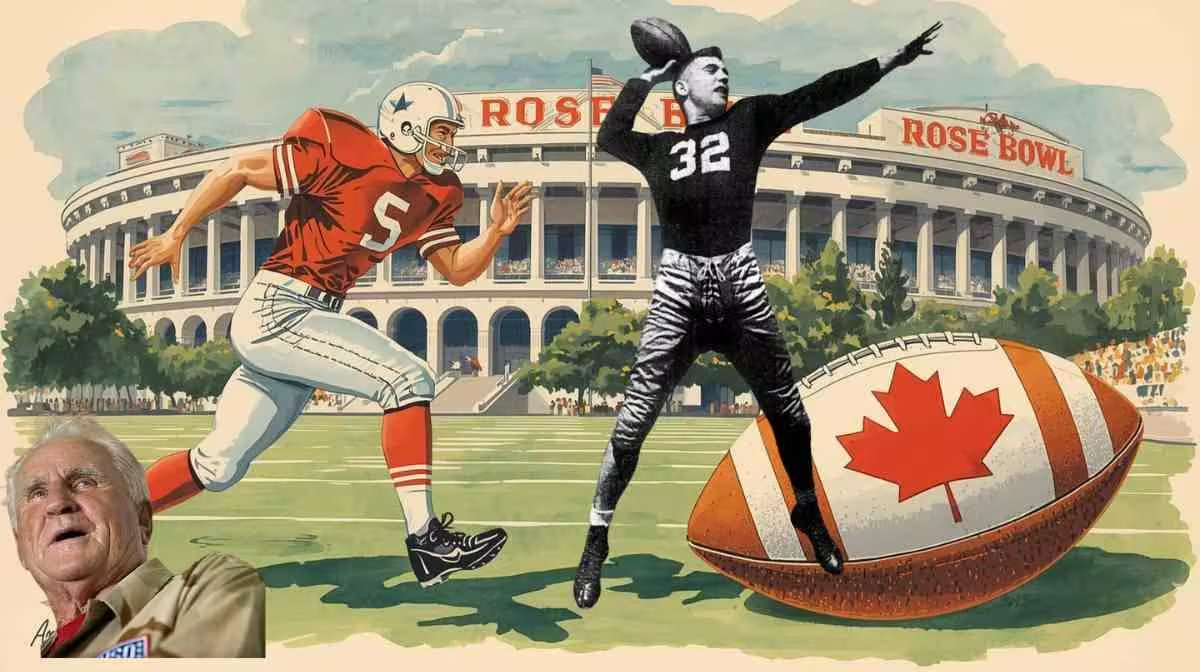
The Unforgettable Fourth: How January 4 Shaped NFL Dynasties and College Football History
From the foundational roots of the Canadian Football League in 1883 to the single greatest college football game ever played in 2006, January 4 stands as one of the most historically significant and explosive dates on the gridiron calendar. This single day has delivered everything: NFL Championships amidst global conflict, fierce AFC rivalries between the Steelers and Raiders, a record-shattering playoff performance by Eric Dickerson, and the shock resignation that defined the Bill Belichick era. Prepare to travel through time and relive the unforgettable championships, upsets, and legendary moments that solidified January 4 as a hallmark of football history.
January 4 American Football History Timeline
- On January 4, 1883, the Ontario Rugby Football Union was formed. May you ask, Hey, isn’t this a place for football history? Yes, it is my friends, and this Rugby Club from Ontario was the forerunner of the Canadian Football League.
- January 4, 1942 – Polo Grounds, New York City – At the 4th NFL All-Star Game in a series where the NFL champs would play against the best players from the rest of the League, the Bears faced a group led by Slingin’ Sammy Baugh and Frank Filchok of Washington and Green Bay’s Don Hutson. This game occurred less than a month after the attack on Pearl Harbor and was a distraction for the fans who were focused on the War effort. The Chicago Bears showed why they were so good as they defeated the NFL All-Stars, 35-24, in a game filled with fights on the field and snowball fights in the stands, per the story by ESPN.com.
- January 4, 1970 – Alameda County Coliseum, Oakland – The Kansas City Chiefs met their rivals, the Oakland Raiders, in the 1969 AFL Championship game. The Chiefs’ defense came to play and made it tough sledding for the Raiders all game, forcing 4 interceptions. KC earned the right to advance to the Big Game in a 17-7 victory over the home team.
- January 4, 1970 – Metropolitan Stadium, Bloomington, Minnesota – Meanwhile, at the NFL Championship game to see who would face the Chiefs, it was the Minnesota Vikings who outlasted the Cleveland Browns, 27-7.
- January 4, 1976 – Three Rivers Stadium, Pittsburgh, PA – The AFC Championship games of the 1970’s had two pretty common teams playing in it. Can you believe there was only one game for the Lamat Hunt Trophy in the decade of the ‘70’s, where neither the Steelers nor the Raiders were a participant? Well, in the Conference Title game of the 1975 season, it was one of three meetings in the decade between the Pittsburgh Steelers and the Oakland Raiders. This time around, it was the Steelers who outlasted the Raiders, 16-10. Pro-Football-Reference gives us the data that Franco Harris and John Stallworth scored to help the Steel City advance to the Super Bowl. (source)
- January 4, 1981 – In Cleveland, Ohio, a Browns comeback bid against the Raiders was thwarted when the famous Red Right 88 play was run. We have a full article link here.
- January 4, 1981 – The Atlanta Falcons were stymied by Danny White and Tony Dorsett of the Cowboys, who led Dallas back from a steep deficit. Full story on the Dallas Comeback.
- January 4, 1986 – Anaheim, California – Los Angeles Rams running back Eric Dickerson scored twice as he pounded the turf for an NFL postseason record of 248 yards in a 20-0 Rams win over the Dallas Cowboys in the NFC divisional playoff.
- January 4, 1986 – The Miami Dolphins shook off the cold and a Cleveland Browns 18-point lead to defeat the Cleveland Browns in the AFC Playoff game.
- January 4, 1992 – The John Elway and Denver Broncos had a gritty 15-point comeback win over the Houston Oilers in the AFC playoffs. Full details here.
- January 4, 1999 College Football, 1st BCS National Championship, Sun Devil Stadium, Tempe, AZ: #1 Tennessee beats #2 Florida State, 23-16, at the 28th Fiesta Bowl
- On January 4, 2000, a day after accepting the head coaching position with the New York Jets, Bill Belichick resigned from the Jets and later accepted the head coaching job with the New England Patriots.
- January 4, 2000 – Louisiana Superdome, New Orleans – The 2nd BCS National Championship game held was under the guise of the Allstate Sugar Bowl. It matched up two pretty good offensive teams. #1 Florida State would face the #2 Virginia Tech squad. The Seminoles had their great Wide Receiver, Peter Warrick, and company, while the Hokies placed an interesting red-shirt freshman under center named Michael Vick, per the AllstateSugarBowl.org site. There were plenty of offensive fireworks as advertised. Warrick helped the Seminoles jump out early to a 28-7 lead in the first half. But Vick spearheaded the Hokies to a great comeback that actually put Virginia Tech ahead 29-28 at the end of the third quarter. Then Warrick and Florida State gave the final push that sealed the game for them. FSU outlasted VT 46-29 in an exciting game!
- January 4, 2004 – Louisiana Superdome, New Orleans – The 6th BCS National Championship was held at the Sugar Bowl, where the top two teams in the rankings met. The second-ranked LSU Tigers were the opponents for the #1 Oklahoma Sooners, per the AllstateSugarBowl.org site. Even the coaches in this game were interesting, as OU’s Bob Stoops would face Nick Saban’s strategies. The Sooners went into the game as a 6-point favorite. Oklahoma’s offense, which was tops in the land, averaged an astounding 45.2 points coming into the game, and the Sooners were the nation’s third-best overall defensive team, giving up an average of a mere 255.7 yards a game. The Tigers fielded two All-America selections in the contest, but Oklahoma looked like an All-Star team when they rolled out 7 young men who received the All-America honors, including Heisman winner Jason White. On paper, no wonder the Sooners were favored, but there is a reason why they still play the games. LSU came out and played as a complete cohesive unit in the ultimate team sport. The Tigers’ defense stifled White and the Sooners’ offense most of the evening, limiting them to a mere 152 yards and two TDs. Saban’s offense responded when it needed to most, including right after the Sooners scored when they had great field position after a blocked punt. It was LSU in a 21-14 upset of Oklahoma at the 70th Sugar Bowl for the National Title.
- January 4, 2005 – Pro Player Stadium, Miami Gardens – The Sooners would be back as a participant in the 7th BCS National Championship in the Orange Bowl. This time, Bob Stoops and company would enter as the second-ranked team in the country and face a Pete Carroll-coached #1 Southern California team. The Orange Bowl site promotes the game as the battle of Award Winners, as 2004 Heisman Trophy winner Matt Leinart faced off against 2003 Heisman Trophy winner Jason White. The posting goes on to say that the Orange Bowl hosted its 18th National Championship, six of which have included Oklahoma. The contest wasn’t even close as the Trojans jumped out to a 28-8 lead at the half and never looked back as they triumphed 55-19 to win the BCS Title. Leinart threw five touchdown passes in the game. But that is not the end of this story… A few years after the game was played in June of 2010, the BCS, according to the Conquestchronicles.com website, under the guidance of NCAA findings of USC’s “lack of institutional control,” stripped the Title from the Trojans. The investigation of college football’s governing board found that running back Reggie Bush was ineligible for violation of NCAA rules, which in essence disqualified Southern Cal in games that Bush played. Bush also had to vacate his 2005 Heisman Trophy. The BCS said in a statement that the 2004 national title will remain vacant. One team besides the Sooners that was upset about this matter was the Auburn Tigers, who, with a perfect 13-0 season in the rugged SEC, were not chosen to play in the big game.
- January 4, 2006 – the Rose Bowl, Pasadena, California – There may have been another national title stripped, too, because of the NCAA findings with the Trojans. But USC fell in the 8th BCS National Championship to Vince Young and #2 Texas, who defeated #1 Southern Cal, 41-38, at the 92nd Rose Bowl. Texas won the National Championship, but boy, was it a classic battle. In fact, some folks, such as SBNation.com, call it the greatest National Championship game ever! And they may be right! This game had all the drama, the star power, and great coaching that made it an instant classic! Reggie Bush, Matt Leinart, and the aforementioned Vince Young highlight a couple of legendary college rosters for the contest. The game was also significant as it was the last one called by broadcaster Keith Jackson, who is probably the greatest college football play-by-play man of all time. Young became a collegiate legend on this big stage as he went 30-of-40 passing for 267 yards, plus 19 runs for 200 yards and three scores. He really took the Longhorns on his shoulders and propelled them back into the game from a 38-26 deficit with 6:42 to play. Then one of the greatest plays occurred. With a mere 26 ticks of the clock remaining and down by 5, Texas faced a fourth and 5 from the USC 8-yard line. Young took the shotgun snap and dropped back to pass. All of a sudden, he saw daylight and dashed around the right end to trot into the endzone for the go-ahead winning score! The Texas Longhorns of Coach Mack Brown would become the National Champs!
- January 4, 2010 – The Tostitos Fiesta Bowl – Boise State faced Texas Christian University in the first BCS Bowl game between two non-BCS teams, as well as the first BCS bowl game in which both teams were undefeated. The Broncos squad was led by QB Kellen Moore and running back Doug Martin, while the Horned Frogs had Andy Dalton under center, per ESPN.com. Boise State won the game when Doug Martin got a two-yard touchdown with 7:21 left in the fourth quarter to make it 17–10.
- January 4, 2014 – Quarterback Andrew Luck led the Indianapolis Colts on a 28-point comeback against the Kansas City Chiefs in an AFC Wildcard game.
- January 4, 2026 – The defacto Championship for the NFL’s AFC North division. The pivotal Week 18 matchup between the Steelers and the Ravens was a defensive struggle that turned into a late-game thriller, ultimately securing Pittsburgh’s playoff berth. The Steelers clinched a tight victory after the Ravens missed a crucial game-winning field goal attempt in the final seconds, with kicker Tyler Loop missing wide right. The game was marked by strong defensive play and limited offensive firepower for much of the afternoon. Pittsburgh’s victory was dramatic, keeping their postseason dreams alive and completing a season sweep of their rival, concluding their roller-coaster regular season on a high note.
January 4 Football Hall of Fame Birthdays
- Johnny Lujack – For more on this Notre Dame and Chicago legend, check out our bio post on Lujack

- Don Shula – He took both the Baltimore Colts and the Miami Dolphins to the Super Bowl, and we have a bio page on Coach Shula.
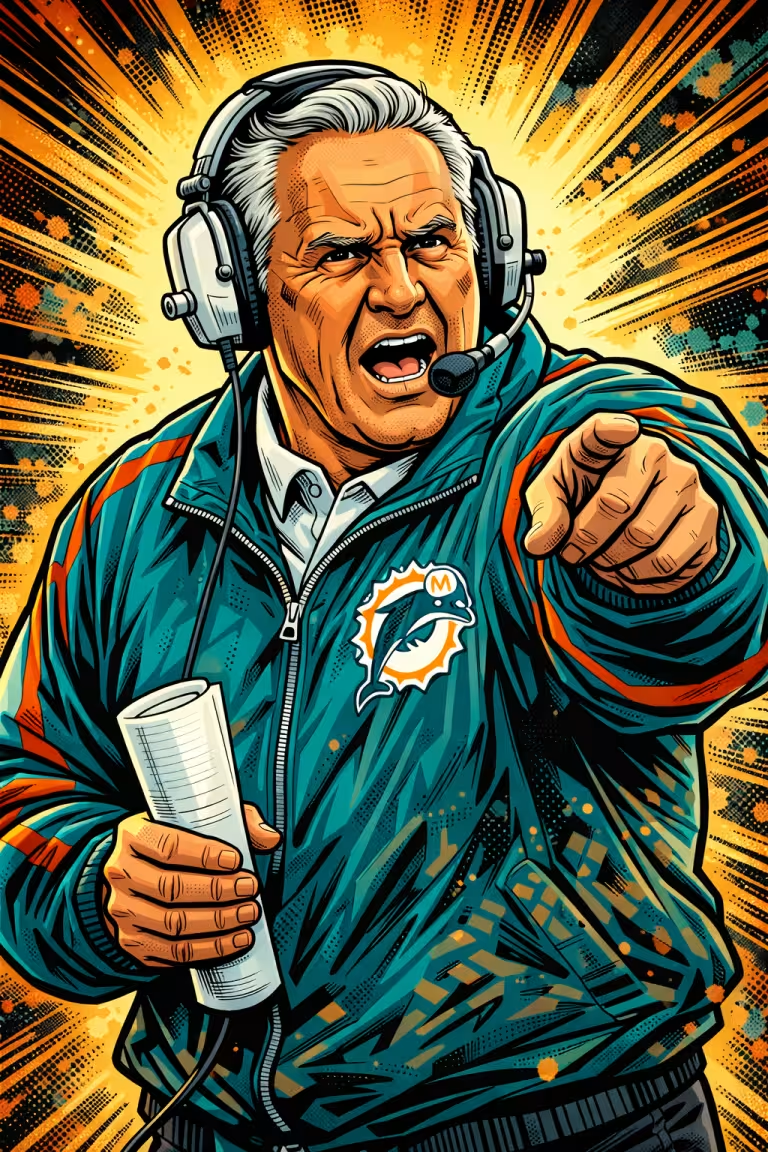
1970-1995
Conclusion
Whether it was the birth of the CFL, the dominance of the Chicago Bears in the early 1940s, or the epic BCS battles that saw Tennessee, LSU, and Texas crowned National Champions, January 4th consistently delivered high-stakes, historical drama. From Vince Young’s iconic Rose Bowl scramble to the lasting impact of a single resignation by Bill Belichick, this date represents not just a timeline, but a definitive shift in the landscape of both professional and college football. It is a day of definitive endings, thrilling beginnings, and legendary achievements.