
 By Darin
 Pigskin Dispatch’s Part 2 in the Series on American Football History
Did you miss Part 1 of the Football History Rewind Series?
Rome adopts the Greek game.
PigskinDispatch.com’s football history lesson appears in the site’s article, “How American Football Developed from the Ancient Ones.” The episode ends with a discussion of the ancient Greeks playing harpaston. History then recounts how the Greeks were conquered by Rome.
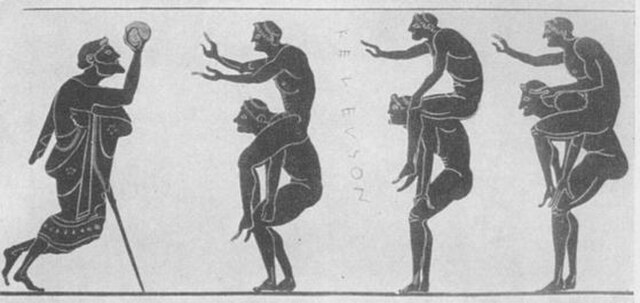
Roman Ball Game
The Romans played a similar game called harpastum. Harpastum was known as “the small ball game.” It had similar objectives to its Greek predecessor, but it used a ball of about the same size and hardness as a modern softball. (Harpastum, n.d.)
The Romans embraced the Greek game early on, but when Caesar Augustus took the throne a few decades before the birth of Christ, he found it had too much “gentleness” for Roman youths destined to be centurions and commanders of legions. He commissioned a “philosopher” to craft tougher rules, and the new game was called “harpastum.” (Harpastum, 2024) These new tougher rules were best described by the writer, Julius Pollux, who penned a description of the Roman game as played in the 2nd century:
“At the two ends of the field, behind the line where the players are stationed, are two other lines, beyond which these two bands endeavor to carry the ball, a feat that cannot be accomplished without pushing one another backward and forward.”
Harpastum
Harpastum was known as the Small Ball Game. This is because the other ball games played by the Romans used much larger balls. The Harpastum ball was made from a leather skin stitched together and stuffed with chopped sponges or animal fur. The ball was approximately 8 inches in diameter. (Harpastum – A Roman Sport, n.d.) The number of players varied from game to game – some reports suggest games with hundreds of players on each side. (Tanyeri & Tanyeri, 2023) Players had to get the ball over the opposing line to ‘score’. Harpastum was an incredibly fast and physical game. It was also quite violent, with tackling allowed, and, given the nature of the game, Harpastum was played on grass or dirt, since players were expected to end up on the ground. (Harpastum, 2024) Additional descriptions suggest a line was drawn in the dirt, and that the teams would endeavor to keep the ball behind their side of the line and prevent the opponents from reaching it. It was almost an inverted football, because instead of the team with the ball advancing it down the field, they were protecting it at all costs from their opponents, as the ball lay on the ground in what we can best describe as the offensive backfield. (Harpastum, 2024)
Even Ancient Philosophers were fans of ancient football.
The ancient philosopher, Atheneaus, wrote this:
“Harpastum is the game I like most of all. Great is the exertion and fatigue attendant upon contests of ball-playing, and violent twisting and turning of the neck. He seized the ball and passed it to a team-mate while dodging another and laughing. He pushed it out of the way of another. Another fellow player he raised to his feet. All the while, the crowd resounded with shouts of Out of bounds, Too far, Right beside him, Over his head, On the ground, Up in the air, Too short, Pass it back in the scrum.”
The ancestors of the Romans in Italy brought the game back to life, only they called it calcio. The Piazza della Novere of Florence is the cradle of this sport, which became known as giuoco del calcio fiorentino (“Florentin kick game”) or simply calcio (“kick”). The official rules of calcio were published for the first time in 1580 by a certain Giovanni Bardi. (Bardi, 1580)
Allegedly, another root of football evolved from an activity that began during the Danish occupation of England (circa 787-1066 AD). During this period, belligerent Anglo-Saxons reportedly kicked Viking skulls from village to village. (United Kingdom – Scandinavian Invasions, Britain, Anglo-Saxons, 2026)
To end this part of our series on football history and its rough beginnings, I leave you with Sidonius’s words from 473 AD in France, where Romans survived. He describes their game of harpastum:
“…Philomathius resolutely plunged into the ranks of the ball-players. Daring, even he, to essay the toil of youths vigorously,” as the Mantuan poet (Virgil) has it. Philomathius had been a fine player in his youth, but now, repeatedly pushed by the inside runner from his place in the standing circle, he struggled. When brought inside the ring again, he failed to cut across or dodge the ball’s path as it flew close to his face or over his head. He would bend low in a flying tackle and then scarcely recover from a staggering swerve. Ultimately, he was the first to retire from the strain of the game, puffing and blowing with internal inflammation. His poor, swollen liver sent frequent stabs of pain through his overtaxed body.”
Please read on in our Part 3 installment titled, “British Influence on the Ancient Game.” Right here on your favorite website for football information, PigskinDispatch.com.
