
 By Darin
 How does a high school substitute become the “most dangerous” runner in the most famous backfield in football history? Don Miller didn’t just walk onto the field at Notre Dame; he defied every expectation of his era. An “unimposing” 160-pound sophomore who surprised even Knute Rockne by trying out, Miller transformed into the breakaway engine of the legendary Four Horsemen. With a unique, high-stepping gait and elite speed, he turned open-field running into an art form, leading the Fighting Irish to the 1924 National Championship and forever carving his name into the bedrock of college football lore.
The New York Daily News via Wikimedia Commons.
Football Bio
The Defiance High School football season had just concluded in 1921, and Don, who was now a senior, had just witnessed another year in which he got to substitute in for one of his teammates at the end of a one-sided game. The scrawny lad did his best, but his size and speed were not to the measure of his peers. After graduation, Don headed for South Bend, Indiana, to attend Notre Dame.
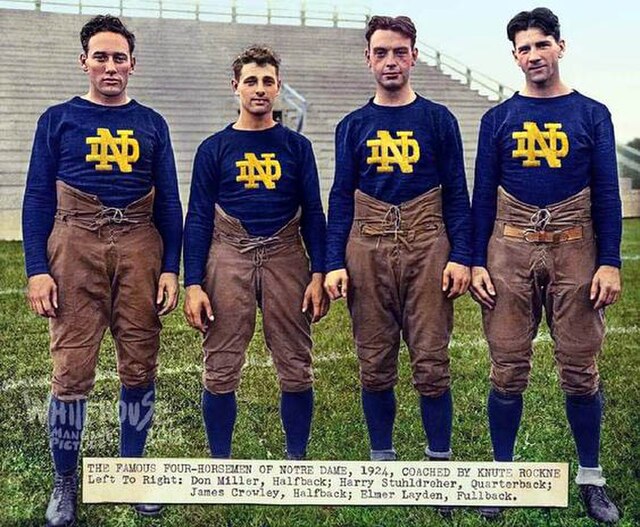
fltr: Don Miller, Harry Stuhldreher, Jim Crowley, Elmer Layden.
He decided, despite the opinions of everyone he knew, to try out for the varsity football team in his sophomore year. Even Irish Head Coach Knute Rockne looked at the 5-11, 160-pound sophomore with a bit of surprise that he would be trying out for his team. But Don, through hard work, hustle, and smart play, was destined for greatness as the workhouse runner in the famed Four Horsemen backfield of Notre Dame’s immortal 1924 national championship team, according to the NFF.
Don Miller was born on March 29, 1902, in Defiance, Ohio, and served as one of the halfbacks from the 1922 to the 1924 seasons. Miller’s legendary coach said this about him, “With his fleetness and daring, he quickly sized up as a halfback to cheer the heart of any coach,” Rockne later admitted. “Once in the open field, he was the most dangerous of the Four Horsemen. I would have to call him the greatest open-field runner I ever had.”
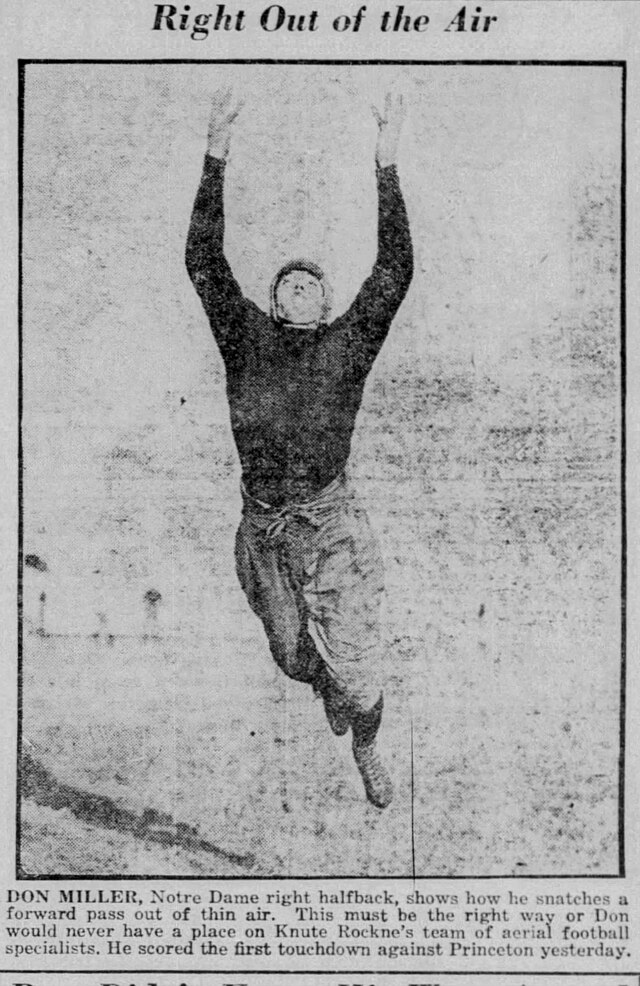
Don Miller had a unique high-stepping gait in which his knees rose higher than those of a typical rusher, making it difficult for defenders to tackle him. In the 1924 season, Miller averaged 7.1 yards per carry, and over his three-year career, he averaged 6.8 yards per carry. Miller was also the leading Notre Dame receiver in each of his three varsity years as well as a football All-America selection in 1923. The National Football Foundation selected Don Miller for entrance into the College Football Hall of Fame in 1970.
Conclusion
Don Miller’s journey from a high school backup to a centerpiece of the Four Horsemen is the ultimate “underdog” story of the early gridiron. By mastering the open field and leading Notre Dame in receiving for three straight years, he proved that football intelligence and sheer hustle could overcome a lack of physical stature. Miller wasn’t just a runner; he was a pioneer of the versatile, dual-threat backfield role that modern offenses still covet today. His legacy—immortalized in Grantland Rice’s famous prose and cemented in the College Football Hall of Fame—remains a testament to the “Magic” of the Rockne era.
Accolades and Football Accomplishments
- College Football Hall of Fame: Inducted in 1970.
- National Champion: 1924 (Notre Dame Fighting Irish).
- Consensus All-American: 1923 (Also recognized in 1924).
- Member of the Four Horsemen: The legendary backfield quartet of Stuhldreher, Miller, Crowley, and Layden.
- Career Rushing Average: 6.8 yards per carry (1,933 total yards).
- 1924 Season Efficiency: Averaged 7.1 yards per carry during the championship run.
- Receiving Leader: Led Notre Dame in receptions in 1922, 1923, and 1924.
- Rose Bowl Winner: Member of the team that defeated Stanford 27–10 in the 1925 Rose Bowl.
- Indiana Football Hall of Fame: Posthumous inductee (1975).
- Post-Career Success: Served as a U.S. District Attorney for Northern Ohio.

