The Magic of the Five: College Football’s Most Iconic Number?
In the cathedral of college football, certain numbers carry a weight that transcends the fabric they’re stitched onto. But while the "No. 1" is often a self-proclaimed title and "No. 7" belongs to the gunslingers, the Number 5 has always hit differently. It is the digit of the ultimate "X-factor"—the jersey worn by the players who didn't just break tackles, they broke the spirit of opposing fanbases.
From the breathtaking North-South lightning of Reggie Bush in the Coliseum to the dual-threat dominance of Vince Young on the fast tracks of the Big 12, wearing the number five has historically been a signal that something impossible was about to happen. It represents a specific lineage of speed, swagger, and "Heisman moments."
But when you look back at the decades of highlight reels and championship rings, who truly wore it best? We are diving into the archives to rank the legends who transformed a simple single digit into a symbol of collegiate immortality.
Top Candidates Not in the Hall of Fame:
Pat White (West Virginia)
A pioneer of the spread option offense, White became the first quarterback in college football history to start and win four consecutive bowl games. His incredible rushing ability transformed West Virginia into a national powerhouse and set the blueprint for the modern dual-threat quarterback.
Christian McCaffrey (Stanford)
McCaffrey shattered Barry Sanders' single-season all-purpose yards record in 2015, proving that a running back could be just as dangerous as a receiver and return specialist. His versatility at Stanford forced a re-evaluation of how Heisman-caliber players are measured across multiple phases of the game.
Manti Te'o (Notre Dame)
Te'o was the emotional and defensive heartbeat of Notre Dame’s 2012 undefeated regular season, becoming one of the most decorated defensive players in history by sweeping nearly every major award. He remains a symbol of the "linebacker as a superstar," finishing as a rare Heisman Trophy runner-up from the defensive side of the ball.
Larry Johnson (Penn State) Larry Johnson delivered one of the most dominant single seasons in college history in 2002, becoming only the ninth player to rush for over 2,000 yards in a regular season. His explosive senior year earned him the Maxwell and Doak Walker Awards, cementing his legacy as one of the premier power backs in Big Ten history.
Heisman Winners of Jersey 5
- Paul Hornung (Notre Dame)Known as "The Golden Boy," Hornung holds the unique distinction of being the only player to win the Heisman Trophy while playing for a losing team (2-8 in 1956). He was a versatile "triple-threat" who led his team in passing, rushing, scoring, and kickoff returns.
- Reggie Bush (USC)One of the most electric playmakers in history, Bush was the centerpiece of the mid-2000s USC dynasty, combining elite speed and agility to redefine the "all-purpose" back. His 2005 season remains legendary for its highlight-reel runs and its role in keeping USC at the pinnacle of the sport during the BCS era.
- Jayden Daniels (LSU/Arizona State)A dual-threat sensation, Jayden Daniels became the first player in FBS history to pass for 12,000 yards and rush for 3,000 yards in a career. His 2023 Heisman Trophy-winning season at LSU was statistically historic, as he led the nation in total offense and set the record for the highest passer rating in a single season.
- Jameis Winston (Florida State)Jameis Winston made history in 2013 as the youngest player ever to win the Heisman Trophy while leading Florida State to an undefeated season and a BCS National Championship. During his two years as a starter, he lost only one game and restored the Seminoles to a position of national dominance through his elite arm talent and leadership.
College Football Hall of Fame Jersey 5 Legends
- Kevin Butler (Georgia)A legendary kicker for the Bulldogs, Butler was the first person at his position inducted into the College Football Hall of Fame. He famously kicked a 60-yard field goal to beat Clemson in 1984 and finished his career as the SEC's all-time leading scorer.
- Michael Crabtree (Texas Tech)The only two-time winner of the Fred Biletnikoff Award, Crabtree had perhaps the greatest freshman season in history, catching 134 passes for 1,962 yards and 22 touchdowns. He is best remembered for his iconic last-second touchdown catch to upset #1 Texas in 2008.
- Kenny Easley (UCLA)A rare three-time consensus All-American, Easley was a defensive powerhouse who finished his career with a school-record 19 interceptions. His jersey was retired by UCLA, and he is widely considered one of the greatest safeties to ever play the college game.
- Terry Hanratty (Notre Dame)A consensus All-American quarterback, Hanratty led the Fighting Irish to a national championship in 1966. He combined with wide receiver Jim Seymour to form one of the most prolific passing duos of the era, finishing in the top ten of Heisman voting three times.
- Paul Hornung (Notre Dame)
- Elmer Layden (Notre Dame)Layden gained immortality as the fullback of the "Four Horsemen," the legendary backfield of the 1920s coached by Knute Rockne. He capped his college career by scoring three touchdowns in the 1925 Rose Bowl, leading the Irish to a national title.
- Darren McFadden (Arkansas)One of the most dynamic runners in SEC history, McFadden is a two-time Heisman runner-up and two-time Doak Walker Award winner. He famously spearheaded the "Wildcat" formation, amassing over 4,500 rushing yards in just three seasons.
- George Savitsky (Pennsylvania)A dominant offensive tackle, Savitsky is the only player in the history of college football to be named a First-Team All-American in four consecutive years (1944–1947). He was a cornerstone of the Penn "Quakers" during their era as a national powerhouse.
- Murray Shelton (Cornell)An end for Cornell in the mid-1910s, Shelton was a key figure on the undefeated 1915 national championship team. He was a versatile athlete and a consensus All-American who helped define the "Big Red" as a dominant force in early college football.
- LaDainian Tomlinson (TCU)Before his NFL stardom, Tomlinson led the NCAA in rushing for two consecutive years, including a 2,158-yard season in 2000. He once held the NCAA single-game rushing record with 406 yards against UTEP, effectively putting TCU back on the national football map.
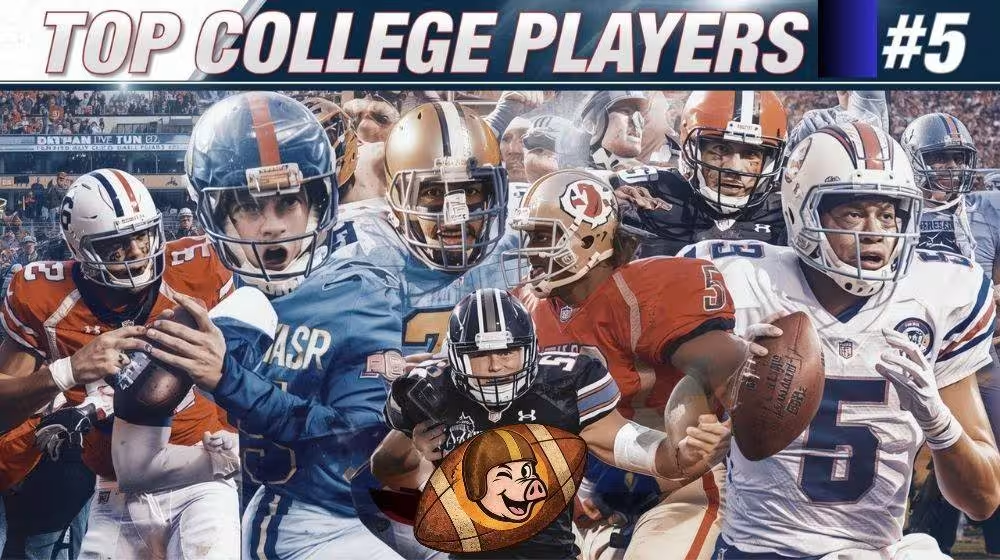
Top 5 College Football Number 5s
1) Reggie Bush
2) LaDainian Tomlinson
3) Paul Hornung
4) Christian McCaffrey
5) Jameis Winston
Conclusion: More Than Just a Number
Whether it was the triple-threat versatility of Paul Hornung in the 1950s or the modern-day dual-threat wizardry of Jayden Daniels, the number 5 has served as a continuous thread through the tapestry of college football history. It is a jersey that demands a certain level of performance—a "High Five" to the fans and a warning to the defense.
While the names on the back of the jerseys change—Tomlinson, McFadden, Crabtree, and White—the legacy of the digit remains the same. To wear the 5 is to step into a lineage of players who didn't just play the game; they electrified it. From the muddy trenches of the early 20th century to the high-flying spread offenses of today, these athletes transformed a simple single digit into a badge of honor, proving that in the cathedral of college football, few things shine brighter than a "5" under the Saturday night lights.
Join us at the Pigskin Dispatch website to see even more Positive football news!
Don't forget to check out and subscribe to the Pigskin Dispatch YouTube channel for additional content and the regular Football History Minute Shorts.
Miss our football by the day of the year podcasts, well don't, because they can still be found at the Pigskin Dispatch website.
Transcript
You know, in the realm of college football, the jersey numbers mean so much.
Speaker A:Today we're going to talk about the jersey number fives, the best players in college football history.
Speaker A:And by the end I'm going to name a top five college players that wore that jersey number five in history and see if you agree with me.
Speaker A:We're going to start off here by talking about some of the great players of college football and some of these players that maybe you, I'm sure you're going to remember, but maybe you didn't realize they wore the number five.
Speaker A:And as we go down through maybe some players that are not yet in the hall of college football hall of fame but had some brilliant careers.
Speaker A:First one we're going to talk about is Pat White from West Virginia.
Speaker A:He was a pioneer of the spread option offense and White became the first quarterback in college football history to start and win four consecutive bowl games.
Speaker A:His incredible rushing ability transformed West Virginia into a national powerhouse and he had quite an arm too.
Speaker A:But his dual threat ability really helped put the Mountaineers on the map and really made people remember as great player Pat White.
Speaker A:We're at number five.
Speaker A:Christian McCaffrey is another one.
Speaker A:We know him now as A San Francisco 49ers great number back.
Speaker A:We're in 23.
Speaker A:But in his college days at Stanford he wore jersey 5.
Speaker A:n all purpose yards record in:Speaker A:His versatility at Stanford forced the reevaluation how the Heisman caliber players are measured across multiple phases of the game.
Speaker A:He did not win a Heisman, but he probably could have because he was pretty, pretty good at that year too.
Speaker A:Now Manti Teo of Notre Dame is another player which we're going to talk about.
Speaker A:A few Notre Dame players awarded number five but Teo was an emotional middle linebacker for the team that played the national championship game against Alabama.
Speaker A:Didn't have too much success against Alabama, but Manti Tao, man what a great season he had.
Speaker A:2012 undefeated regular season, becoming one of the most decorated defensive players and it's by sweeping nearly every major award.
Speaker A:He remains a symbol of the linebacker as a superstar, finishing as a rare Heisman trophy runner up from the defensive side of the ball and a linebacker position, you don't see that very often.
Speaker A:How about Penn State's Larry Johnson?
Speaker A:n college football history in:Speaker A:In a single.
Speaker A:And his explosive senior year earned him the Maxwell and Doak Walker awards cementing his legacy as one of the greatest premier powerbacks in Big Ten history.
Speaker A:And at you know, Linebacker U with some great running backs of Penn State.
Speaker A:Larry Johnson is right up there with most of them.
Speaker A:Now we had a handful of Heisman winners in this, you know we've talked about Notre Dame.
Speaker A:Well, how about Paul Hornig who was known as the golden boy.
Speaker A:And Hornig holds the unique distinction of being the only player to win the Heisman troph playing for a losing team.
Speaker A:and:Speaker A:And his you know, he was a versatile triple threat who led his team in passing, rushing, scoring and kickoff returns.
Speaker A:Most valuable player all the way around.
Speaker A:And Heisman worthy Paul Hornig who went on to some great things in the NFL with the Green Bay packers and Vince Lombardi.
Speaker A:Reggie Bush is another player who won the Heisman had it taken away, but he did win the Heisman.
Speaker A:was a centerpiece of the mid-:Speaker A:Jaden Daniels, you know the great Washington Commanders quarterback now in the NFL player but he also in college had a great run with at LSU and Arizona State.
Speaker A:A dual threat sensation, Jane Daniels became the first player in FBS history to pass for 12,000 yards and rush for 3,000 yards in a career.
Speaker A:His:Speaker A:Great stuff there.
Speaker A:A great athlete.
Speaker A:Jamis Winston, Florida State.
Speaker A:Jamis has made history in:Speaker A:During his two years as a starter he lost only one game and restored to Seminoles as a position of national dominance through his elite arm, talent and leadership on the field.
Speaker A:Now we those are the Heisman Trophy winners, but we also have some.
Speaker A:These guys will probably be college Football hall of Famers.
Speaker A:Paul Hornig already is, but we had some College Football hall of Fame legends that wore jersey number five.
Speaker A:Kevin Butler, Georgia, legendary kicker for the Bulldogs.
Speaker A:Butler was the first person at his position inducted in The College Football hall of Fame.
Speaker A:field goal to beat Clemson in:Speaker A:Michael Crabtree of Texas Tech, you know, you know him as a Dallas Cowboy.
Speaker A:Well, he was a two time winner of the Fred Velitnikov Award.
Speaker A:passes,:Speaker A:He's the best.
Speaker A:to upset number one Texas in:Speaker A:Kenny Easley of UCLA.
Speaker A:A rare three time consensus all American, Easley was a defensive powerhouse who finished his career as a school record 19p picks.
Speaker A:His jersey was retired by UCLA and he is widely considered one of the greatest safeties to ever play the college game.
Speaker A:Terry Hanratty.
Speaker A:You might know him as a quarterback for the Pittsburgh Steelers, but he was a quarterback of Notre Dame.
Speaker A:Once upon a time.
Speaker A:the national championship in:Speaker A:He combined with wide receiver Jim Seymour to form one of the most prolific passing duels of that era.
Speaker A:Finishing in the top 10 of the Heisman voting three different times.
Speaker A:Of course we talked about the electric Paul Hornig.
Speaker A:He's in there.
Speaker A:How about one of the Four Horsemen to Notre Dame?
Speaker A:Elmer Laden wore jersey number five.
Speaker A:our Horsemen squad during the:Speaker A:oring three touchdowns in the:Speaker A:Who did not wear number five by the way, George Savitzky of Pennsylvania who was a dominant offensive tackle back then.
Speaker A:You could tackles could wear jersey number five.
Speaker A:an in four consecutive years,:Speaker A:He was a cornerstone of the Penn Quakers during their era as a national powerhouse.
Speaker A:Murray Shelton of Cornell.
Speaker A:end for Cornell from the mid-:Speaker A:He was a versatile athlete and consensus all American who helped the Big Red be a dominant force in early college football.
Speaker A:And then ladanian Tomlinson of TCU wearing that purple number 5.
Speaker A:consecutive years including a:Speaker A:He once led the NCAA single game rushing record with 406 yards against UTEP and effectively putting TCU back in a national spotlight as a player and as a great team now.
Speaker A:So there we have it.
Speaker A:You have some great players outside the College Football hall of Fame.
Speaker A:Players that won the Heisman, players that did are in the College Football hall of Fame.
Speaker A:That takes us down to making some choices.
Speaker A:We've had some great players throughout the years, many of whom we did not have a chance to talk about in this small segment that we have.
Speaker A:If you have your favorite number five, why don't you let us know here @pigskind dispatch gmail.com.
Speaker A:and now let's get to that top five greatest players in college football history that wore jersey number five.
Speaker A:Number five.
Speaker A:I'm going to give it to a Heisman winner and that's James Winston.
Speaker A:We told you about his arm.
Speaker A:We told you about winning the Heisman.
Speaker A:You know, great running ability, too.
Speaker A:He led leadership, took the Seminoles all the way to the national championship.
Speaker A:He was a great player.
Speaker A:Then he's number five on our list.
Speaker A:He is surpassed by the number four player, Christian McCaffrey, who, you know, he lights it up in the NFL.
Speaker A:Well, he definitely did that at Stanford.
Speaker A:That's why he was so highly touted when the Carolina Panthers drafted and, you know, early in his career and, you know, McCaffrey was all he is in the NFL and more, such a versatile back.
Speaker A:Number four on our list, the golden boy, Paul Hornig takes our number three spot.
Speaker A:He was such an important picture piece of that Notre Dame team, even though they didn't have a very good season his senior year, but turned it on and really did some amazing things with a little talent surrounding him, really to win that Heisman Trophy and win the accolades and become highly picked, sought after by Vince Lombardi in the pros.
Speaker A:how many yards he had in that:Speaker A:He comes in as our number two and I guess you could almost say 1A because but another back just slightly overshadows him.
Speaker A:And that's Reggie Bush, who comes as our number one player in college football history.
Speaker A:Award jersey number five.
Speaker A:Bush, with those amazing years at usc, you know, Heisman Trophy winner, possibly could have won it two years in a row.
Speaker A:Been the only other person besides gentleman at Ohio State earlier.
Speaker A:So, you know, just some great things that happened there.
Speaker A:Our top five, Reggie Bush, Ladanian Tomlinson, Paul Hornig, Christian McCaffrey and Jamis Winston.
Speaker A:What do you think about our top five?
Speaker A:What do you think about our selections?
Speaker A:Talking about these greatest players in number five.
Speaker A:Let us know Pixie and dispatch gmail.com until next time everybody.
Speaker A:Have a great gridiron day.
Speaker A:That's all the football history we have today folks.
Speaker A:Join us back tomorrow for more of your football history.
Speaker A:We invite you to check out our website pigskindispatch.com not only to see the daily football history, but to experience positive football with our many articles on the good people of the game as well as our own football comic strip cleat marks comics.
Speaker A:Pigskindispatch.com is also on social media outlets, Facebook, Twitter, Instagram, and don't forget the Big Skin Dispatch YouTube channel to get all of your positive football news and history.
Speaker A:Special thanks to the talents of Mike and Gene Monroe, as well as Jason Neff for letting us use their music during our podcast.
Speaker A:This podcast is part of the Sports History Network, your headquarters for the yesteryear of your favorite sport.
Speaker A:You can learn more@sportshistorynetwork.com.