
 By Darin
 The whole numbering scheme of NFL players was changed on an early spring day in April. On April 5, 1973, the league implemented a structural transformation that defined the modern appearance of the game by codifying the familiar jersey numbering system. This date also marks the birth of legendary New York Giants linebacker and Maxwell Award winner Brad Van Pelt and perhaps one of the most innovative coaches of all-time, Pop Warner. These instances represent turning points that influenced the course of football history. We explore the rule changes that simplified the gridiron and the influential players who shaped the sport.
Since it’s Pop Warner’s birthday, we present a program cover from one of his games coached while at the University of Pittsburgh as today’s image of the day to appreciate.
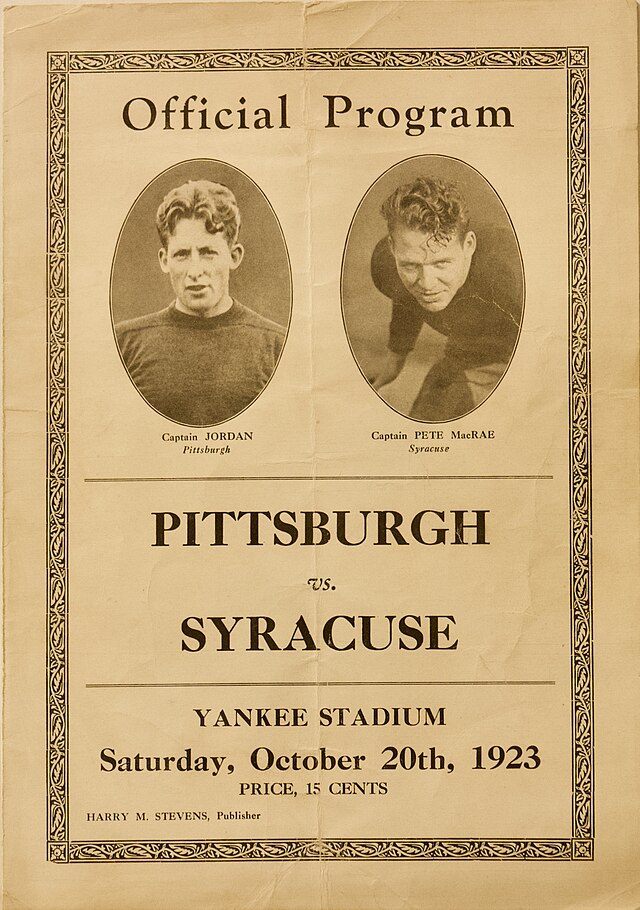
Published by Harry M. Stevens, uploaded to Wikimedia Commons by a collector who cares to share the football history. Thank you.
April 5 American Football History Timeline
April 5, 1973 – The National Football League revises its rules to adopt the jersey numbering system with quarterbacks having numbers from 1-19, etc, 1-19: Quarterbacks and specialists
- 20-49: Running backs and defensive backs
- 50-59: Centers and linebackers
- 60-79: Defensive linemen and offensive linemen other than centers
- 80-89: Wide receivers and tight ends
Numbers 0, 00, and 90-99 are no longer allowed to be issued, even though they were rarely issued in the first place. Numbers 90-99 would be allowed again in 1984 for defensive linemen and linebackers in addition to the above-mentioned numbers.
Other rule revisions for the NFL were that defensive players cannot jump or stand on a teammate while trying to block a kick.
The clock starts at the snap following a change of possession. Previously, the clock would start on a change of possession when the referee spotted the ball ready for play.
If the offensive team commits a foul and it is followed by a change of possession, the period can be extended by one play for the other team.
As of April 5, 1973, a receiving team foul after a kick meant possession was presumed to have changed, and the receiving team kept the ball. (source)
April 5 Football Hall of Fame Birthday
- Pop Warner (1871) – Legendary College Football Hall of Fame Head Coach of Georgia, Iowa Agriculturals, Cornell, Carlisle, Pitt, Temple, and Stanford.
- Brad Van Pelt (1951) – Michigan State College Football Hall of Fame Defensive Back.
Conclusion
The milestones of April 5 highlight football as a sport defined by both structured rules and outstanding individual talent. The 1973 rule revisions brought important changes—standardizing jersey numbers and refining clock management—while Brad Van Pelt’s achievements as the first defensive back to win the Maxwell Award illustrated the extraordinary impact of individuals within the guidelines. Today’s history demonstrates how football constantly adapts in search of excellence.
