Who was the “Gipper?”
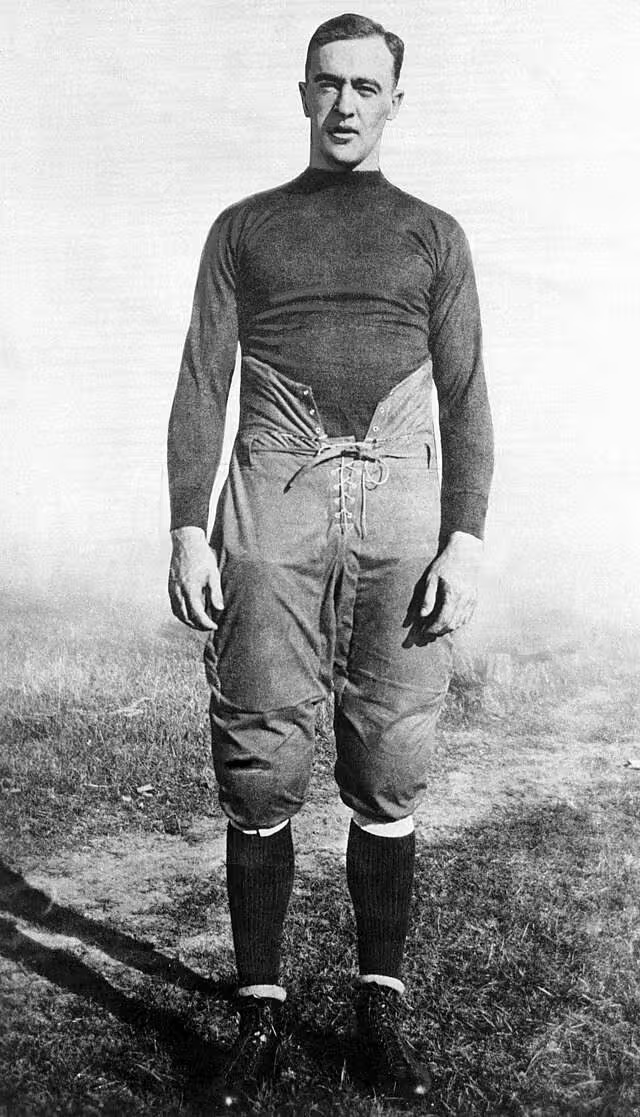
In the hallowed history of Notre Dame football, one name echoes with more mythic power than any other. George Gipp, the “free-spirited, untamed athlete” from Laurium, Michigan, didn’t just play for the Fighting Irish—illegibly, he became the very soul of the program. Before he was immortalized by Ronald Reagan on the silver screen, Gipp was a statistical anomaly, a triple-threat star who could outrun, out-pass, and out-kick anyone on the field. From his accidental discovery by Knute Rockne to a tragic deathbed request that sparked the most famous locker-room speech in sports history, the story of “The Gipper” is a timeless tribute to grit and the unbreakable bond between a coach and his greatest player.
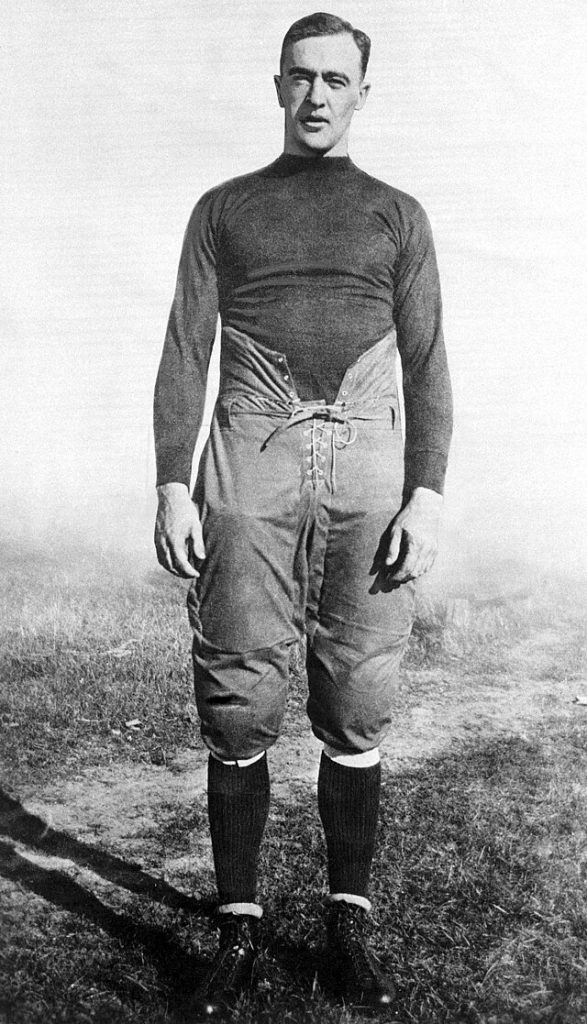
Football Bio
February 18, 1895 – Laurium, Michigan – The legendary University of Notre Dame fullback George Gipp was born. The NFF’s website tells us that in four varsity years, Gipp rushed for 2,341 yards. This was a school record that lasted until 1978. He also completed 93 passes for 1,769 yards, punted, and returned kicks. He scored 156 points, counting touchdowns, extra points, and field goals.
It was no wonder that, with a talent such as George Gipp, legendary Notre Dame Coach Knute Rockne would remember Gipp’s last words to him as Gipp lay in a hospital bed, dying from pneumonia. Gipp had said. “Someday, Rock, when the team is up against it, when things are going bad, and breaks are beating the boys – tell them to go on in there with all they’ve got and win just one for The Gipper. I don’t know where I’ll be then, Rock, but I’ll know about it, and I’ll be happy.” Knute used those words some 8 years after Gipp died in a 1928 game against Army. The Irish were down by six in the halftime locker room, but Rockne’s plea from the dear departed Gipp roused the Irish into a 12-6 comeback victory that may never be forgotten. The National Football Foundation selected George Gipp for entrance into the College Football Hall of Fame in 1951.
Conclusion
George Gipp’s life was cut tragically short at the age of 25, just two weeks after becoming Notre Dame’s first-ever Walter Camp All-American. While he never lived to see the “Fighting Irish” nickname become official or to witness the dynasty Rockne would build, his influence on the program remains unmatched. His school records for rushing yardage stood for nearly 60 years, and his season average of 8.1 yards per carry is a benchmark that still dazzles historians today. Beyond the stats, “The Gipper” represents the romantic, “devil-may-care” era of early American football—a natural talent who played for the love of the game and left an indelible mark on its culture.
Verified Accolades & Football Accomplishments
- College Football Hall of Fame: Inducted in the inaugural class of 1951.
- Notre Dame’s First All-American: Named by Walter Camp in 1920.
- National Championship Teams: Key member of the 1919 and 1920 undefeated “Champions of the West.”
- Notre Dame School Record: 2,341 career rushing yards (stood from 1920 until 1978).
- NCAA/School Record: 8.1 yards per carry in a single season (1920).
- Versatility Milestone: First player in NCAA history to pass for 1,700+ yards and rush for 2,300+ yards.
- Triple-Threat Dominance: Led Notre Dame in both rushing and passing in 1918, 1919, and 1920.
- Interception King: Recorded 5 career interceptions and notoriously never allowed a completion in his defensive zone.
- Special Teams Ace: Averaged 38 yards per punt and returned kicks for 22 yards per return.