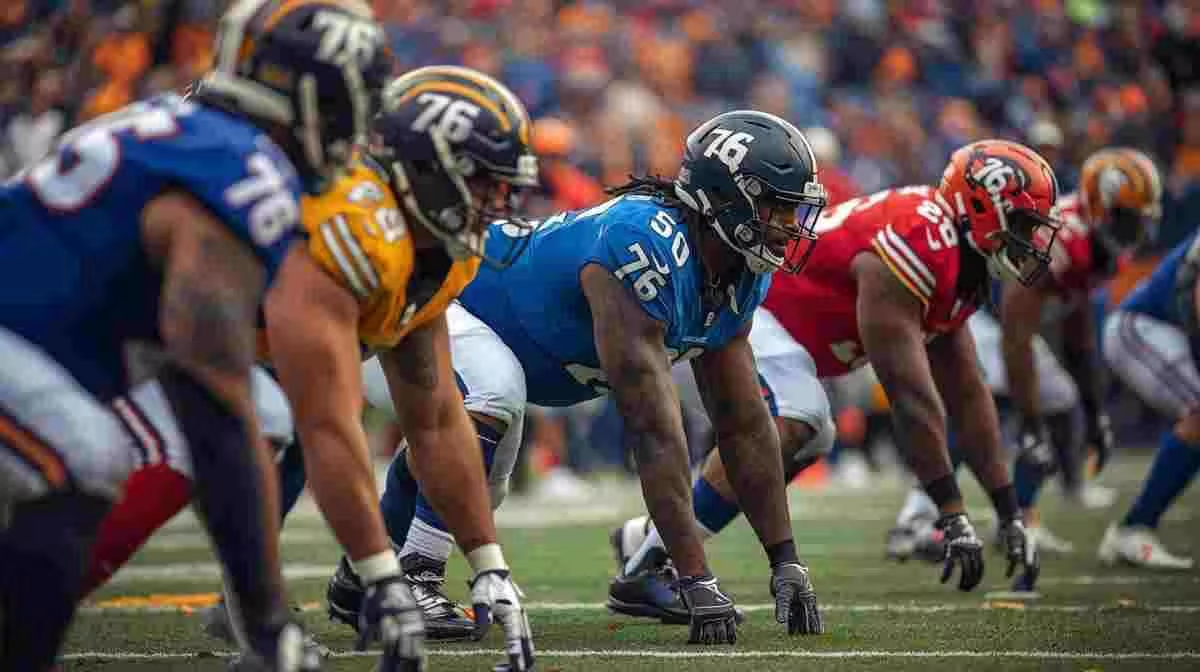
The Wall of 76: Ranking the NFL’s Most Dominant Trench Warriors
In the high-velocity world of the NFL, jersey number 76 is the international symbol for “The Wall.” While the skill positions ignite the scoreboard, the number 76 has historically belonged to the titans who protect the pocket and the wrecking balls who collapse it. From the pioneering power of Marion Motley and Lou Groza to the modern-day dominance of Orlando Pace and Steve Hutchinson, the men who wore this number were the foundational pieces of championship dynasties. Join us as we explore the legends of the 76 jersey—the Hall of Fame anchors, the pancake specialists, and the interior forces who ruled the trenches with iron wills.
Football Bio: The Legends of 76
- Marion Motley (FB/LB): A true pioneer who broke the color barrier in modern pro football, Motley was a bruising powerhouse for the Browns who led the AAFC and NFL in rushing while doubling as a ferocious linebacker.
- Lou Groza (OT/K): Known as “The Toe,” Groza was a dual-threat legend who anchored the Browns’ offensive line for two decades while simultaneously serving as the league’s premier placekicker.
- Orlando Pace (OT): The cornerstone of the “Greatest Show on Turf,” Pace revolutionized the left tackle position with his combination of massive size and dancing feet, famously making the “pancake block” a household term.
- Lou Creekmur (OT/OG): A versatile anchor for the 1950s Detroit Lions dynasty, Creekmur was an eight-time Pro Bowler who helped lead his team to three NFL championships.
- Bob Brown (OT): Nicknamed “The Boomer,” Brown was arguably the most aggressive offensive lineman to ever play, utilizing his 280-pound frame to physically overwhelm defenders for the Eagles, Rams, and Raiders.
- Steve Hutchinson (OG): One of the most dominant guards of the 21st century, Hutchinson was a seven-time Pro Bowler who famously cleared the path for Shaun Alexander’s MVP season in Seattle.
- Gene Lipscomb (DT): “Big Daddy” Lipscomb was a massive, 284-pound interior force for the Baltimore Colts whose rare agility for his size helped the franchise secure back-to-back titles in 1958 and 1959.
- Steve Wisniewski (OG): A legendary figure in Raiders history, Wisniewski was an eight-time Pro Bowler known for his physical brand of football and incredible longevity over 13 seasons.
- John Niland (OG): A key member of the Dallas Cowboys’ first Super Bowl championship team, Niland was a six-time Pro Bowler who provided the elite interior blocking necessary for the “Doomsday” era.
- Fred Smerlas (NT): The prototype for the 3-4 nose tackle, Smerlas was a five-time Pro Bowler for the Buffalo Bills who specialized in taking on double teams to free up his linebackers.
- Rosey Grier (DT): A foundational member of the New York Giants’ 1956 championship team and later the “Fearsome Foursome” in Los Angeles, Grier was a mountain of a man who defined the defensive interior.
- Steve McMichael (DT): Known as “Mongo,” McMichael was the relentless, high-motor heart of the 1985 Bears’ defense, finishing his career with 95 sacks—an elite total for a defensive tackle.
More Significant NFL Uniform Number 76 Players
- Duane Brown
- Flozell Adams
- Jumbo Elliott
- Tim Irwin
- Chad Clifton
- Len Rohde
- Fred Miller
- John Alt
- Chris Snee
- Jeff Backus
- Jamal Williams
- Ken Lanier
- Jerry Sisemore
- Roger Brown
- Rodger Saffold
- Rocky Freitas
- Broderick Thompson
- Jon Jansen
- Steve McKinney
- Walt Suggs
- John Tait
- Vern Holland
- Russell Okung
- Bob Skoronski
- Sebastian Vollmer
- Paul Dickson
- David Stewart
- Charley Long
- Mike McCoy
- Ed Simmons
- Steve August
- Donovan Smith
- Dwaine Board
- David Logan
- Brian Holloway
- Chris Liwienski
Conclusion
The legacy of jersey number 76 is one of immovable objects and irresistible forces. It is a number that represents the often-unsung heroes who determine the outcome of a game before the ball is even thrown. Whether it was the historic versatility of Lou Groza or the modern-day blindside protection provided by Orlando Pace, these twelve icons ensured that number 76 would be synonymous with toughness and technical mastery. From the “Fearsome Foursome” to the “Greatest Show on Turf,” these players were the structural steel that held up the greatest teams in NFL history.