January 18 is a date that fundamentally reshaped the NFL’s DNA. In 1951, a single rule change regarding offensive line eligibility transformed the forward pass from a chaotic scramble into the strategic, high-flying game we recognize today. But the impact of this date doesn’t stop at the rulebook. From the resurrection of the Baltimore Colts and Al Davis taking the reins of the Oakland Raiders to the “Steel Curtain” dominance in Super Bowl X, January 18 has consistently served as a crossroads for the legends of the gridiron. Join us as we journey through the decades to witness Heisman triumphs, legendary coaching debuts, and the long-overdue justice for “The World’s Greatest Athlete,” Jim Thorpe.
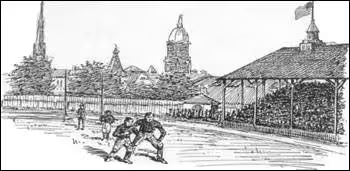
January 18 Football Image of the Day

January 18 American Football History Timeline
- On January 18, 1951, Rule revisions were adopted at the annual NFL meetings. A rule was instituted that made guards, tackles, and centers ineligible to receive the forward pass, according to the Pro Football Hall of Fame. This rule change led to making the game what it is today, as there can only be 6 eligible receivers on any given play, the widest player on each end of the line, and the four in the backfield. The NFL took control of the original failing Baltimore Colts franchise. Colts owner Abraham Watner returned the Baltimore franchise and its player contracts to the NFL for $50,000. These former Baltimore Colts players were made available in the upcoming 1951 NFL Draft, along with college players. The Colts were originally members of the AAFC, and when that league disbanded, they, along with the Browns and the 49ers, were absorbed into the NFL. In 1953, the Baltimore Colts’ name was revived when the NFL granted permission for a struggling Dallas Texans franchise to be taken over by the League. NFL Commissioner Bert Bell challenged the city of Baltimore to sell 15,000 season tickets within six weeks, and when they succeeded, the franchise was sold to Carroll Rosenbloom, who then opened up shop as the Baltimore Colts. Robert Irsay acquired the Los Angeles Rams franchise in 1972 and then subsequently engineered a big trade of teams with Carroll Rosenbloom that year. Twelve years later, on March 28, 1984, Irsay moved the Colts to Indianapolis.
- January 18, 1951, Speaking of that 1951 NFL Draft, it took place right after the meeting above was completed. Kyle Rote from SMU was the first pick by the New York Giants. Future Hall of Famers that came out of this Draft were quarterback Y.A. Tittle as the 3rd overall pick by the 49ers, Dan Stanfel by the Lions at 19, and the Bears taking Bill George with the 23rd pick. The Pro-Football-Reference.com website also tells us that other future Pro Football Hall of Famers, Mike McCormack was taken by the New York Yanks, Art Donovan by the Browns, Detroit’s pick of Jack Christiansen, and a guy by the name of Don Shula was picked by the Browns. (source)
- On January 18, 1963, Al Davis became the head coach and general manager of the Oakland Raiders. Davis had an extremely interesting ride in his pro football career. Al turned the Raiders into winners in 1963, posting a 10-4 record in the AFL after the franchise had managed only a dismal 9-33 record in the three seasons prior to Davis being hired as coach. Soon after, in 1966, according to a bleacherreport.com article, Al Davis was selected to serve as the AFL Commissioner and held that position until the league merged with the NFL. It was after this point that Davis returned to Oakland, where he served as a co-owner of the franchise, eventually becoming the majority owner and the main decision-maker.
- January 18, 1970 – Los Angeles Memorial Coliseum – The 20th NFL Pro Bowl featured the Western Conference outlasting the Eastern Conference, 16-13. Chicago Bears legendary halfback Gale Sayers and George Andrie, the defensive end of the Dallas Cowboys, were selected as the game’s Most Valuable Players per the Onthisday.com website.
- January 18, 1976 – Orange Bowl, Miami, Florida – The NFL World Championship was settled in Super Bowl X. The Dallas Cowboys, winners of the NFC, were matched up against the AFC champs, the Pittsburgh Steelers. These two teams were filled with future Pro Football Hall of Famers. In fact, there were 12 in all. The Cowboys fielded Roger Staubach, Rayfield Wright, Mel Renfro, and Cliff Harris, while the Steelers countered with Terry Bradshaw, Franco Harris, Jack Lambert, Mel Blount, Joe Greene, Jack Ham, John Stalworth, and Lynn Swann. The Head coaches Chuck Noll and Tom Landry also ended up getting their busts in Canton, according to Pro-Football-Reference.com. The Cowboys had a three-point lead at the half, but the majority of the scoring took place in the final stanza. It was the Steelers who put up two touchdowns in the fourth quarter by some iconic acrobatic catches by Lynn Swann to overcome the Cowboys’ late charge. The final score was the Pittsburgh Steelers 21 to 17 points over the Dallas Cowboys. Lynn Swann was an obvious choice as the game’s MVP.
- On January 18, 1983, the International Olympic Committee restored Jim Thorpe’s Olympic medals for winning both the Pentathlon and Decathlon, 70 years after they were taken from him, according to an NDNsports.com article. At the 1912 Olympic Games, Thorpe became the first Native American to win Olympic gold, years before his people were recognized as American citizens. After his performance at the Games, Sweden’s King Gustav V called Jim Thorpe “The World’s Greatest Athlete.” The victory and the world acclaim were soured, though, about six months later, when it was uncovered that in 1909 and 1910, Thorpe had allegedly had his room and board paid for by a semi-pro baseball team he had played for. The IOC almost immediately stripped Thorpe of the medals and took his name out of the record books while refusing to hear Thorpe’s side of the story of allegedly receiving what would amount to be $25 of his expenses being paid for. After decades of petitioning and the release of 1912 IOC documents, the Olympic governing board returned Thorpe’s medals but erroneously listed him as a co-champion of the events. Sorry, there should not be any asterisks next to this great athlete’s name!
- January 18, 2000- Robert Wood Johnson IV, the heir to Johnson & Johnson, was approved by the NFL at the owners’ meeting to purchase the New York Jets franchise.
OnthisDay.com Conference Championship Scoreboard
- January 18, 2004 – Gillette Stadium, Foxborough – The AFC Championship game ended with the New England Patriots defeating the Indianapolis Colts, 24-14.
- On January 18, 2004, the NFC Championship was played at Philly’s Lincoln Financial Field, where the Carolina Panthers overcame the home team Philadelphia Eagles, 14-3.
- January 18, 2009 – Heinz Field, Pittsburgh – The 2008 AFC Championship game resulted in a Pittsburgh Steelers 23-14 victory over their AFC North rivals, the Baltimore Ravens. Check out our full story on this game.
- The January 18, 2009, NFC Championship was played at the University of Phoenix Stadium. In the game, the Arizona Cardinals knocked off the Philadelphia Eagles, 32-25.
- January 18, 2015 – Gillette Stadium, Foxborough – The AFC Championship finished up with the New England Patriots outmatching the Indianapolis Colts, 45-7.
- January 18, 2015 – CenturyLink Field, Seattle – The NFC Championship resulted in the Seattle Seahawks taking out the Green Bay Packers, 28-22 in overtime!
January 18 Football Hall of Fame Birthdays
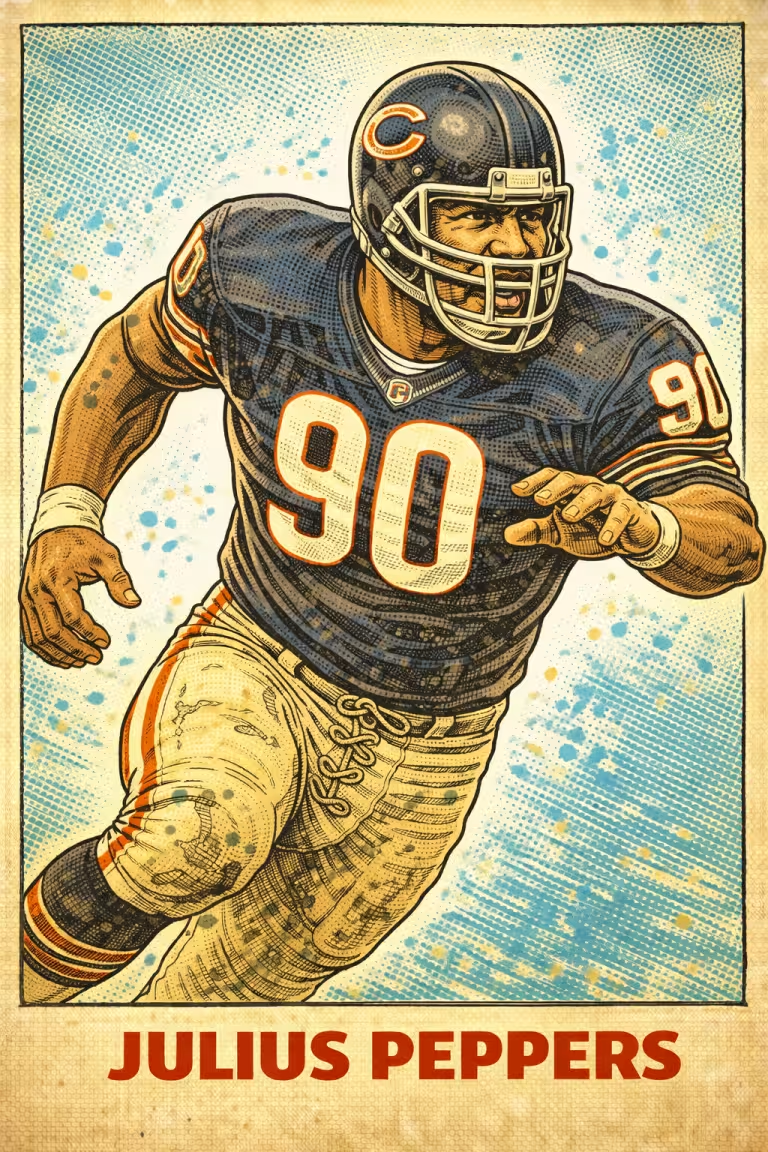
JULIUS PEPPERS
2010–2013
Conclusion
Whether it was the technical restructuring of the offensive line in 1951 or the modern-day fireworks of the AFC and NFC Championship rounds, January 18 stands as a testament to the evolving nature of American football. It is a day when franchises like the Colts and Raiders found their identities, and where icons like Lynn Swann and Pat Sullivan cemented their legacies in the record books. As we look back on these milestones—from the mud of Cornell in 1897 to the overtime thrills in Seattle—we see a sport that is constantly refining itself while never forgetting the legends who built its foundation.