The Evolution of the "Pigskin": From Animal Bladders to Modern Valves
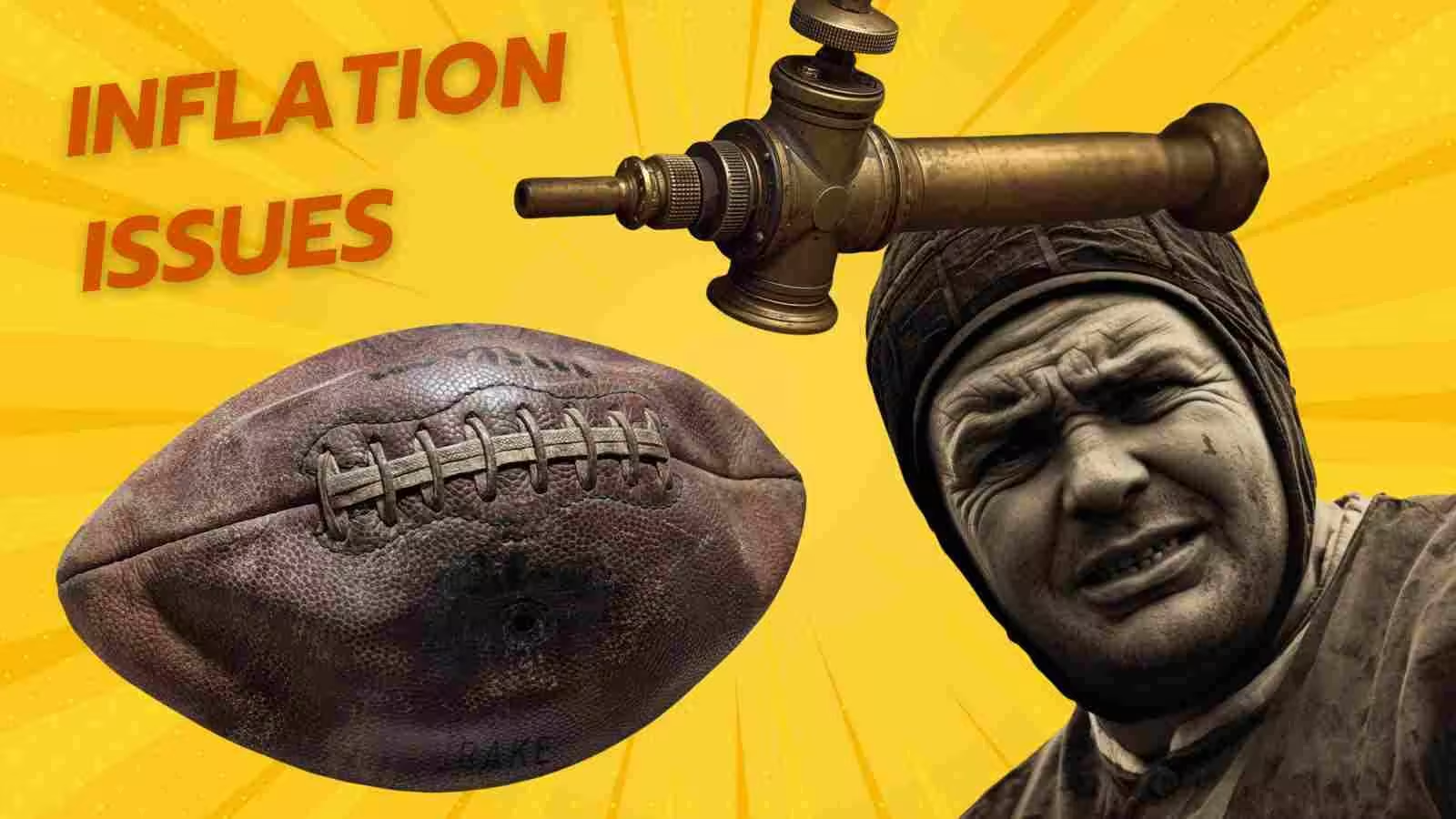
In the modern era of American football, we rarely give a second thought to the ball itself. We grab it, check the grip, and if it feels a little soft, we insert a needle for a quick five-second fix. However, as Darin Hayes and Timothy Brown of Football Archaeology recently discussed, the simple act of keeping air inside a football was once one of the sport's most significant technical hurdles.
Tim illuminates the intricate innovations that have transpired over the decades, culminating in the sophisticated mechanisms we observe today. He elaborates on the concept of the "adjacent possible," which underscores the incremental advancements that characterize technological progress in our sport. Through this exploration, we gain profound insights into the seemingly simple act of inflating a football, revealing a rich tapestry of innovation and adaptation inherent in the sport's history. The conversation is based on Mr Brown's recent Tidbit titled: Inflating Footballs, the Adjacent Possible, and Progress , complete with some excellent imagery.
The Era of "Some Assembly Required"
In the earliest days of the game, the term "pigskin" was literal. The internal bladder of a football was often an actual animal bladder—from a pig or a sheep. To inflate these primitive balls, someone had to quite literally blow into a stem, much like inflating a balloon, before folding the nozzle over and tying it off.
This method was as dangerous as it was unhygienic. As Timothy Brown noted, legend has it that the wife of the man who invented the vulcanized rubber bladder actually died from the bacteria or strain involved in blowing up animal bladders. This grim reality spurred the first major innovation: the move toward rubberized bladders and manual pumps that resembled old-fashioned insecticide sprayers.
The "Adjacent Possible" and Iterative Innovation
Brown highlights a concept from evolutionary biology called the "adjacent possible." This theory suggests that innovation rarely happens in giant leaps; instead, it moves in small, iterative steps. We see this clearly in the mid-1920s.
For decades, even after rubber bladders became standard, the process was cumbersome. To inflate a ball, you had to completely unlace the leather housing, pull out the bladder, connect a pump to a long "Schrader valve" (similar to a bicycle tire), pump it up, and then lace the ball back together.
In 1924, Spalding invented a flatter valve that sat flush against the bladder. Curiously, even with this new tech, it took another two years before someone realized they could simply punch a hole through the leather to reach the valve. Up until 1926, players were still unlacing the ball every time it lost pressure, simply because the "obvious" next step—the needle-and-button system we use today—wasn't yet part of the "adjacent possible."
A Different Kind of Game-Day Prep
The transition was slow. During the 1920s, a football wasn't something you just took out of a box. Every game required a fresh assembly. Equipment managers would have to manually insert the bladder, carefully align the nozzle, and sew the laces by hand.
Even as late as the 1930s, footballs often featured a small screw-on cap over the nozzle—much like a car tire—to keep dirt and water out of the valve. It’s a far cry from today’s high-tech, ready-to-play equipment, reminding us that the "good old days" of football required as much work off the field as they did on it.
Join us at the Pigskin Dispatch website to see even more Positive football news!
Don't forget to check out and subscribe to the Pigskin Dispatch YouTube channel for additional content and the regular Football History Minute Shorts.
Miss our football by the day of the year podcasts, well don't, because they can still be found at the Pigskin Dispatch website.
Transcript
In the early game of American football, one of the biggest issues was how do you keep air inside the ball? The balls were not developed the same way they are today. And you had to figure out, how do you get that air in there?
We're going to take a study of that today with our friend Timothy b. Brown of footballarchaeology.com Tim, welcome back to the Pig Pen.
Timothy Brown:Hey, Darin, good to see you. And hopefully this episode will pump up your ratings.
Darin Hayes:I hope it does. I'm pumped up for this, I can tell you that.
Now, you wrote a recent tidbit as, like we just alluded to, titled Inflating Footballs the adjacent possible and progress. And what can you tell us about this story, Tim?
Timothy Brown:Yeah, so. So there's kind of like just the basic how did footballs get inflated Stories.
And then I kind of went off on this adjacent possible issue, which I think is a pretty cool concept. But anyways, so, you know, when. When football began, you know, we went. We've gone through stages where initially the ball was.
You know, the bladder was just a pig's bladder or sheep's bladder, you know, depending at the time. But anyway, some animal bladder, and they just, you know, there was like a stem on it that they blew into it. You know, they put.
Just like you blow up a balloon, you put it in your mouth and you blow the thing up and then you tie it off, you fold it over there. A different piece techniques for. For how you. How you kept the air in there, but eventually it leaked out. And so then they.
Darin Hayes:If you like to put rotten animal parts in your mouth, that's. That's the job for you, right?
Timothy Brown:Well, and in fact, you know, the guy who invented the rubberized or vulcanized bladder, supposedly his wife died from blowing up one of those balls because, you know, so anyways, so, so then they started, you know, in part because of that danger, they started using like, kind of what you'd think of as a bicycle pump. You know, I mean, there's a kind of a pump.
It almost looked like the old kinds kind of look like like on old cartoons when they'd be spraying bugs, you know, you know, trying to get the, you know, whatever insecticides up in there. But it was, you know, kind of a pumping action little thing that they insert into the. Into this nozzle.
Then they finally went to, you know, what we think of as valve. You know, they had the valve that was initially. The valves were Schrader valves.
So they were basically the same kind of thing as on a car or On a bicycle. And, you know, so. Longer stem and.
But it kept the air in, but it was still kind of awkward yet, you know, and throughout all that process, when the ball got inflated, you had to unlace it to. To get at it, to. To inflate it. So then they. Then they came up with a. This flatter valve that, you know, sat flush with the top of the bladder. Okay.
And so you can, you know, it was a valve kind of shaped like, you know, little markers you use on golf greens to, you know, for where your ball is. It was kind of that kind of a structure. It kind of looked like that.
And so I had always thought, because, you know, that came out in, like, 23, 24, and by 26, everybody had balls that you could inflate right through the leather. You know, the big innovation was you no longer had to unlace the ball in order to inflate it, because you always had to before.
So I thought when they'd come out with that valve, that they'd immediately gone to that level, but it actually took two years, you know, so in 24, Spalding invents a ball with this flat, you know, kind of valve, but you still had to unlace it in order to pump it up and, you know, to connect the little thingy and. And pump it. And I only know that because I ended up seeing it in, you know, in an old catalog. So I bought the catalog so they had.
It would have a picture, and so that's what's, you know, led to. Led to, you know, the. The tidbit. So it's just one of those things where I just, you know, there's. We always talk about football as, you know, the.
The game repeats itself. And, you know, if everybody steals ideas from other people. And that's true. But that's true pretty much in everything we do.
You know, almost all the vast majority of innovations come from small improvements, iterative little improvements over whatever the previous process was. You know, you got a better player, you got a slightly different player, so you try to use them differently.
And so you innovate a new style of play, you know, or you just come up with a kind of a cool idea. But so. But most. Most things are just real small steps. And so this.
There's a concept in evolutionary biology called the adjacent process possible, which just, you know, my analogy for it is, you know, in evolution, you take small steps for the most part. And so that's why wolves didn't become dachshunds overnight. You know, there were lots of little steps to get there.
And so then this particular example is just one where, looking back, we can see it and say, well, why didn't they just go right to the valve, go going through the ball, you know, through the leather. But either there was a tech, you know, the technology wasn't quite there, or some. They just didn't think about it, you know.
You know, because, I mean, it's so obvious. But, you know, it took them two years to figure out how to do it, you know, and it just. Again, it's just one of those things.
I find those kinds of things fascinating. But eventually, you know, we got to the point where, you know, the ball works like it. Like it has for about 100 years.
You got that little rubber button and you insert the needle. Though it took a while for those needles to come along, too. There was, you know, for a while when the.
When those balls first came out, like in the 19, later 20s, a lot of times, you know, companies, the ball manufacturers would supply a little cap that would go over. You know, it's like kind of like the cap that you screw on your car tire on the nozzle, but they're flat.
And so you put that on so that dirt and water and stuff didn't get into the little nozzle. Right.
It's just one of those things you don't think about, but that, you know, that's the best solution that they could come up with at the time, you know, but just, you know, when's the last time you picked up a football that had a little cap over the nozzle? Yeah.
Darin Hayes:Yeah. Never. Never.
Timothy Brown:But I.
Darin Hayes:But I can tell you that the gentleman that I worked with for years and years, I was a referee. He was the umpire, and we worked on the same crew for probably 15, 20 years. He would, you know, the umpire always checks the balls.
And in high school football, I'm not sure if it does it at other levels. So the teams would bring the balls to the locker room.
However, whatever balls they want to use, we'd have to test them, make sure they're the right pressure. And my umpire, Dick Zocky is his name, He. He. He got so disappointed when the balls would come in and they wouldn't.
Timothy Brown:They'd be.
Darin Hayes:Not enough pressure in them or. Or too much pressure. So he went out and he bought one of those little things, like you said, the little canister where you.
You pump from the end and you had the, you know, a couple extra needles and everything. And he felt so bad because he's. Usually they'd have the. The Kids bringing the balls.
You know, these kids are probably 8th grade or something bringing the balls. And, you know, you know, he'd check in, is like, you know, £9. And you're. Well, you got to get up. You know, I gotta get this up to 12 and a half.
e are still used, at least in:is when you're talking about:t was definitely happening in:Timothy Brown:ually the. I believe it was a:And it was either in that one or in. In the 26, where some of the, you know, the language like the ball is shipped with laces and bladder. Right.
So that would have been the earlier version.
So you, you know, if you got the ball under the Christmas tree, you know, you had to figure out how to stuff that bladder in there, how to inflate it, and. And they. They.
Darin Hayes:Some assembly required.
Timothy Brown:Yeah, well, I mean. Yeah, it's one of those. That's a. That's a great line because it's one of those things we don't even think about.
Obviously, the ball's ready to go, but, you know, it wasn't always.
Darin Hayes:So, hey, just put a couple pounds of pressure in it, and you're out throwing it in the front yard, you know?
Timothy Brown:Yeah. Yeah.
Darin Hayes:So.
Timothy Brown:Well, and there's. There's old stories about, you know, kids who would. Basically, they had some kind of little device where they would blow up the ball.
They'd put the nozzle, you know, when it was still just the. The kind of rubber nozzle, they'd put it over a car tire and then press the little pin in the car tire to let air out.
So, you know, whoever's car happened to be on the street, you know, they. They basically steal air from, you know, their neighbor's tires and stuff.
Darin Hayes:Then they moved on to siphoning gas out once they start driving themselves, those little criminals. Well, that. That is a very interesting aspect of early football, Tim, that we don't think about in today's modern football. And you.
You do this a lot in your tidbits and on your site. Maybe you could tell us a little bit how people can partake in this.
Timothy Brown:Yeah, easiest thing is just go to footballarchaeology.com it's a substack site. You can subscribe, which means you'll get an email every time that I send out a new story.
You can also just follow, which allows you to kind of more easily track, you know, from within the. Within the site. You know, I've got it. I've now got a new YouTube channel. It's just got, you know, a handful of different items on there.
But anyways, lots of ways to figure it out. Just footballarchaeology.com and one way or another, you'll get there.
Darin Hayes:All right. Well, Tim, we really appreciate you coming on this week and talking about this football of antiquity, and we'd love to talk to you again next week.
Timothy Brown:Very good tuxing.
Darin Hayes:That's all the football history we have today, folks. Join us back tomorrow for more of your football history.
We invite you to check out our website, pigskindispatch.com not only to see the daily football history, but to experience positive football with our many articles on the good people of the game, as well as our own football comic strip, cleat marks comics, pigskindispatch.com is also on social media outlets, Facebook, Twitter, Instagram, and don't forget the Big Skin Dispatch YouTube channel to get all of your positive football news and history. Special thanks to the talents of Mike and Gene Monroe, as well as Jason Neff for letting us use their music during our podcast.
This podcast is part of the Sports History Network, your headquarters for the yesteryear of your favorite sport. You can learn more@sportshistorynetwork.com.