January 13 is a day rich in pivotal moments spanning the history of American football. From collegiate legends entering the world and shaping their teams, to major championships and crucial rule changes, this date has consistently delivered gridiron drama. We look back at the numerous Pro Bowls, the birth of the high-stakes two-point conversion rule, a Super Bowl victory, and a College Football National Championship that collectively define the significance of January 13th in the sport’s timeline.
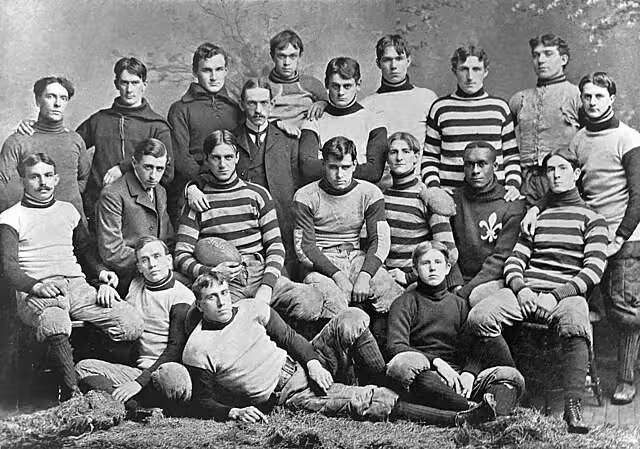
January 13 Football Image of the Day

Western Reserve University via Newspapers.com
Oh, those tantalizing horizontal stripes of early American football. The Spartans ended the 1899 campaign with a respectable 5-4 record.
January 13 American Football History Timeline
- January 13, 1957 – Los Angeles Memorial Coliseum – The NFL held its 7th annual Pro Bowl game, and it was the all-stars of the Western Conference who overcame the challenge of their Eastern Conference rivals 19-10. The Most Valuable player on the defensive side was Pittsburgh’s Ernie Stautner, a defensive tackle, and Baltimore Colt Bert Rechichar, a kicker, won the award for the MVP of the offense. (source)
- On January 13, 1958, the NCAA added a 2-point conversion to football scoring. Despite the plays used in college ball, according to the LiveAbout.com website, they were not immediately adopted in professional football. In fact, the two-point conversion rule was not officially adopted by the NFL until 1994. The professional levels of football did tinker with the 2-point play prior to 1994, though. According to the American Football Database, the AFL used the conversion tactic during its ten years of existence in the 1960’s. The NFL Europe and its reincarnation, the World League of American Football, adopted the rule and were likely a further testing ground for it before the NFL adopted it. It has really added some interesting dynamics to contests as formulas and charts have been famously made to determine when a team should go for two. The success rate of the two-point try has been reported to be anywhere from 40% to 55%, so there is a pretty good-sized risk-reward aspect to it.
- January 13, 1963 – Balboa Stadium, San Diego – The second AFL All-Star Game was played. In the contest, it was the Western Division All-stars who edged their Eastern Division counterparts 21-14. The MVPs of the game were Dallas Texans running back Curtis McClinton and Chargers defensive end Earl Faison.
- On January 13, 1963, the annual NFL Pro Bowl game was played at the Los Angeles Memorial Coliseum once again. The NFL Eastern Conference outscored the Western Conference Pro Bowlers 30-20. The offensive Most Valuable Player was Jim Brown of the Cleveland Browns, while the MVP of the defense was Pittsburgh’s defensive tackle Eugene Lipscomb.
- January 13, 1974 – Rice Stadium, Houston, Texas – The Miami Dolphins won their second consecutive NFL Title by claiming victory over the Minnesota Vikings in Super Bowl VIII. The final score was Miami 24, Minnesota 7. The big game’s Most Valuable Player was Dolphins bruising running back Larry Csonka. Check out our January 13 Football Fix quote from this game.
- January 13, 2020 – Superdome, New Orleans – The College Football National Championship took place as Heisman Trophy winner Joe Burrow and his teammates of the #1 LSU Tigers faced Trevor Lawrence and the rest of the #3 Clemson Tigers. LSU overpowered Clemson 42-15 to win the National College Playoff Championship in this battle of Tigers.
January 13 Football Hall of Fame Birthdays
Conclusion
The events of January 13 are significant in football history at multiple levels. It includes the NCAA’s adoption of two-point conversions, notable team achievements such as the Miami Dolphins’ Super Bowl win, and recognition of collegiate leaders such as Gerald Mann and Tyrone McGriff. These highlights, from Pro Bowl MVP performances to LSU’s National Championship win, demonstrate the impact January 13 has had on football’s legacy.