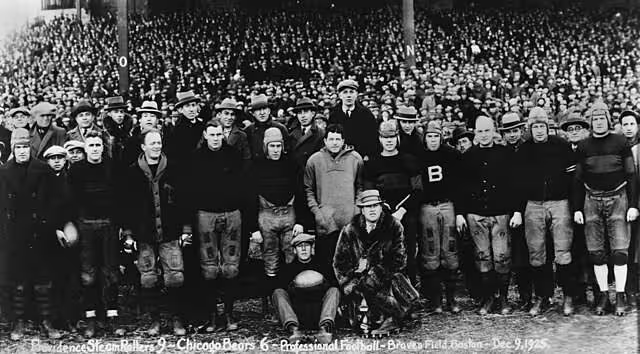
From a stripped NFL title to football’s first professional player and a broadcast without announcers, December 20th stands as one of the wildest days in football history. Dive into the legendary Pottsville Maroons scandal of 1925, meet “Pudge” Heffelfinger, the game’s first paid pro, and celebrate the births of Hall of Famers Bob Hayes and Jack Christiansen. Explore the incredible moments that define the drama of the gridiron on this memorable day.
December 20 American Football History Timeline
- December 20, 1925 – An NFL Title of the Potsville Maroons is stripped. The Chicago Cardinals, with an 11-2-1 record, won an extremely controversial National Football League Championship Title.
Boy, does this story get deep in a hurry. On December 6, 1925, the Chicago Cardinals faced the other top-tier team in the NFL that season, the Pottsville Maroons. Pottsville is a small town about 85 miles Northwest of Philadelphia. The first year in the League, the Maroons were on fire in the NFL, boasting a 9-2 record going into the Cardinal match-up. The Pottsville eleven was a gritty bunch, mostly composed of coal miners from the area, who had dominated the regional coal football league, the Anthracite League. In 1924, a local Pottsville business owner, John Striegel, sponsored the team. According to a Penn State Library story on the Maroons, just before the first game of the 1924 season in the Anthracite League, owner John Striegel decided the team needed new jerseys and quickly ordered 25 from a local sporting goods store. Striegel told the store owner that the color was not important. The team received 25 maroon jerseys and was known as the Pottsville Maroons immediately thereafter. The Maroons applied to play in the NFL in 1925, and the community footed the entry fee as they raised money for the NFL franchise costs.
The Maroons were in for some stiff competition on December 6, as the Chicago Cardinals themselves entered the game, posting a respectable 9-1-1 record. This game was billed as the NFL championship of sorts when the top two teams squared off so late in the season, and remember, there was no formal title game in the League then; the team with the best winning percentage claimed the title. Pottsville soundly defeated the Cardinals by the score of 21-7, then won their final game to end the season with an 11-2 record. That should be the end of the story, right? Pottsville wins the 1925 Championship. Unfortunately, in the drama that was the early NFL, that was not the case, as controversy was brewing nearby. The Penn State site tells the story well.
To understand the full controversy, it’s important to look at what happened with the Frankford Yellow Jackets, the top pro football draw in Philadelphia in 1925. Frankford, about 7 miles northeast of the city center, had earlier upset the Maroons 20-0 and felt certain they would be crowned 1925 champions. Holding this belief, the Yellow Jackets arranged a non-league game against a team of former Notre Dame stars, backed by a Philadelphia promoter, as a challenge to the top NFL team in Pennsylvania. This game promised significant revenue. Yet, after Pottsville later beat Frankford and clinched the NFL title, it was the Maroons who had the opportunity to play the Notre Dame lineup. Rather than using their small home field, Pottsville scheduled the game at Philadelphia’s Shibe Park, hoping for a large crowd. In a tightly contested match, Pottsville edged out the Notre Dame stars 9-7.
The Frankford franchise was miffed, probably a bit embarrassed, and jealous that they weren’t the ones to play the Irish stars and pocket the extra cash. Frankford protested to the NFL that the maroons had violated the Yellow Jackets’ territorial rights by playing the game so close to and at the same time as Frankford was playing a game only a few minutes away. The Jackets claimed it took spectators away from their home game. NFL Commissioner Joseph Carr agreed with Frankford and their protest. Allegedly, Carr warned Pottsville 3 times prior to the game at Shibe Park not to play the game. Since, in Carr’s eyes, they ignored his direction, the Pottsville Maroons’ NFL rights were suspended, they were fined $500, and they were stripped of their title after playing the unsanctioned game. With Pottsville eliminated from the standings, the Cardinals finish with the highest winning percentage. Chicago, however, refused to accept the title, stating that without winning it on the field, they did not want it. The NFL, however, recognizes the Chicago Cardinals as the 1925 champs. (source)
We have much more on this in a book, Marooned: The Rise, the Fall, and the Redemption of the NFL’s Pottsville Maroons, released in 2025. See the details here on how to get a copy.
- On December 20, 1980, NBC broadcast a game with no announcers, trying to be different. ESPN.comshares the story that, in fact, the only sounds the TV audience would hear were the same as those heard by fans in the stadium: the public address announcer, the cheers of the fans, and maybe, just maybe, a hotdog vendor or two. In the meaningless game, the 4-12 New York Jets defeated the 8-8 Miami Dolphins, 24-17.
- December 20, 1985, Sportscaster Howard Cosell retired from television sports with ABC. On August 23, 1984, it was reported that Cosell had resigned from his job as a Monday Night Football broadcaster. The New York Times article on the subject explains that Cosell would still host an ABC Sports program called “SportsBeat.” Reports said that Howard was what he described as “disenchanted with the football mentality.” In an SI.com article, it was reported that Howard Cosell fulfilled his contract with ABC to be part of the MLB broadcasts, doing so reluctantly. On December 20, 1985, Cosell formally retired from ABC, where he had worked for 20 years, and thereafter limited himself to radio-only broadcasts for the rest of his career.
December 20 Football Hall of Fame Birthdays
- Pudge Heffelfinger
- Jack Christiansen
- Bob Hayes
- Mike Utley
Conclusion
December 20th is a date where gridiron legends, historic controversy, and media moments converge. Whether it’s the enduring mystery of the 1925 NFL Championship strip, the quiet retirement of broadcasting icon Howard Cosell, or the groundbreaking legacy of revolutionary athletes like Pudge Heffelfinger and Bullet Bob Hayes, this date reminds us that football’s history is always dramatic and often unpredictable.