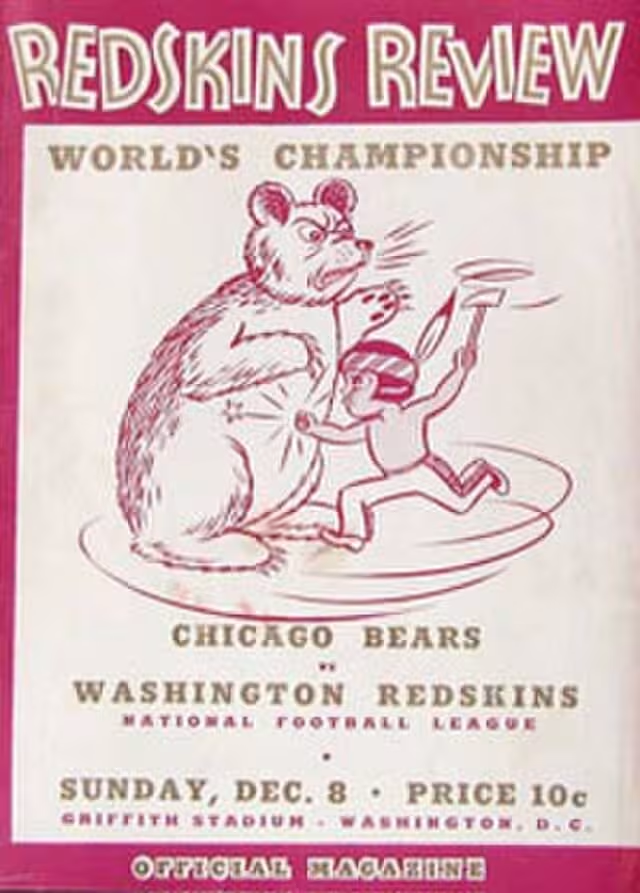
The year 1940 found America on the cusp of change, but on the gridiron, an unprecedented spectacle unfolded that forever changed the game of football. This was the season that culminated in the NFL Championship clash between the mighty Chicago Bears and the Washington Redskins—a contest that defied all expectations and delivered a score that still echoes through the ages. This game was not just a victory; it was a revolution, powered by the tactical genius of George Halas and the flawless execution of the Bears’ new offensive weapon: the T-Formation.

Halas’s Master Stroke: The Revolution of the T-Formation
To understand the 1940 Bears, one must look back to 1937. Following a disappointment in the Championship game that year, Halas faced a crisis when legendary fullback Bronko Nagurski retired over a contract dispute to pursue professional wrestling. Losing the best player in the league left the Bears “a pretty average team” in 1938.
This crisis spurred Halas into action, proving his genius not just as a coach, but as a brilliant general manager and innovator. He began scheming with University of Chicago’s historian Clark Shaughnessy on how to modernize the T-Formation, a system already in use at the college ranks.
Halas’s first critical move was a trade with the Pittsburgh Steelers in 1938, sending two linemen for the Steelers’ next year’s first-round pick. That pick turned out to be quarterback Sid Luckman, an all-timer who would become the face of the revolution. Luckman, who had never run the T-Formation at Columbia, was meticulously coached in 1939 by Sal Sherman, specifically to master the formation with the man-in-motion—a key innovation that stretched defenses horizontally.
The T-Formation, with its three backs lined up straight across the backfield, used pivots, fakes, and, most crucially, a pre-snap man-in-motion. This innovation was the “first iteration of modern innovation for offense,” providing a massive first-mover advantage and setting the stage for the league’s transformation.
Building the Dynasty: The Key Players of 1940
Halas’s brilliance was in the personnel he assembled to execute this complex system:
- Sid Luckman (QB): Drafted in 1939, the Hall of Famer became the engine of the T-Formation. Though often subbed out due to defensive liabilities (as single platoon football was still the norm), Luckman was considered the best pure thrower of his era and holds the career touchdown percentage record (7.9%). Halas had to personally convince Luckman, who initially planned to go into the family trucking business, to play professionally.
- Bulldog Turner (C): A first-rounder in the 1940 draft, the seven-time First-team All-Pro from Harden Simmons anchored the line and served as a capable middle linebacker in the single-platoon system.
- George “One Play” McAfee (RB/DB): Another 1940 first-round pick acquired via trade (from the Eagles). McAfee, nicknamed “The Jackrabbit,” was a Swiss Army knife who could score in almost every way imaginable—rushing, receiving, kick return, punt return, and interception return. He is a Hall of Famer and one of the most versatile players in history.
- Danny Fortman (G): Drafted in 1936, Fortman was one of the best linemen in the league, known for his toughness. He was famously convinced by Halas to attend medical school at the University of Chicago while simultaneously playing football.
- Established Veterans: The team was built on a foundation of Hall of Famers like right guard George Musso (“Moose,” a 75th Anniversary Team member) and tackle Joe Steidahar (the team’s first draft pick in 1936).
The Game that Defied Expectations
Heading into the championship game against the Washington Redskins, the Bears had a respectable 8-3 record but had actually lost to Washington 7-3 late in the regular season. No one predicted what happened next.
The 1940 NFL Championship, broadcast nationally for the first time on radio, became the most lopsided game in NFL history: the Chicago Bears annihilated the Washington Redskins with a final score of 73-0.
The T-Formation’s man-in-motion confounded the Washington defense, who had never faced anything like it. Halas’s meticulous film study—a practice uncommon at the time—had uncovered specific defensive weaknesses, allowing the Bears to tailor their offense perfectly. The final score of 73 points remains the most points scored by one team in a single NFL game in history, cementing the December 8, 1940 championship as a singular event in gridiron lore. The contest was a powerful demonstration of how tactical innovation—the T-Formation—coupled with elite talent and relentless preparation, could reshape the sport overnight.