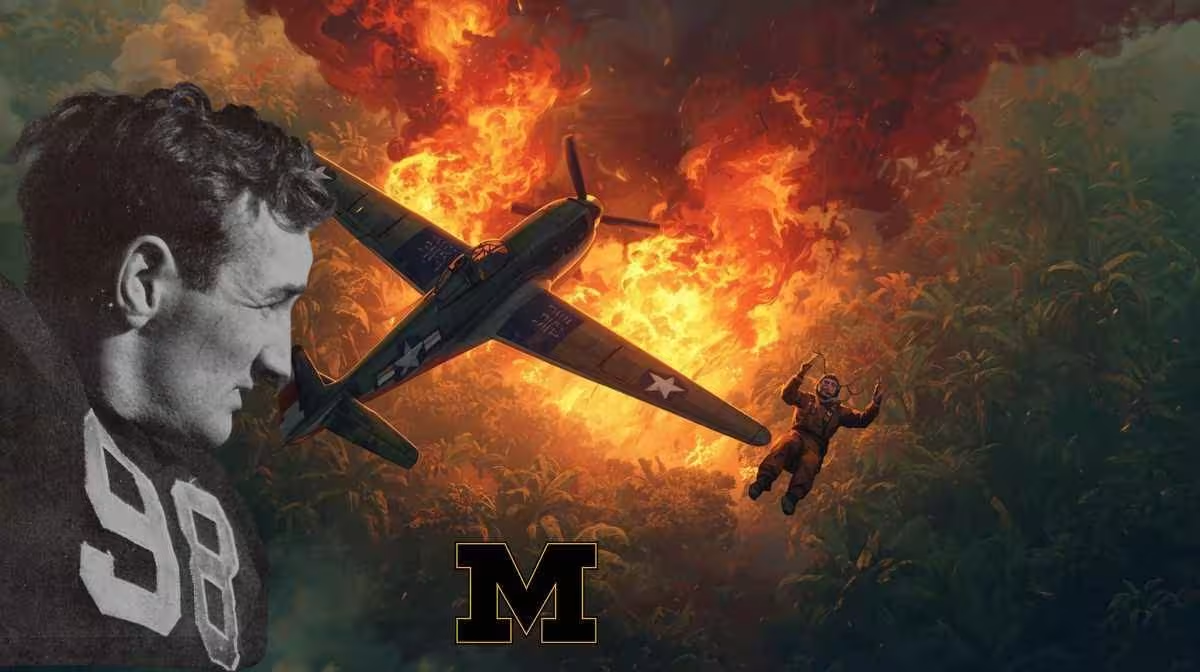
Old 98: The Golden Boy Who Fell From the Sky (Twice)
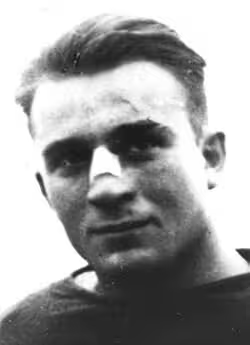
In the late 1930s, the name Tom Harmon was synonymous with unstoppable American athletic prowess. The University of Michigan’s single-wing tailback, number 98, was more than just a college football player; he was a phenomenon, the “Golden Boy” of the gridiron. He shattered records, won the Heisman Trophy in 1940, and famously earned a standing ovation from the rival Ohio State crowd in his final game—a show of respect so rare it remains legendary.
In 1941, Harmon was the first overall pick in the NFL draft and even starred in a movie about his own life. The world was his, but as the United States plunged into World War II, Harmon put his celebrity and professional career on hold, trading his football helmet for a pilot’s cap in the U.S. Army Air Force. The man who seemed invincible on the field was heading into a war where no one was.
Crash 1: The Jungle Ordeal
Tom Harmon’s first brush with death didn't come in a dogfight against enemy planes, but against the raw, unyielding power of nature.
By April 1943, Lieutenant Harmon was piloting a B-25 Mitchell bomber, fittingly nicknamed Old 98 after his famous jersey number. While flying through a brutal tropical storm over the dense jungles of Dutch Guiana in South America, disaster struck. The storm’s violence was so extreme that it tore the right wing clean off the aircraft, sending the bomber into a catastrophic, deadly spin.
Harmon desperately screamed for his six crew members to bail out, but with the plane plummeting, he knew he had only seconds to save himself. He fumbled for his parachute cord, leaped out, and blacked out.
He awoke to find himself dangling from a tree, just yards from the burning wreckage. He was the sole survivor.
For four agonizing days, Harmon, the former All-American, became a castaway. He battled through razor-sharp grasses, dodged crocodiles, and trudged through miles of murky, dark swamps, surviving on swamp water and meager rations. He later credited his legendary “football legs” with carrying him through the nearly impassable terrain. Exhausted and believing he couldn't take another step, he finally collapsed. It was then, at the brink of death, that he was found by local natives who guided him to safety via dugout canoe.
He eventually reached an American army base where he made a simple, relieved phone call to his parents: "I'm not hurt." He had survived a fiery crash and five days alone in the jungle. But his war was far from over.
Crash 2: Fire, Zeros, and the Chinese Underground
After recovering from his ordeal, Harmon transferred to the 449th Fighter Squadron in the China-Burma-India Theater, where he trained to fly the P-38 Lightning, a fast, twin-tailed fighter. Again, his signature number 98 was painted on the side.
On October 30, 1943, while escorting bombers over the Yangtze River in Japanese-occupied China, Harmon’s squadron was ambushed by Japanese Zero fighters. Harmon, showing the same aggressive instinct he displayed on the field, managed to shoot down two enemy planes. But in the thick of the dogfight, his own P-38 was critically hit. The cockpit erupted in flames.
His famous legs were literally on fire. Frantically beating the flames, he popped the canopy and was violently sucked out of the disintegrating aircraft. He yanked his ripcord and was yanked into the open sky, now a helpless target for the remaining enemy fighters. As they strafed his position, Harmon played dead and plunged into a lake below, hiding beneath the parachute silk until the enemy planes departed.
Severely burned, wounded, and deep behind enemy lines, Harmon was reported missing in action for the second time. For 32 terrifying days, the American hero was gone.
But once again, a miracle unfolded. Harmon was rescued by Chinese guerrilla fighters. His journey back to safety became an unbelievable ordeal that required an immense feat of human endurance. His burns became infected, and he was too weak to walk, forcing his Chinese rescuers—the real heroes of this chapter—to carry him on a stretcher for hundreds of miles over mountain trails and through Japanese lines. This clandestine operation was the Chinese version of the American Underground Railroad.
Finally, at the end of November 1943, news broke: Tom Harmon had cheated death again. He was safe. For his extraordinary valor and refusal to surrender, he was awarded the Silver Star and the Purple Heart.
The Silk That Saved Him
When Harmon returned from the war, the physical toll of his crashes was immense. His legendary speed was gone, and after two injury-plagued seasons with the Los Angeles Rams, he retired from professional football. He then began the broadcasting career he always wanted, and for decades, his voice was as famous as his legs had once been.
Perhaps the most enduring symbol of his unbelievable survival came on his wedding day. He married actress Elyse Knox, and for her wedding gown, he gave her the very silk parachute that had carried him out of the burning sky over China. His mother-in-law carefully took the fabric, working around the tears and bullet holes, fashioning it into his bride's dress.
The same fabric that saved the Golden Boy became a symbol of a new beginning, a testament to a hero who fell from the sky twice and simply refused to be broken. From that marriage came three children, including the actor Mark Harmon. Tom Harmon passed away in 1990, but his legacy endures as a powerful reminder that true strength isn't about being invincible—it’s about getting back up, no matter how far you've fallen.
Join us at the Pigskin Dispatch website to see even more Positive football news!
Don't forget to check out and subscribe to the Pigskin Dispatch YouTube channel for additional content and the regular Football History Minute Shorts.
Miss our football by the day of the year podcasts, well don't, because they can still be found at the Pigskin Dispatch website.
Transcript
In the suffocating humidity of a South American jungle, a hero America thought was invincible was fighting for his life.
Speaker A:He was the sole survivor of a fiery plane crash.
Speaker A:Completely alone, all alone.
Speaker A:The world of razor sharp grasses and dark menacing swamps.
Speaker A:This is the story of Tom Harmon, Heisman Trophy winner.
Speaker A:,:Speaker A:Those same legs were were carrying him through a wilderness that didn't really care about touchdowns or trophies.
Speaker A:He was just a man trying to survive.
Speaker A:And here's the crazy part.
Speaker A:This was only the first time that he would fall from the sky in a fiery crash, vanish from the world.
Speaker A:And his story was just one of those impossible odds.
Speaker A:Not just once, but twice.
Speaker A:And a jaw dropping tale of fire and brimstone, plane crashes and an absolute refusal to die in a jungle on two different continents.
Speaker A:The story of Tom Harmon, Heisman winner, war hero.
Speaker A:This is the Pigskin Daily History Dispatch, a podcast that covers the anniversaries of American football events throughout history.
Speaker A:Your host, Darren Hayes is podcasting from America's North Shore to bring you the memories of the gridiron one day at a time.
Speaker A:Before we get into our episode today, let's take the time to drill that football right into the like and subscribe button on your console so you know exactly when the notifications come up of the latest releases of Pixie and Dispatch podcast for some more great football history.
Speaker A:Now on to our episode.
Speaker A:e football fields in the late:Speaker A:He was, he wasn't just a player, he was a phenomenon.
Speaker A:He was the single wing tail back for the University of Michigan Wolverines.
Speaker A:, who in:Speaker A:His team lost by one point to the eventual national champions, Minnesota and they took second place to him.
Speaker A:But they lost by one point and Minnesota ended up winning the national championship that year.
Speaker A:His number 98 became a symbol of unstoppable power and grace and a solid 195lbs.
Speaker A:Harmon was a force of nature, a power runner known for his devastating cutbacks that left defenders grasping at air.
Speaker A:Now, his jersey often ripped into shreds by opponents who couldn't do much else to to stop him.
Speaker A:But he was a more than that.
Speaker A:He was a man who was on a mission.
Speaker A:In his three years with the Wolverines, he didn't just break records, he rewrote the book.
Speaker A:e entire nation in scoring in:Speaker A:He scored 33 touchdowns those two seasons total, threw for 16 more.
Speaker A:It was an all around tear on the field.
Speaker A:And by:Speaker A:The Maxwell Award, Heisman Trophy, Associated Press Athlete of the Year.
Speaker A:Definitely a formidable man on the football field.
Speaker A:But the defining moment of his college career came in his final game against arch rival Ohio State.
Speaker A:And that performance, it sounds like something out of a movie.
Speaker A:Harmon led Michigan to a 40 to nothing blowout.
Speaker A:He scored on three rushing touchdowns, threw for two more, kicked four extra points, intercepted three passes on defense, and punted three times for a jaw dropping 50 yard average.
Speaker A:And when a game was over, the Ohio State crowd, the sworn enemy, rose to its feet and gave him a standing ovation.
Speaker A:Imagine that.
Speaker A:The big game saluting a Michigan player never probably happened again.
Speaker A:Probably the only time it will ever happen.
Speaker A:It was a show of respect so rare it has never been repeated for the Wolverine player in that stadium.
Speaker A:His number 98 jersey was was retired after that season, cementing the legendary status of the man known as Tom Harmon.
Speaker A:the first overall pick in the:Speaker A:The world was his.
Speaker A:But that world was about to change forever.
Speaker A:Just as Harmon star was burning its brightest, the nation plunged into a second World war.
Speaker A:Like so many of his generation, Tom Harmon answered the call and he put on his pro career on hold and enlisted in the US Army Air Force, training his football helmet for a pilot's cap.
Speaker A:He was a man that seemed so invincible.
Speaker A:And he was heading into a war where no one was invincible.
Speaker A:Now his first brush with death didn't come in a dogfight, but against the raw and different power of nature.
Speaker A:In April of:Speaker A:Flying through a brutal thunderstorm over the dense jungle, disaster struck.
Speaker A:The storm was so violent that it tore the right wing clean off the plane, sending it into a deadly spin.
Speaker A:Now Harmon screamed for his six man crew to bail out.
Speaker A:He saw three men jump, but with the plane plummeting, he knew he had seconds to save himself.
Speaker A:He fumbled and taped for the rip cord and finally leaped and then pulled it again and the chute opened and he blacked out.
Speaker A:And then he came to, he was dangling from a tree just 20 yards from the burning records of his bomber.
Speaker A:He ended up being the only survivor in that wreck, now the F. For four agonizing days, he trudged through the jungle, a football hero who was so desperate it was now a castaway.
Speaker A:He battled insects, dodged crocodiles, and pushed through miles of murky swamps, surviving on rations and swamp water.
Speaker A:Finally, exhausted and believing it was the end, he collapsed.
Speaker A:And that's when he was found by local natives who guided him by dugout canoe to a small settlement.
Speaker A:And from there he made his way to an American army base where he finally called his parents.
Speaker A:And his words were simple.
Speaker A:I'm not hurt.
Speaker A:He had stared death in the face and won.
Speaker A:But his war was just getting started.
Speaker A:Now, after surviving this harrowing escape in April 43 in South America, Harmon was assigned to the 449th Fighter Squadron in China, where he learned to fly the P38 Lightning, a fast twin tailed fighter.
Speaker A:He had his famous number 98 painted on the right side.
Speaker A:,:Speaker A:While escorting bombers over the Yancy river, his squadron was ambushed by Japanese Zero fighters.
Speaker A:Herman managed to shoot down two enemy planes, but in the chaos, his own P38 was hit and the cockpit erupted in flames.
Speaker A:His legs that had made him a legend were literally on fire and he frantically beat the flames with his arms and face, popped up the canopy and was violently sucked out of the cockpit just as the plane began to break apart.
Speaker A:Now, as he floated down, enemies fighters were shooting at him and flying, firing their guns as he held hung helpless to the parachute cords.
Speaker A:And he plunged into a lake and used the parachute soak to hide beneath the water until they were gone.
Speaker A:And he was burned in an agony and deep behind enemy lines.
Speaker A:Remember, China was occupied by the Japanese at this time.
Speaker A:This time he wasn't just lost, he was also missing in hostile territory.
Speaker A:For 32 days, Americans Golden Boy was gone.
Speaker A:Newspapers back home announced that he was missing in action, and the nation that idolized him feared the worst.
Speaker A:But on the ground, another miracle was happening.
Speaker A:Harmon was rescued by Chinese guerrilla fighters.
Speaker A:His journey back was an ordeal.
Speaker A:His burns became infected and he was so weak he had to be carried on a stretcher over mountain trails for the rest of his life.
Speaker A:He rarely spoke about those 32 days, saying only that he went through the most physically painful experience of his life.
Speaker A:End quote.
Speaker A:, on the last day of November:Speaker A:He was awarded with a Silver Star and a Purple Heart.
Speaker A:These Chinese gorillas were the real heroes in this as they carried a man that could barely speak, barely eat, was drinking tea and a little bit of rice to survive.
Speaker A:And his Chinese rescuers carried him hundreds of miles to get him through Japanese lines to safety and finally to an American base.
Speaker A:That helped him out and got him the correct medical attention that he needed in this grueling, really life saving feat that these Chinese guerrillas did.
Speaker A:Now, Tom Harmon's story is an unbelievable testament to the power of the human spirit.
Speaker A:There's so many of these incredible stories from that generation just waiting to be told.
Speaker A:And if you found this story as inspiring as we did, do us a favor and hit that like button and subscribe button for more and let us know about it in the comments.
Speaker A:Who's another hero in a story that the world needs to hear about from the football world that went into the World war and, you know, saved us and protected our freedom.
Speaker A:When Tom Harmon returned from the war, he was a different man.
Speaker A:The physical toll of his crashes and injuries were immense.
Speaker A:d for the Los Angeles Rams in:Speaker A:But his legendary speed was gone and he retired from football and started a career he'd always wanted in sports broadcasting as for decades his voice became famous as his legs had once been.
Speaker A:But perhaps the most beautiful symbol of his survival came on his wedding day.
Speaker A:He married actress Elise Knox and gave that very silk parachute that saved his life over in China to his mother in law, carefully took the silk apart, working around the tears and bullet holes, and fashioned it into his bride's wedding dress.
Speaker A:That same fabric that carried him from the burning plane became a symbol of a new beginning.
Speaker A:And from that marriage, he ended up having the actor Mark Harmon, who was a great football player himself.
Speaker A:And now you see him on television, the NCIS television shows.
Speaker A:Mark Harmon is Tom Harmon's son.
Speaker A:ow, Tom Harmon passed away in:Speaker A:He was a father to three children, all including Mark Harmon.
Speaker A:And he was a broadcaster, war hero, and one of the greatest college football players to ever live.
Speaker A:He was a man who fell from the sky twice and simply refused to be broken.
Speaker A:A hero who taught us that from real strength isn't about being invincible, it's about getting back up, no matter how far you've fallen.
Speaker A:Hope you enjoyed this football history we talked about today.
Speaker A:Hope you enjoy, you know, talking about a real hero and somebody that had the great will to live and love to talk to you more about this and more football history even each and every day on pigskindispatch.com we have many podcasts coming out during the week, many videos coming out.
Speaker A:You can check those all out too.
Speaker A:Pigskin Dispatch YouTube channel and where Pigskin Dispatch is found on your favorite podcast provider or@pigskindispatch.com till next time everybody have a great gridiron day.
Speaker A:That's all the football history we have today folks.
Speaker A:Join us back tomorrow for more of your football history.
Speaker A:We invite you to check out our website pigskindispatch.com not only to see the daily football history, but to experience positive football with our many articles on the good people of the game as well as our own football comic strip clete marks comics.
Speaker A:Pigskindispatch.com is also on social media outlets, Facebook, Twitter, Instagram and don't forget the Big Skin Dispatch YouTube channel to get all of your positive football news in history.
Speaker A:Special thanks to the talents of Mike and Gene Monroe as well as Jason Neff for letting us use their music during our podcast.
Speaker A:This podcast is part of the Sports History Network, your headquarters for the yesteryear of your favorite sport.
Speaker A:You can learn more@sportshistorynetwork.com.