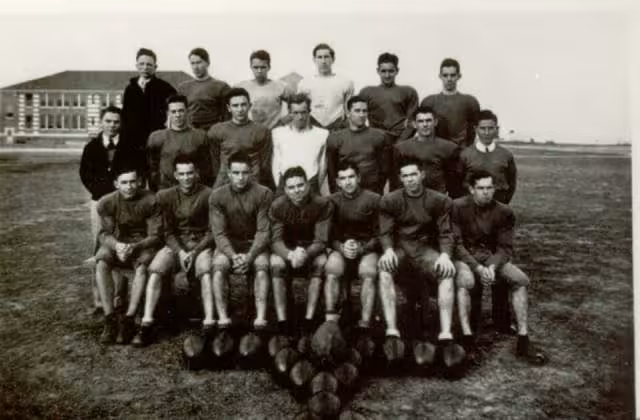
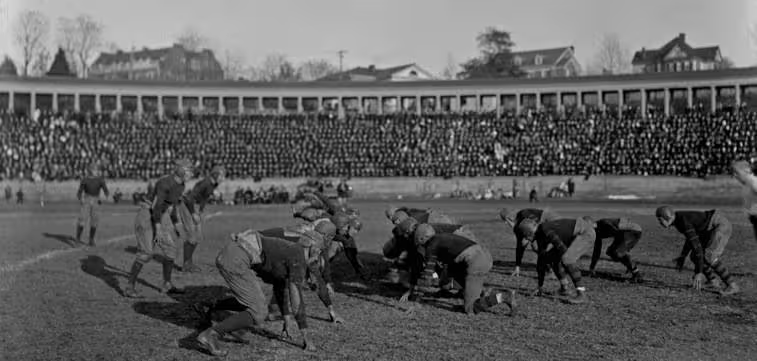
The University of Virginia football program began with informal, kicking-style pickup games played by students as early as 1870. Some historical accounts even suggest that enterprising students arranged a match against Washington and Lee College in 1871—just two years after Rutgers and Princeton played the first college football game in 1869—though no official score or record of that contest survives.
Organized intercollegiate football officially took root in Charlottesville in the autumn of 1887. Representing the university as an independent squad, the 1887 Virginia Orange and Blue team took the field on November 13, 1887, against Pantops Academy, a local preparatory school. That contest ended in a scoreless 0–0 tie, marking the first organized football game played in the Commonwealth of Virginia. The following year, in 1888, the program formalized its varsity schedule, playing four games and securing its first official victory with a 20–0 shutout over Episcopal High School.
In its formative years, Virginia operated without a dedicated head coach, relying instead on team captains and graduate managers to organize practices and strategy. The program hired its first formal head coach, Harry Mackey, in 1893, who led the team to an impressive 8–2 record. Subsequent early coaches helped elevate Virginia into a Southern powerhouse, most notably Pop Lannigan (1905–1909) and Hall of Fame coach Earle “Greasy” Neale (1923–1928), who laid the tactical foundation for modern Southern football.
Early Virginia rosters featured standout athletes who established the program’s reputation. Halfback and kicker Johnny Poe—a former Princeton star and second cousin of Edgar Allan Poe—helped coach and mentor early squads in the 1890s. On the field, stars like fullback Henry “Buck” Mayer, who scored a program-record 36 points in a single game against Richmond in 1915, and quarterback Eugene “Red” Mayer defined the era. Later, in the 1930s and 1940s, “Bullet” Bill Dudley emerged as Virginia’s first consensus All-American and Maxwell Award winner, cementing the program’s national stature.
Interestingly, the players of 1887 did not yet bear the “Cavaliers” moniker. For decades, Virginia teams were referred to simply as the “Orange and Blue” or the “Wahoos.” The official “Cavaliers” nickname originated in 1923 through a student contest hosted by the university’s humor magazine, The Virginia Reel. A student named Lawrence Haywood submitted the winning entry, “The Cavalier Song,” which celebrated the chivalrous, daring spirit of the Virginia gentlemen who supported King Charles I during the English Civil War. The university community quickly embraced the name, uniting the program’s 19th-century gridiron roots with an enduring collegiate identity.
Here Are More Stories of University of Virginia Football Legends
- Herman Moore: The High-Flying Pioneer of Detroit’s Aerial Assault
- Jim Dombrowski: Virginia Cavaliers Hall of Fame Tackle
- Tom Scott: Virginia Football Legend & Hall of Famer
- Joe Palumbo: Hall of Fame Guard for Virginia Football
- The Iron Man of the Secondary: The Ronde Barber Story
- The Streak Stops Here: How Virginia’s Goal Line Stand Ended FSU’s ACC Reign (1995)