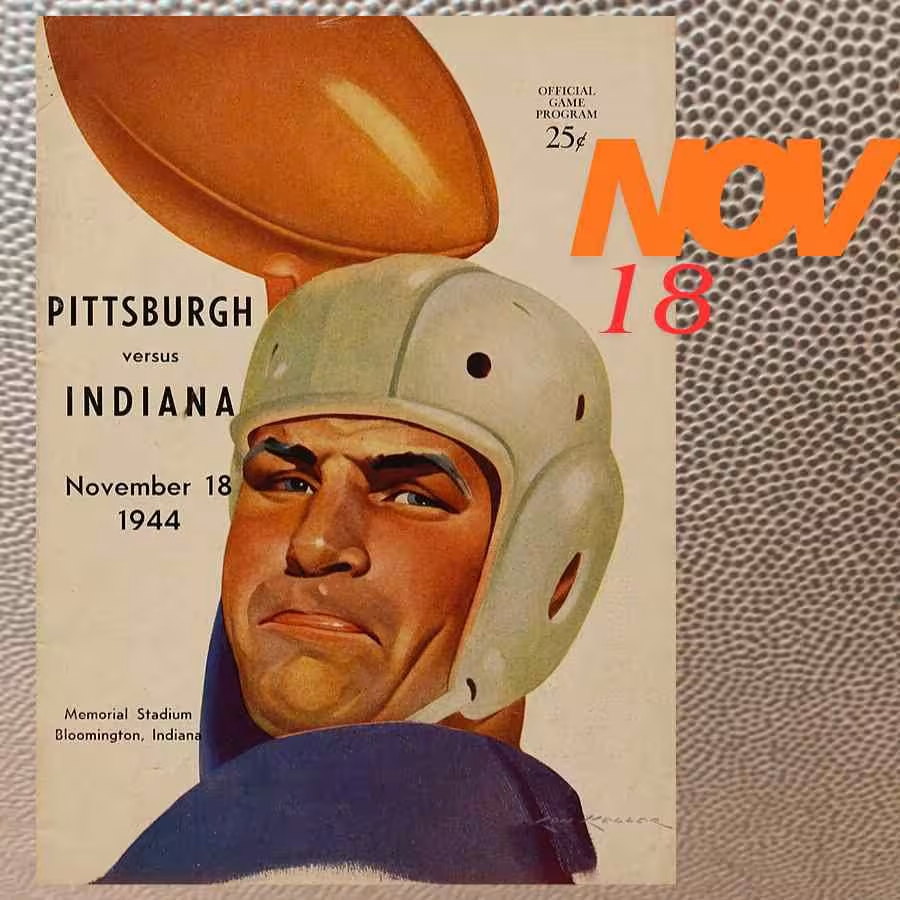
November 18 is more than just another date on the calendar—it’s a landmark day that cuts across the entire spectrum of football history. From groundbreaking gear innovations to the birth of legendary athletes, this date has truly seen it all. Did you know the very first football shoulder pads were introduced by Rawlings on this day, way back in 1902?
Fast-forward through the decades, and November 18 gave us iconic moments like the Notre Dame Fighting Irish securing their monumental 500th victory in 1967 and the New York Giants charging toward a Super Bowl with a 10-0 start. Crucially, this date marks the birth of gridiron giants like the “Assassin” Jack Tatum, College Football Hall of Famer Raghib “The Rocket” Ismail, and the pioneering quarterback Warren Moon, who conquered both the CFL and the NFL. Tragically, it was also the day Joe Theismann‘s Hall of Fame-caliber career came to a sudden, painful end in 1985. Dive into the archives with us to explore the most significant, record-breaking, and memorable moments in football’s past, all linked by November 18.
November 18 American Football History Timeline
- November 18, 1893 – Tulane University played its first official game against the Southern Athletic Club at Sportsman’s Park in New Orleans. Tulane lost the debut contest 0-12 to the SAC.
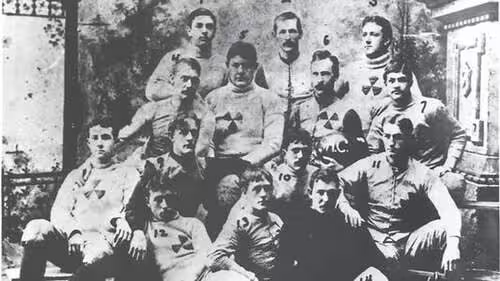
- November 18, 1894 – The Washington Agricultural College (Washington State Cougars) played its first official game on the road, traveling across the border to Moscow to face the University of Idaho. The early Cougars won 10–0 in their debut.
- November 18, 1902 – Rawlings is credited with introducing the first football shoulder pads when they introduced Whitley’s Armor Clothing. William P. Whitley, an executive at Rawlings, filed for US Patent 714079. He did this on behalf of the Rawlings Sporting Goods Company. The product was made of felt and fiber, and though it offered poor protection compared to the pads of our era, it was a significant upgrade over what they had at the time.
- November 18, 1905 – Birmingham, Alabama – The 10th Iron Bowl is played, and Alabama shuts out rival Auburn 30-0 in a game played a year before the forward pass became legal in college football.
- November 18, 1961 – Texas Christian and the Texas Longhorns played a memorable contest, known as the “Cockroach Game.”
- November 18, 1967 – The Fighting Irish hit a milestone in the school’s legendary football history. Notre Dame notches up victory number 500 for the program as the Irish run over Georgia Tech by the score of 36-3.
- November 18, 1967 – On the West Coast, the National Title was being decided as rivals Southern Cal and UCLA squared off in a BIG one.
- November 18, 1978 – Grant Field, Atlanta, Georgia – Running back Vegas Ferguson sets a Fighting Irish record as he puts up 255 yards on the ground against Georgia Tech in a 38-21 victory for the Golden Domers. Ferguson, according to an archived story on nd.edu, set the tone for the day as he took a handoff through the right side of the line on the game’s second play, 68 yards to the Tech 6-yard line.
- November 18, 1978 – Unranked Auburn spoiled a Sugar Bowl berth for the eighth-ranked Georgia Bulldogs, holding them to a 22–22 tie in Auburn. Tigers running back Joe Cribbs rushed for a school-record 250 yards, nearly matching Georgia’s entire offensive output. With five minutes remaining, Hall of Fame coach Vince Dooley chose to kick the tying extra point rather than attempt a two-point conversion, gambling that the Bulldogs would get another scoring chance—a decision that ultimately sealed the deadlock. [National Football Foundation]
- November 18, 1984 – Commonwealth Stadium, Edmonton – The 72nd Grey Cup was played. This CFL championship game was special because it was the first-ever Grey Cup game played in Edmonton, according to the bluebombers.com website. The game also marked the first time in nearly two decades that the Winnipeg Blue Bombers had made it to the title game of the CFL. Their opponent was a very gritty Hamilton Tiger-Cats squad led by former Bomber quarterback Dieter Brock, who had just been traded to the Ticats a year earlier. The Cats struck first with Brock sneaking the ball into the endzone for the early lead. At one point early in the second quarter, their lead had extended to 17-3, but that Hamilton momentum was short-lived. Winnipeg would pop off 27 points in the second quarter, setting a Grey Cup record, and rattle off the final 44 points of the game. What at first seemed to be all Hamilton quickly turned into a Bombers blowout with the Winnipeg Blue Bombers defeating the Hamilton Tiger-Cats, 47-17. Quarterback Tom Clements, the very player Brock was traded for, was named the offensive MVP; running back Sean Kehoe was the top Canadian, while the top defender was Tyrone Jones, who set a Grey Cup record with four quarterback sacks.
- November 18, 1985 – Joe Theismann’s NFL career ended with what may have been one of the most vivid injuries witnessed in a nationally televised game, as you could see the bone in his leg break during a sack by legendary NY Giants linebacker Lawrence Taylor on November 18, 1985
- November 18, 1990 – The New York Giants run their record to 10-0 as the G-men drop the Detroit Lions in a shutout, 20-0, per pro-football-reference.com. The following two weeks of the season would give the Giants back-to-back losses to the Philadelphia Eagles and the San Francisco 49ers, leaving the team at 13-3 and another late-season loss to the Buffalo Bills. The Giants would get their revenge on the Bills, though, in Super Bowl XXV, as after a Scott Norwood game-ending field goal attempt sailed wide right, the Giants would win the title game by the score of 20-19, with running back Ottis Anderson winning the game’s MVP. (source)
- November 18, 2006, Mansfield University turned out the lights as it ended its football program, more than 100 years after introducing nighttime football to the world. The Washington Post article from November 18, 2006, tells how the Division II team finished 0-10 in its final season and cut its football program, yet left a unique legacy. Mansfield hosted the first outdoor night football game on September 28, 1892. Then called Mansfield State Normal School, it played a scoreless tie against Wyoming Seminary in Mansfield, Pa. Happily, the college added football once again in 2007 in the Collegiate Sprint Football League, where players must weigh in at 178 pounds or less to compete.
Steelers History Was Made
Ok, bear with me for a minute….
— Steel City Star (@steelcitystar) November 18, 2025
1) OTD in 1962, the Steelers wear the Steelmark logo on their helmet for the first time
2) In 1961, the last full season without logo, Steelers had losing record
3) In first game with logo at home vs Washington (OTD in 1962) Steelers trailed… https://t.co/xYORTNwYWH pic.twitter.com/vV3UTdzgV5
November 18 Football Hall of Fame Birthdays
- Slip Madigan [1896] – A former center for Knute Rockne at Notre Dame, Edward “Slip” Madigan transformed tiny Saint Mary’s College of California into a national giant-killer from 1921 to 1939, compiling a 116–45–12 record. Known as a flamboyant showman who dressed his “Galloping Gaels” in bold colors and scheduled cross-country powerhouse matchups—including an upset of Fordham in New York and a 1929 Cotton Bowl victory—the College Football Hall of Fame coach also led the University of Iowa during World War II.
- Paul Wiggin [1934] – A two-time All-American defensive end at Stanford, Wiggin played 11 seasons with the Cleveland Browns, capturing the 1964 NFL Championship and earning two Pro Bowl selections. Enshrined in the College Football Hall of Fame, he also spent decades in coaching and front-office roles, including serving as head coach for both the Kansas City Chiefs and his alma mater, Stanford.
- Jack Tatum [1948] – Known as “The Assassin,” Tatum was a two-time unanimous All-American safety and national champion at Ohio State before becoming the feared enforcer of the Oakland Raiders’ secondary during the 1970s. A three-time Pro Bowler, Super Bowl XI champion, and College Football Hall of Famer, his bone-jarring hits defined the physical intimidation of classic Raiders football.
- Warren Moon [1956] – An undrafted quarterback out of Washington, Moon revolutionized the position by dominating the Canadian Football League—winning five consecutive Grey Cups—before shattering barriers and passing records in the NFL. The nine-time Pro Bowler and 1990 NFL Offensive Player of the Year racked up over 70,000 combined pro passing yards and stands as the only player enshrined in both the Pro Football Hall of Fame and the Canadian Football Hall of Fame.
- Raghib Ismail [1969] – Nicknamed “The Rocket,” Ismail was one of college football’s most electrifying playmakers at Notre Dame, winning the 1990 Walter Camp Award, finishing as Heisman runner-up, and earning induction into the College Football Hall of Fame. After starting his pro career by winning a Grey Cup MVP in the CFL, he went on to play nine NFL seasons as a deep-threat wide receiver and dynamic return specialist.
Conclusion
From the introduction of the first rudimentary shoulder pads in 1902 to the birth of future Hall of Famers like Warren Moon and Raghib Ismail, November 18 clearly holds a unique and powerful place in football history. It’s a day that encapsulates the full spectrum of the sport: innovation, legendary victories (like the Giants moving to 10-0 or the Blue Bombers’ record-setting Grey Cup rally), and heartbreaking career-ending moments like Joe Theismann’s injury. Whether it’s college milestones, CFL championships, or NFL dominance, November 18 provides a fascinating snapshot of the gridiron’s rich and complicated past. We’ve seen records set, programs shuttered (and reborn, like Mansfield’s), and the game itself evolve—all tied to this one day.