Part 1 of our Look at the Greatest 1924 College Pass Plays
The Golden Age of American football in the 1920s set trends we can appreciate today. While modern experts like Jon Gruden, John Madden, and Ron Jaworski have taught casual fans the “X’s and Os” of football playbooks, this practice began just after World War I in syndicated newspaper columns.
One of these occurred in 1925, when fishwraps around the country, as Army’s then-head coach, Captain John J. McEwan, shared his knowledge and breakdowns of the previous 1924 season’s best passing plays. He titled his 48-part series the “Greatest Forward Pass Plays in Modern Time,” and it appeared six times a week in participating local papers (no Sundays).
For those of you who follow Pigskin Dispatch and read our books, you know how highly we regard the 1924 season, which was magical with the likes of Red Grange, the Four Horsemen of Notre Dame, Ernie Nevers, Wildcat Wilson, and more.
Cap McEwan’s Football Expertise
Captain John J. “Cap” McEwan was a pioneering figure in early 20th-century American football, known for his innovations and dominance both as a player and a coach.
As a Player:
- Innovator: Playing center for the U.S. Military Academy (Army) from 1913 to 1916, McEwan is credited with pioneering the spiral center-snap and introducing an early version of the defensive rover-back to Eastern football.
- Physical Dominance: Built like a heavyweight fighter at 6’4″ and roughly 200 pounds, he was unusually fast for his size. He was renowned for his ability to cover large areas of the field and his tremendous tackling and blocking skills.
- Accolades: He was a three-time All-American, a consensus first-team All-American in 1914, and was elected team captain in 1916. Upon his graduation, he was hailed as the greatest center in Army’s history.
As a Coach:
- Collegiate Success: After returning to West Point as an assistant, he served as Army’s head coach from 1923 to 1925, leading them to an 18–5–3 record. He went on to serve as the head coach for the University of Oregon (1926–1929) and Holy Cross (1930–1932), amassing a 59–23–6 overall collegiate head coaching record.
- Professional Transition: McEwan later transitioned to the NFL, coaching the Brooklyn Dodgers for two seasons from 1933 to 1934.
In recognition of his tremendous impact on the sport, McEwan was inducted into the College Football Hall of Fame in 1962.
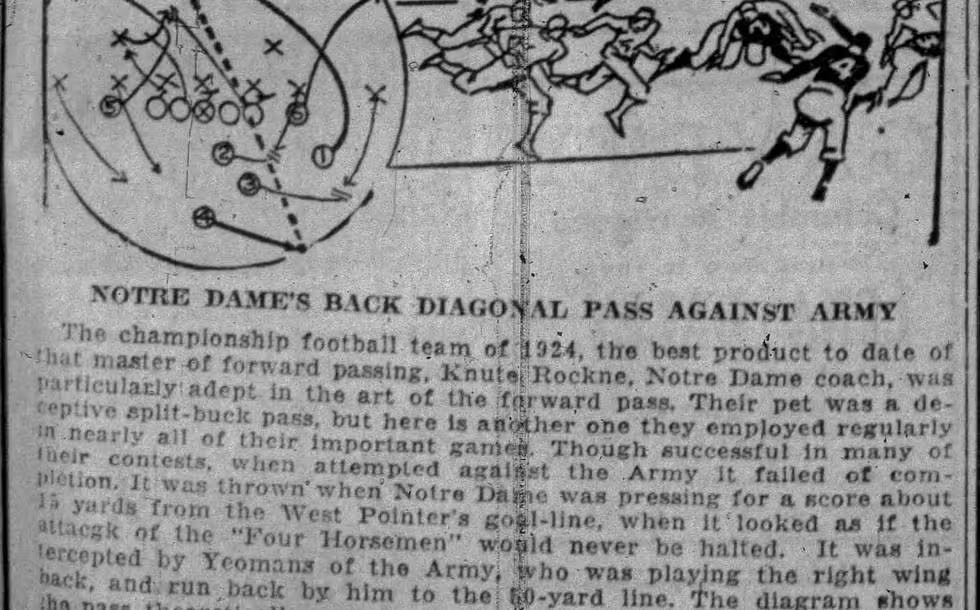
The first ’24 pass play that we will take a look at is one that Coach McEwan saw firsthand. Knute Rockne deployed the play against McEwan’s Army eleven at the Polo Grounds on October 18, 1924, in front of 60,000. Cap titled this play the Notre Dame Back Diagonal Pass. McEwan is very complimentary of the Fighting Irish and the Championship status Rockne’s group earned in 1924. He is also beaming with pride that his Cadet defense was prepared for and picked off this pass play that the South Benders deployed.
The Play Design and Outcome
During a crucial red-zone drive at the 15-yard line, Notre Dame’s seemingly unstoppable “Four Horsemen” offense dialed up a trick play against Army: a deceptive end-around pass out of a split-back formation.
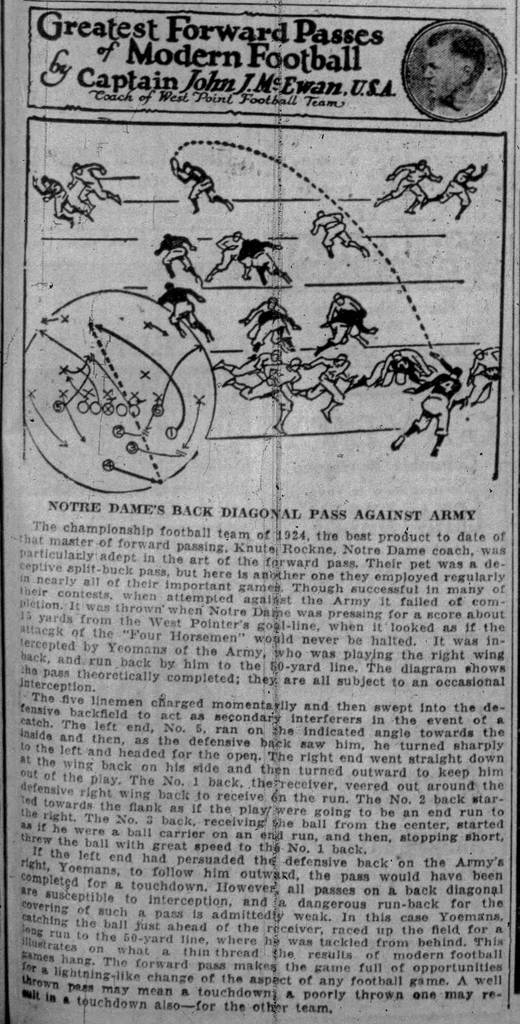
Greatest forward passes Notre Dame back diagonal agianst Army
Article from Nov 30, 1925 The Times-Union (Rochester, New York) Greatest winning passes
Here is how the play broke down:
- The Design: The play was drawn up to look like a standard sweep. The left end took the ball, faked the run to draw the defense outside, and suddenly stopped to throw a fast, cross-field pass back to a running back. At the same time, the offensive linemen leaked downfield to act as lead blockers (similar to a modern tunnel screen) once the catch was made.
- The Result: The trick play completely backfired. Army’s defensive back, Yeomans, didn’t bite on the fake run. He held his water, read the dangerous cross-field throw, and undercut the route for a clutch interception just in front of the receiver.
- The Return: Because the offensive linemen had already released downfield to block, Notre Dame had no one in position to make a tackle. Yeomans ripped off a massive return, taking the pick all the way out to midfield before finally being tracked down from behind.
The modern takeaway: Throwing late and back across the field is just as dangerous today as it was in 1924. It is a high-risk gamble that can instantly flip the momentum of a game, turning a guaranteed scoring drive into a devastating turnover.
The interception helped Army’s cause, but the Irish were a machine and earned a hard-fought 13-7 victory. Sportswriter Grantland Rice immortalized Notre Dame’s backfield after the game. He penned the famous lines about the “Four Horsemen”—Harry Stuhldreher, Don Miller, Jim Crowley, and Elmer Layden