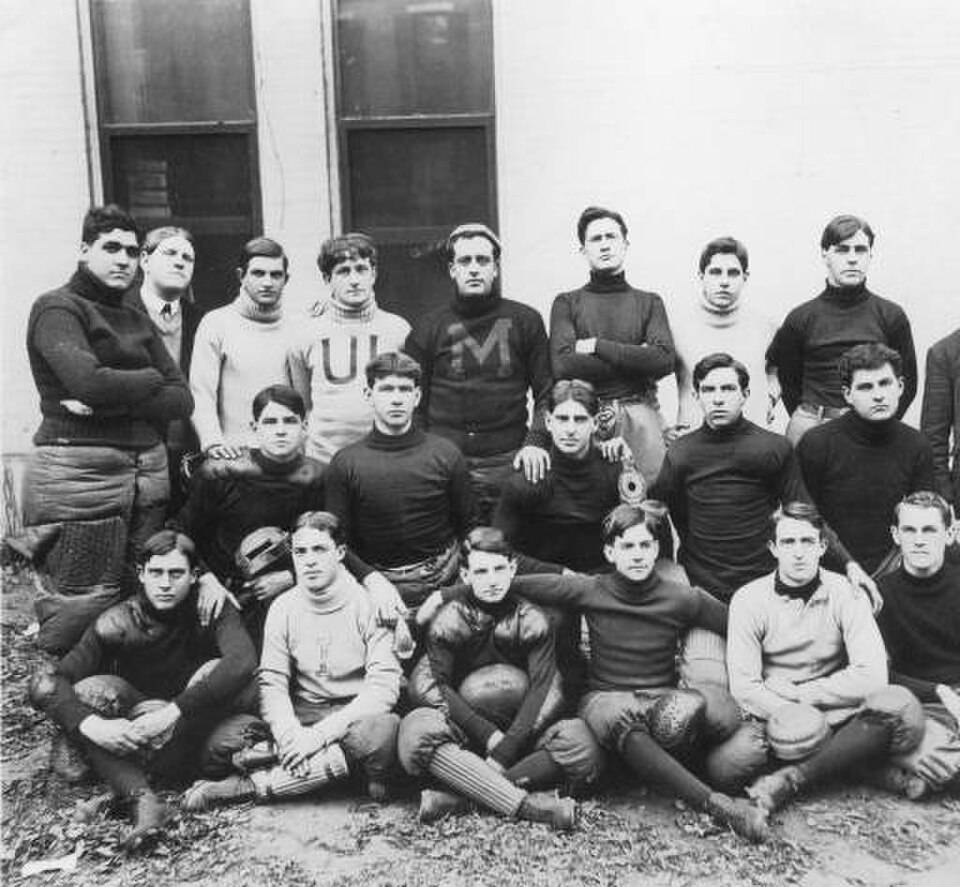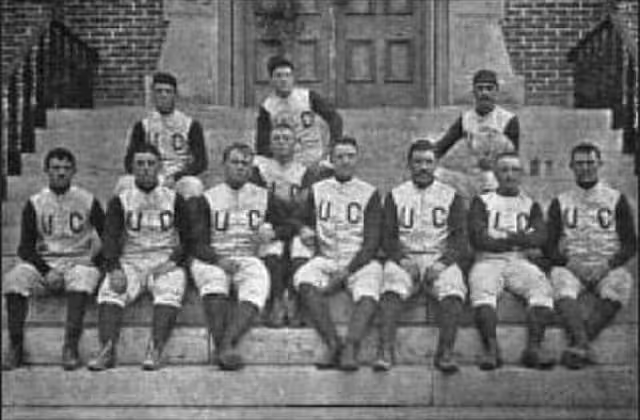
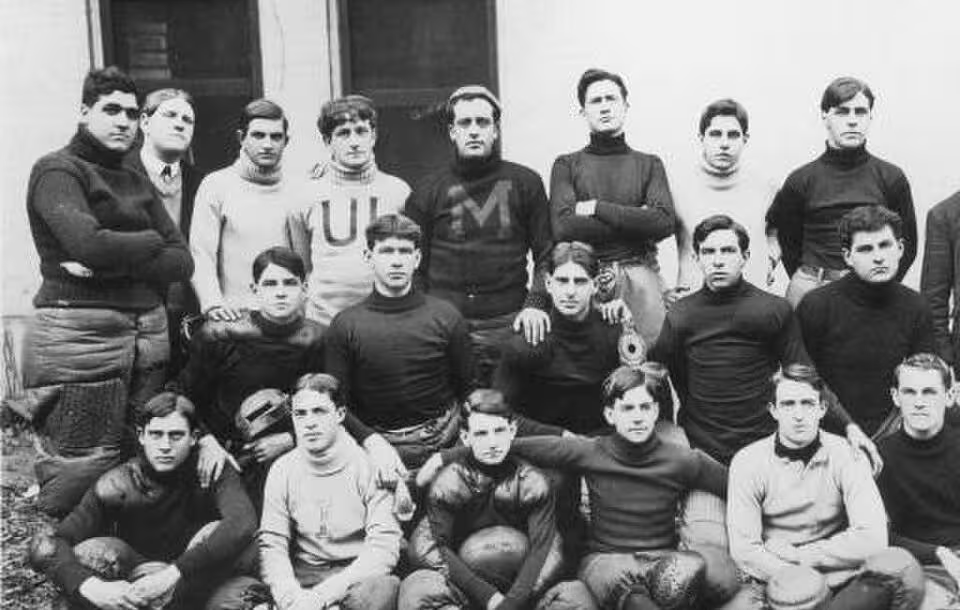
The University of Louisville football program transitioned from informal club play into official varsity competition in the fall of 1912. Before establishing a unified athletic department, teams composed primarily of medical students represented the school on an unofficial level. To launch its inaugural varsity squad, the university hired Lester Larson, a typewriter salesman and former end on the University of Chicago’s 1905 national championship team under Amos Alonzo Stagg.
The First Game and Early Coaches
Under Larson, Louisville played its first intercollegiate game on October 11, 1912, traveling to Lexington to defeat Transylvania University 32–0 at Thomas Field. Playing home games at High School Park, the team finished its debut season 3–1, capturing the Kentucky Intercollegiate Athletic Association title with additional victories over Central University (23–6) and Hanover (73–0), alongside a 41–0 loss to the University of Kentucky.
Larson departed after a 5–1 campaign in 1913, ushering in a revolving door of coaches—including Bruce Baker (1914) and Will Duffy (1915–1916)—before World War I forced the university to suspend football from 1917 through 1920. Following brief stints by Bill Duncan and Fred Enke in the early 1920s, former Notre Dame standout Tom King arrived in 1925 as athletic director and head coach. King was the first to seriously modernize the program, implementing a spread-wing offense suited for smaller rosters and compiling a 27–21 record through 1930. After severe budget cuts during the Great Depression led to back-to-back winless seasons in 1931 and 1932, Laurie Apitz stabilized the program from 1936 until World War II halted play again in 1943. When football resumed in 1946, Frank Camp took over for a 23-year tenure that anchored the program’s postwar growth.
Origin of the Cardinals Nickname
When Louisville took the field in 1912, newspaper accounts referred to the team simply as the “Red and Black”. Shortly after 1913, the university officially adopted the Cardinals nickname in honor of the northern cardinal, the state bird of Kentucky. School colors of cardinal red, black, and white were formalized around the same era at the suggestion of Mrs. John L. Patterson, wife of the university’s dean. A physical mascot did not appear until 1953, when home economics chair Frances Goldsmith sewed a prototype bird head for cheerleader T. Lee Adams, eventually evolving into the modern mascot known as Louie the Cardinal.
Early StarsLouisville’s first national standout emerged during the Tom King era in Fred Koster. A 16-time letterman across football, basketball, baseball, and track, Koster drew national headlines in 1926 by scoring 68 points in his first two games and finishing second in the nation in scoring with 124 points (18 touchdowns, 10 extra points, and two field goals).
Two decades later, under Coach Frank Camp, Louisville landed a lightly recruited Pittsburgh quarterback named Johnny Unitas (1951–1954). Despite playing on struggling teams, Unitas passed for 2,912 yards and 27 touchdowns—highlighted by a famous 1951 comeback effort against St. Bonaventure where he completed 11 consecutive passes in the rain—before going on to become an NFL Hall of Fame legend. Soon after, running back Lenny Lyles (1954–1957) became the first Cardinal to eclipse 1,000 rushing yards in a season, leading all of college football with 1,207 yards in 1957 and earning All-America honors.