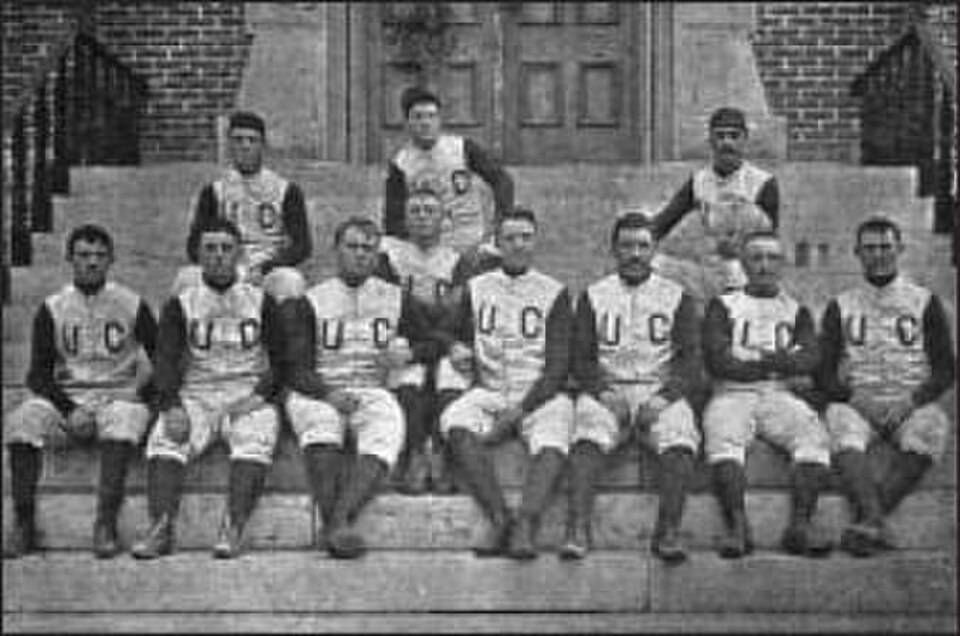
The University of Colorado’s football program started more as a reaction than in a planned manner. In 1890, the growing university fielded a soccer team, but it struggled to find nearby opponents. The team decided to change course mid-season, hastily switching from soccer to American football. The switch was reckless and destined to fail, as only 2 of the eleven team members aged 16 to 29 had ever seen a gridiron contest. With little guidance and no coach, player John Nixon studied magazine and textbook accounts of strategy and rules of play. Hopefully his academic studies were stronger than his pigskin studies, because as the University records show, that forst season was painful.
First Colorado Buffaloes Football Game
Colorado took its lumps as its forst official football game took place on November 15, 1890. The opponent was the Colorado School of Mines, which handed the early Buffs their worst defeat in recorded school history, 103-0. School history denotes that about half of the team was injured in the contest, leaving the team at even more of a disadvantage, but lessons in he school of hard knocks. It may have been so devastating that that meeting remained the only game of the winless first season for the University of Colorado team.
The first “W” for the Colorado program came on October 22, 1892, when the team knocked off the University of Denver, 26-0. The early Buffs won the rematch later that season. They finished with the first winning season in school history, a 3–2 record, with what the Colorado.edu site describes as “a remarkable turnaround for the team,” and player Edwin Ingram described as knowing “no more about football than a jackrabbit” two years earlier.
For its first four seasons, the team operated without a formal coach until August 1894, when Harry Heller was hired as Colorado’s first head coach. Heller immediately guided the squad to an 8–1 record and its first conference title in the Colorado Football Association. In 1895, Fred Folsom took over the program, coaching across three separate stints through 1915. Folsom amassed 78 victories—a school record that stood until Bill McCartney surpassed it in 1993—and lent his name to Folsom Field, which opened in 1924.
Early on, Colorado teams lacked an official nickname and were referred to simply as the “Silver and Gold”. In 1934, the campus newspaper, the Silver & Gold, held a contest offering a $5 prize to select a permanent moniker. Boulder resident Andrew Dickson submitted the winning entry, “Buffaloes,” which officially debuted on November 10, 1934, during a 7–6 Homecoming victory over Utah. Students celebrated the new identity later that month by renting a live bison calf for $25 to patrol the sidelines at the University of Denver. This tradition eventually evolved into the live mascot program led by Ralphie in 1967.
Under head coach Bernard “Bunnie” Oakes in the late 1930s, Colorado produced its greatest early superstar: triple-threat tailback Byron “Whizzer” White. In 1937, White led the nation in rushing and scoring, guided the Buffaloes to an undefeated regular season and their first bowl appearance in the 1938 Cotton Bowl, and became the program’s first consensus All-American and first-round NFL draft pick before serving on the U.S. Supreme Court.