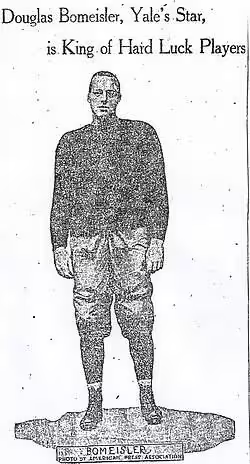
Doug Bomeisler defies career-ending injuries to cement his legacy as one of the most ferocious ends in college football history. Through sheer willpower and unmatched creativity, the Yale superstar overpowers his opponents and earns a permanent spot among the gridiron’s earliest legends.
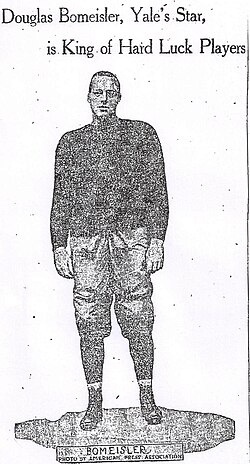
Football Bio
June 20, 1892 – Brooklyn, New York – Doug Bomeisler, who played end at Yale from 1910 to 1912, was born. Bomeisler is one of the best ends Yale ever had despite being injured during his time in New Haven.
The FootballFoundation.org web bio states that Doug was injured in just the second game against Syracuse, causing Bomeisler to miss the remainder of the 1910 season. During the 1911 season, he dislocated his shoulder early and played through the injury for the rest of the year. Against Princeton, he injured his knee.
Displaying a creative nature, he invented a leather-and-steel knee brace that enabled him to continue playing. In naming “Bo” to his 1911 and 1912 All-America teams, Walter Camp described Bomeisler as “powerful, thickset, fast, a terror to his opponents.”
Doug Bomeisler received the great honor of being selected for inclusion into the College Football Hall of Fame in 1972.
Doug Bomeisler exemplifies the absolute grit and determination of early 20th-century college football. He transforms devastating physical setbacks into opportunities for innovation, engineering his own braces just to stay on the field and battle his rivals. Today, football historians celebrate his powerful legacy through his immortalized place in the College Football Hall of Fame.
Accolades and Football Accomplishments
- College Football Hall of Fame: Inducted in 1972.
- Consensus First-Team All-American: 1912.
- First-Team All-American: Selected by Walter Camp in both 1911 and 1912.
- Gridiron Innovator: Invented and utilized a custom leather-and-steel knee brace to continue playing after a severe injury against Princeton.
- Yale Football Legend: Widely recognized by historians and peers as one of the most powerful and fastest ends to play for the Bulldogs during the sport’s formative years.