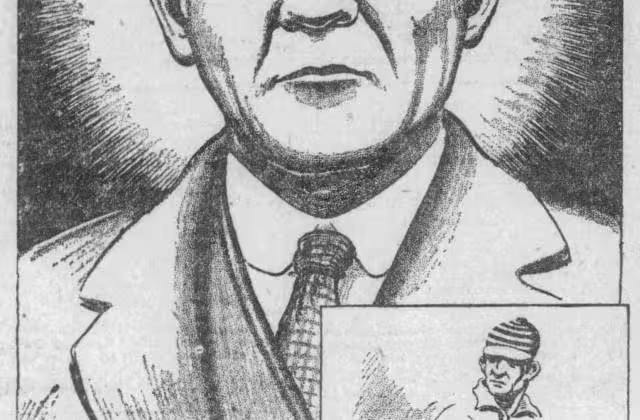
The biographical sketch of Head Coach Bud Grant from youth till his retirement from coaching and everything in between. Rick Loayza of the award-winning Basketball History 101 Podcast and Ross Blilie of Pigskin Tales Podcast join Darin in the Pigpen to tell about the well-rounded carer of one Bud Grant.
Come join us at the Pigskin Dispatch website and the Sports Jersey Dispatch to see even more Positive football news! Sign up to get daily football history headlines in your email inbox @ Email-subscriber
Miss our football by the day of the year podcasts, well don't because they can still be found at the Pigskin Dispatch website.
Go to SportsHistoryNetwork.com/Row1 for access to the full Row One catalog for gallery prints and gift items. Plus, get a 15% discount on all prints on the Row One Pictorem Gallery with coupon code SHN15.
Transcript
On this program, we'd like to talk about legends of the game, but what about when we talk about people that were legends as a player and as a coach? And how about when they're a legend of other sports as well? Well, we have that today and Bud Grant.
And we have a couple of experts from the Sports History Network here to share with us the expertise on the life and career of Bud Grant, one of North America's greatest sports heroes.
Announcer:This is the Pigskin Daily History Dispatch, a podcast that covers the anniversaries of American football events throughout history on a day to day. Bas, your host, Darrin Hayes is podcasting from America's North Shore to bring you the memories of the gridiron one day at a time.
So as we come out of the tunnel of the Sports History Network, let's take the field and go no huddle through the portal of positive gridiron history with pigskindispatch.com.
Ross Blilie:This podcast is part of The Sports History Network, your headquarters for the yesteryear of your favorite sport. You can learn more@sportshistorynetwork.com
Darin:Hello, my football friends. This is Darren Hay.
Welcome to the pigskindispatch.com welcome once again to the Pig Pen, your portal deposit of football history. And we're going to do something really interesting today.
We're going to talk about first one of the great legends in all of North American sports history, Bud Grant. And he's got to be one of the most interesting and most loved figures in North American sports.
We're going to do it sort of in a great little style where we're going to bring in some of our experts that are in their fields of the Sports History Network.
And we're going to talk about this legend because he covers so many genres of sports and different proficiencies at those sports, you know, as a player, as a coach. So we're going to grab some of these experts and talk about them.
And first up is somebody I think that you will definitely recognize an award winner here on Sports History Network.
Rick Loiza:This is Rick Loiza with Basketball History 101. We bring old school basketball to a new school audience. And it is my honor to be here with all you loyal listeners of the Pigskin Dispatch.
Even though I focus on basketball history in my podcast, I am a huge football fan. I come from Southern California where I have been a Rams fan my entire life. Even when they were in St. Louis, I still rooted for them.
I also played nose tackle for my high school.
So it is a real treat to be here with you today I want to share with you about a football hall of Famer, but I am going to talk about his basketball career now. If you are a fan of football history, then you know the name Bud Grant. I want to talk about Bud Grant the basketball player.
,:He was born and raised in Superior, Wisconsin and he was an extremely athletic kid, as is nearly every person who ever played a professional sport.
Darin:That is absolutely correct and many people don't realize that.
Grant as a youngster was diagnosed with a disease called poliomyelitis and a doctor suggested he become active in sports to strengthen his weakened leg muscles over time. And he did it in full force as he started with baseball and later added basketball and football as he got a little older.
I'm gonna hand this microphone back over to Rick Loiza to tell us a little bit about him in high school and thereafter.
Rick Loiza:In high school he was a three sport athlete.
As one of the stars of the football team, baseball team and basketball team, he was recruited and had been accepted to attend the University of Wisconsin to play all three sports. He was 6 foot 3, 195 pounds and could play almost anything.
ter graduating high school in:Darin:That's a very interesting part of Grant's relationship with sports because he was assigned to the Great Lakes Naval Training Station in Illinois and played on their football team which was coached by the very legendary Paul Brown. Yeah, that guy that ended up going to the Cleveland Browns and ended up founding the Cincinnati Bengals. Well, the 18 year old bud Grant was a sailor.
He was pretty decent player on a very talented roster of the Great Lakes Naval Training Station team.
eague championship in January:Just an interesting connection that would happen some 25, 30 years later.
Rick Loiza:So after just one year in the Navy and with the war being over, he presented his acceptance letter from the University of Wisconsin to get an honorable discharge so that he could begin his university studies. But in another twist, once he was out of the Navy, he switched schools and enrolled in the University of Minnesota instead.
They were happy to have him, as they were also recruiting him when he was in high school. So he accepted a scholarship to the University of Minnesota to play all three sports.
Now, how many kids do you know that were invited to play Division 1 in three different sports? But that is the kind of athlete that Bud Grant was, and he excelled in all three sports.
He was an ace pitcher for the baseball team, a wide receiver and defensive end for the football team, and a power forward for the basketball team. In three years of varsity basketball for the Minnesota Gophers, he played 34 total games and averaged 8.3 points per game.
And I looked up his statistics and unfortunately they did not track rebounds, assists, blocks, or steals back then. The only thing they kept track of was field goals made, free throws made, and overall points.
They did not even keep track of when a guy missed a shot. So they had no idea what anyone's shooting percentage was anyway. His production was solid, but not overwhelming.
There was a decent chance he could make the NBA, but the NFL wanted him too.
And even before he finished up his time at the University of Minnesota, he had already begun pitching for local pro baseball teams for pay during his downtime in the summer.
Darin:Rick, I'm going to break in here just a little bit here because I think we need to talk a little bit more about his football career in college. And we have somebody that is from the Minnesota area that follows the Minnesota Golden Gophers quite closely and their history.
And he'd like to say a few words about Coach Grant as well.
Ross Blilie:My name is Ross and I'm the host of the Pigskin Tales podcast.
And my thing is, is talking about the Vikings, the history, as well as the lesser known players, about how they started, you know, basically where they grew up and kind of like getting to know how they made the pros and then what their performance was like in the pros and things like that.
Darin:Very interesting, Ross.
Now, just a few minutes ago, Rick was telling us a little bit about a letter that Mr. Grant used to excuse himself from being in the Navy to go back and attend college.
Ross Blilie:Actually, he had to think about where and what he was going to do after he was discharged from the Navy. And so he actually decided to take that letter and he wanted to go to the University of Minnesota. So that's what he did.
And he ultimately chose to go to the University of Minnesota because he didn't actually want to have to own anything to anyone. So that's part of his character. You know, he just didn't feel like he needed to owe anybody anything. He didn't want to be in debt to anybody.
So that's why he chose to go to the University of Minnesota.
Darin:All right, now I understand Ross. Very good. Now, Rick, you had a couple things that you wanted to say more about his college career because he was a pretty good athlete, wasn't he?
Rick Loiza:He was so good at all three sports that the big question for him was which sport would he play professionally? Now that is quite a question. There are not that many players in history who ever get to make that decision. Bo Jackson comes to mind.
So does Deion Sanders, Danny Ainge, John Elway and others. Now, here is another unusual thing about Bud Grant.
ced something funny about the:cal NBA team during that same:h the Lakers on Christmas Day:He averaged 2.6 points per game. Now that wasn't exactly lighting it up, but of all the teams that he could have joined for that season, the Lakers were the team to be on.
The Lakers team had George Mikan, Vern Mickelson, Jim Pollard and Slater Martin. All four of those players are in the Basketball hall of Fame. They at the time, George Mikan was considered the greatest player of all time.
And he was still in his prime in the Finals that year, the Lakers were matched up with the Syracuse Nationals. By the way, the Syracuse Nationals would later change their name to the Philadelphia 76ers.
In Game 1 of those Finals, Bud Grant contributed two points to the effort, but the team won behind 37 points from George Mikan. The final score was 68 to 66 in the Lakers favor. Now remember, these were the days before the shot clock. Stalling was still a highly employed tactic.
In game two of that series, Grant had a real breakout performance scoring 12 points. Mikan was his usual self, scoring 32, but with little contribution from anyone else.
The Lakers lost 91, 85 and that tied the series at one game apiece. The Series went on like this, back and forth.
Going into game six, the Lakers were up three games to two and a half and hoping to close out the series. Bud Grant scored six points, George Mikan scored 40 points.
to secure the:He played a second season with the Lakers where he played 61 games but still only averaged 2.6 points per game. It became obvious that individual success was not going to happen in the NBA. His talent had topped out and he was a reserve player at best.
Of course there is no shame in that. Just getting an opportunity to play at the highest level of any sport is a major accomplishment.
e fact that at the end of the:That meant that a lot of players were going to lose their jobs, especially reserve players like Bud Grant. And the really good players were signing contracts with the surviving teams. So this made the decision very easy. It was time for him to move on.
Now that was when he decided to switch back to the NFL and join the Philadelphia Eagles as a defensive end. Once he was in football, he never looked back. Now how many hall of Fame coaches do you know that also have an NBA championship ring as a player?
Well, the answer is one. And that man's name is Bud Grant. This has been Rick Lawiza with Basketball History 101, part of the Sports History Network.
Take care and see you soon.
Darin:Hey, thanks Rick. That appreciate that information about the basketball athlete that Bud Grant was. Now Ross, back to you.
We know that Bud was a three sport athlete in football, basketball, baseball, earning a grand total of like eight, eight or nine varsity letters with the Golden Gophers, you know, Also pretty good in the college ranks. Received all Big Ten honors into the football game of football twice. And he didn't graduate.
But he, you know, like Rick said, he played with the Lakers for a couple years in National Basketball association. But what happened right after that?
Ross Blilie:Then he decided to take his talents to the professional ranks.
He was actually drafted by the Philadelphia Eagles and then he ended up in the CFL and played for the Bombers, the Blue Bombers there according to the.
Darin:Records he played with the Philadelphia Eagles for two Years and ended up having a little dispute with them. They didn't want to pay him as Philadelphia what he felt he was worth. So he ended up leaving and went to go play some three down football in Canada.
Like you said in:ed for the Blue Bombers until:,:If you haven't figured that out already. Now, Ross, what happened with him in his playing career with the Blue Bombers,.
Ross Blilie:He had some contract issues with them and so that's actually what led him to actually retire from being a player and then chose to go into coaching.
an Brocklin at that time from:Norm Van Brocklin was a first time head coach and the Vikings were an expansion.
just come off of winning the:Something happened between him and Tarkenton where a lot of times he rode Tarkenton because of the way that he played. He wanted Tarkenton to be more of a pocket passer, but Tarkenton just couldn't play that way.
In several interviews that I had seen him talking about Van Brocklin, he had talked about how the fact that he wanted to be able to run around because he didn't want to keep getting clobbered all the time. So he had to figure out a different way to play the game to his strengths, not to what the coach wanted.
ded to the New York Giants in:But Norm Van Broecklan, he just, he couldn't figure anything out. So he decided that he was going to retire from coaching. He just could not do it.
Darin:So that must be at the point where the general manager of the Vikings, Jim Finks at the time brought him over to Minnesota from the Blue Bombers, that is Bud Grant from the Blue Bombers to take Norm Van Brocklin's vacated head coaching position. Is that correct?
Ross Blilie:,:But now he was a guy that was a man of very few words. He brought discipline and a hard work ethic and he focused a lot on defense because that's how he won his four gray cups in the cfl.
So a lot of what he knew was basically just not saying a whole lot and just being respectful of everybody and just, just kind of being his own guy, but also instituting a hard work ethic.
Darin:Very interesting.
,:And the coach never again missed anything that he knew he was going to do from the start.
The lesson is kind of, you know, humorous, but does point to the importance of family in Bud Grant's life and the family like environment that he sort of created in the Vikings locker room. And you know, and having a family adds a little bit of discipline. Is that right, Ross?
Ross Blilie:So when he was coach, he believed that football should be played under controlled emotions. And that's what he basically brought to coaching. He was well known for showing a lack or thereof emotion during games.
Nobody could really figure him out, but he was tough minded and he wanted his players to practice outdoors in the winter to get them used to playing in cold weather. And I think for the most part it did work because they did win a lot of games at the Met, but unfortunately they just didn't win any championships.
Heaters weren't actually allowed on the sidelines during games because of their tough, hard work ethic in practicing outdoors.
And I just picked out some stories that were very interesting to me about this particular guy, this legendary coach in Vikings franchise history, because he just has a way about him, and a lot of people kind of gravitated to what he did, or I guess really didn't do. I mean, he just was a guy that didn't show an emotion, and he just didn't say a whole lot.
That's kind of like Teddy Roosevelt saying, you know, speak softly and carry a big stick. So I think that's kind of what Bud Grant was like.
And I think to a degree, it worked because for his 18 seasons in Minnesota as a head coach, he was 158. 96 And 5 in the regular season, 10 and 12 in the postseason, but unfortunately, 0 and 4 in the Super Bowls.
Overall, his career record with the Vikings was 168. 108 And 5. And I believe that is a. 620 Career winning percentage.
I don't believe that there's really been anybody that's come close to winning that many games in the franchise other than Denny Green. And I know Denny Green was with the Vikings for 10 seasons. I don't know, they just haven't found anybody nearly as good as Bud Grant.
But from the book 100 Things Vikings Fans Should Know and Do before they Die, a couple of things that I noted were that Bud loved the outdoors, especially hunting and fishing. And Mick Tinglehoff and Dave Osborne actually became great friends with Bud Grant.
But there was a story in that book that was really interesting, and Dave Osborne actually told this story he wasn't with. But I think Mick Tinglehoff told the story to him. And it was when Mickey, Bud and another teammate went to Nebraska to do some hunting with Grant.
They drove in Grants old pickup from the Twin Cities to almost the Iowa border without saying a word to each other. Mick and the other teammate agreed beforehand that they wouldn't so much as clear their throat before the coach spoke.
So when they stopped for gas, but only said six words, it was full when I left. Mick and his teammate knew that Bud meant they were paying for the gas. That is how Bud was. He just wasn't a guy that really talked a whole lot.
And so he only needed to say just a few words before people just kind of knew exactly what he meant.
Another story that I got from the Book of Tradition of Purple, which was written by Jim Brutton, he says the success of Grant's tenure with the Vikings was because no one could figure him out. He acted differently from others.
Fans were confused and distanced themselves from him because they couldn't tell how he felt after a last second win or a devastating loss. Norb Berg, a close friend of Grants, remembers a time when Grant was being interviewed by Phyllis George before a game and she said, smile, Bud.
His reply was, tell me something funny, Phyllis. Classic Bud. During press conferences, Grant would pause for what seemed like a forever time.
No one knew if he didn't know the answer to the question, or if he was thinking about the question, or if he just liked to see the reporters squirm. He always had the upper hand.
to Dallas in the playoffs in:Lynn didn't say what Grant's response was, but he says that he could just tell that Bud was very down, very disappointed. And he goes on to say, it shook me up so much to see him like that. I called my wife and told her, we're out of here, we're leaving.
I was gonna quit just because of the reaction of Bud. That's pretty powerful. And that's the effect that a lot of people had on Bud Grant. Nobody can really just figure it out. That's just the way he was.
He was also a strong believer that the team owed something to the fans. He believed that the team needed to be as loyal to the fans as the fans were to the team.
So he also believed that the team needed to give back to the fans to show appreciation for their loyalty.
Darin:I guess that's why he's just such a special coach and so many people are so fond of his memories of coaching the Vikings, you know, up in Canada. The Blue Bombers are very fond and look very highly and it was a great loss when he left the Blue Bombers organization too.
You know, everybody speaks so very highly of this man who's, you know, just man, a few words like you said, Ross. But just what his actions did and what he got people to do is just unbelievable and the successes that he truly had.
So, you know, first of all, we want to thank Rick Loeza for helping us to discover some of this history of Bud Grant and fill in some of those blanks of the basketball in some of, you know, his early years.
And to you too, Rasa, thank you very much for joining us here and giving us a full picture of one of your heroes, Bud Grant, from a Minnesota perspective.
Ross Blilie:Hey, thanks for having me on, Darren. I really appreciate it. And the Pigskin Tales podcast is on the Sports History Network. Yeah, thanks again.
Darin:We're taking a peek over at the chains and the down marker. It's fourth and long. We're gonna have to punt the ball and get on out of here.
But we'll have another series tomorrow for your football history headlines, so be sure to tune in.
We invite you to check out our website, pigskindispatch.com not only to see the daily football history, but to experience positive football with our many articles on the good people of the game, as well as our own football comic strip, cleet marks comics.
Pigskindispatch.com is also on social media outlets, Facebook, Twitter, Instagram, and don't forget the Pigskin Dispatch YouTube channel to get all of your positive football news and history. Special thanks to the talents of Mike and Gene Monroe, as well as Jason Neff for letting us use their music during our podcast.
PigSkindisPatch.com is a proud affiliate of the Sports History Network, the headquarters of sports yesteryear.