Hall of Fame Birthdays and Historic Rivalries: What Happened on October 25 in Football History?
They were unbeatable, so it seemed. Opponents entered the games against them with little hope of victory. October 25 was a day when the winning streaks of two of college football’s powerhouses ended: first, Yale in 1887, and 70 years later, Army’s run.
October 25 is a date marked by pivotal moments and legendary figures who shaped American football! We’re celebrating the birthday of one of football’s wartime era stars, Marshall Goldberg. But the history doesn’t stop there—this date also marks classic college football showdowns, including Columbia’s epic stop of Army’s winning streak. Get ready to dive into the iconic players, record-breaking games, and enduring traditions that make October 25th essential reading for any gridiron fan!
October 25 American Football History Timeline
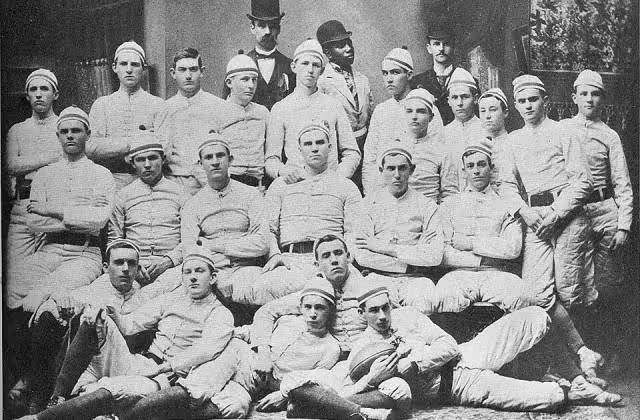
- October 25, 1884 – Yale entered the 1884 season riding a 17-game winning streak and had won multiple National Championships in the past few years. The powerhouse Bulldog squad really flexed their muscles against the Dartmouth team that season. It marked the first game in which over 100 points were scored, as Yale toppled Dartmouth 113-0.
- October 25, 1905 – Annapolis, Maryland – The very first College Football Crab Bowl Classic is played. The U.S. Naval Academy and the University are less than 30 miles apart, so it is no surprise these two would clash regularly on the gridiron. The series ended temporarily in 1934 after Maryland protested a controversial play. According to a Wikipedia account, the Maryland brass deemed the Navy go-ahead touchdown play in the 1934 edition of the series illegal after a film review—an exciting development in football history for 1934. The series resurfaced a couple of times in the 1950s, and then after a 1964 contest in which a Terrapin player flashed his middle finger at Navy fans. It occurred after a punt return by Navy, where an angry Terp, Jerry Fishman, was penalized for an unnecessarily brutal hit that injured receiver Skip Orr directly in front of the Navy faithful. The jeers from the Navy stands increased above normal and were directed at Fishman. In response, Fishman approached the Brigade of Midshipmen section and flipped them off.. Later, Fishman was penalized again for a late hit on Heisman Trophy-winning Navy quarterback Roger Staubach, and again the heckling from the Navy crowd prompted Fishman to give the obscene gesture for a second time. High-ranking Navy officers noticed Fishman’s middle finger and were outraged by its disrespectful nature. Always taking the high road, Staubach later told the press that Fishman “told the fans he thought Maryland was number one and got his fingers wrong.” Navy brass suspended the series for a period that lasted until the 2005 season. In this first matchup, Navy defeated Maryland 17-0.
- October 25, 1947 – The unbelievable happened: the Columbia Lions upset the powerful Army Black Knights, ending the legendary winning streak of the West Point Cadets.
- October 25, 1953 – The Polo Grounds, New York City, New York – The famed Polo Grounds was a sloppy track on this day in late October 1953. The Cleveland Browns were well into their 4th NFL season after dominating the now-defunct American Football League. The Giants were a mid-level team at best in ’53, but being at home in the mud could be a great equalizer, and it was! Cleveland Browns QB Otto Graham set a club record with 4 fumbles as the Giants’ defense did everything it could to claw the ball away. A story on Cleveland.com recounts the only scoring sequence. (https://www.cleveland.com/browns/1953/10/browns_nail_5th_straight_in_mu.html ) The long count paid off for the Cleveland Browns on that day. The long count was a strategic maneuver designed to draw Giants rookie defensive lineman Joe Ramona offside as the Browns lined up for a second-period field goal attempt. Browns center Frank Gatski noticed the youngster was a little jumpy, so as the Browns lined up to try a field goal from the 18-yard line, Gatski told Otto Graham to delay snapping the ball a few counts.
It worked: Ramona jumped the count, and the Giants were penalized five yards and a first-and-goal on the six-yard line. Two plays later, Graham carried the ball through the left side of the line for the only score of the game. It is rare for a player to turn the ball over four times in a game and still escape the hero. The Browns won 7- 0 against the New York Giants in the mudfest. - October 25, 1964 – Possibly the most well-known sports blooper in American sports History could be “The Wrong Way Run” by Viking Jim Marshall. On the play, Minnesota defensive standout Jim Marshall was having his way with the San Francisco 49ers that day. Even on the play in question, Marshall got his paws on Niners QB George Mira and caused Mira to lose control of the ball. Marshall promptly picked the ball up and proceeded to run 66 yards to what he presumed was an extremely easy scoop-and-score. Unfortunately for Jim and the Vikes, Marshall ran in the wrong direction for a safety. Marshall was a fantastic player; in fact, he was a dominant player in his era of football. Unfortunately, all of his great plays are put aside in place of this embarrassing moment of confusion.
- October 25, 1997, 9th College Football Holy War: Notre Dame beats Boston College 52-20 in South Bend
- October 25, 2003, 15th College Football Holy War: Boston College beats Notre Dame 27-25 in Chestnut Hill
October 25 Football Hall of Fame Birthdays
Here is the chronological list of player birthdays for October 25, ordered from earliest to most recent:
- Bill Reid [1878] – A star fullback and later head coach at Harvard, Reid was inducted into the College Football Hall of Fame in 1970. Beyond his on-field success, he was a key figure during the 1905–1906 intercollegiate football crisis, working closely with President Theodore Roosevelt and the rules committee to reform the rulebook and legalize the forward pass to save the sport.
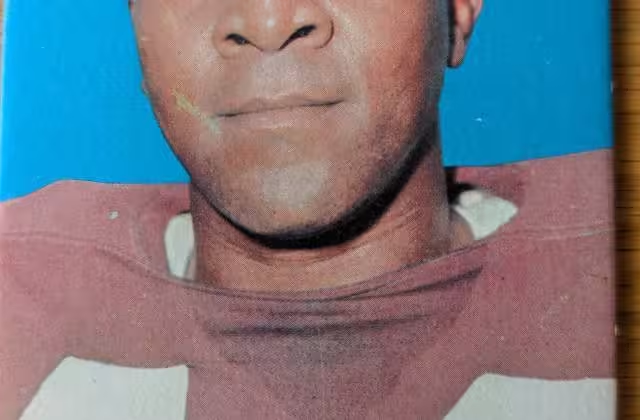
- Marshall Goldberg [1917] – A two-time consensus All-American for Jock Sutherland’s University of Pittsburgh powerhouses, Goldberg led Pitt to the 1937 national championship as the cornerstone of the famed “Dream Backfield.” Enshrined in the College Football Hall of Fame in 1958, he went on to star for the Chicago Cardinals, helping capture the 1947 NFL Championship as part of their “Million Dollar Backfield.”
- Bob Steuber [1921] – A consensus First-Team All-American halfback at Missouri, Steuber led the nation in scoring in 1942 and had his No. 37 jersey retired by the Tigers. A 1971 College Football Hall of Fame inductee, he was selected in the first round of the 1943 NFL Draft and won championships with both the 1943 Chicago Bears (NFL) and the 1946 Cleveland Browns (AAFC).
- Gifford Nielsen [1954] – A record-setting All-American quarterback under LaVell Edwards at BYU, Nielsen helped pioneer the Cougars’ high-octane passing attack that transformed college football offenses in the late 1970s. Inducted into the College Football Hall of Fame in 1994, he spent six seasons in the NFL as a quarterback for the Houston Oilers.
- Pat Swilling [1964] – An All-American pass rusher at Georgia Tech and 2009 College Football Hall of Fame inductee, Swilling terrorized NFL offenses as a foundational outside linebacker in the New Orleans Saints’ legendary “Dome Patrol”. He was named the 1991 NFL Defensive Player of the Year after recording 17 sacks, earning five Pro Bowl nods and finishing his career with 107.5 sacks.
Conclusion
From the end of the Yale Bulldogs’ string of victories to the stunning defeat of a 32-game Army winning streak by a determined Columbia squad in 1947, October 25 delivers a spectacular lesson in football history. This date showcases the power of the underdog and the enduring significance of Hall of Fame talent. October 25 remains a crucial anchor point, reminding us that every date on the calendar holds a piece of the gridiron’s rich, competitive soul.
October 25 Gridiron Image of the Day

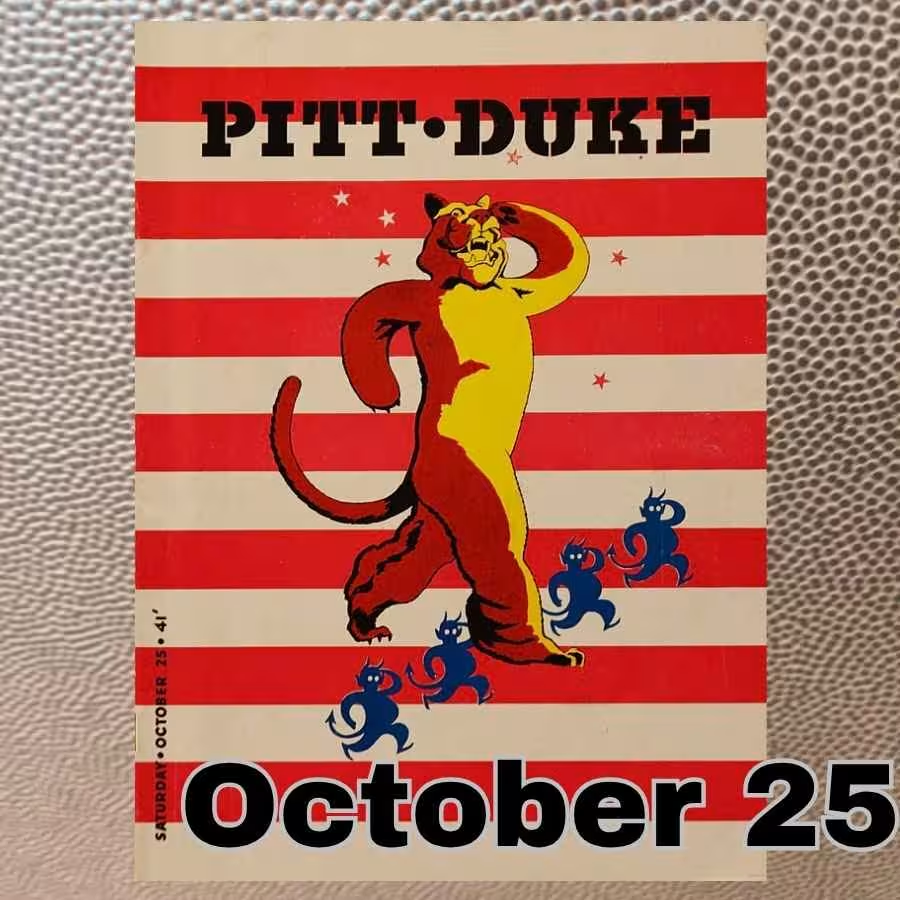
Published cooperatively by the Athletic Departments of the University of Pittsburgh and Carnegie Institute of Technology. Frank F. Carver (Editor) and D. W. Scott (Director of Publication). Public domain via Wikimedia Commons