Although students at Iowa Agricultural College (now Iowa State University) played informal intramural rugby-style football as early as the 1870s, the school’s organized varsity program officially launched in 1892.
Founding and First Games
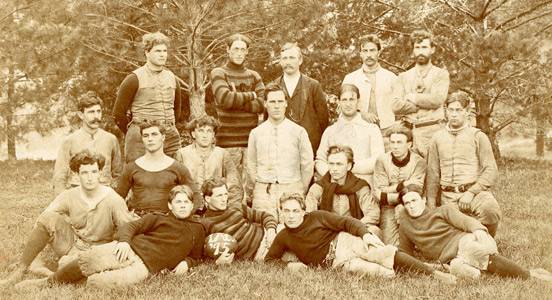
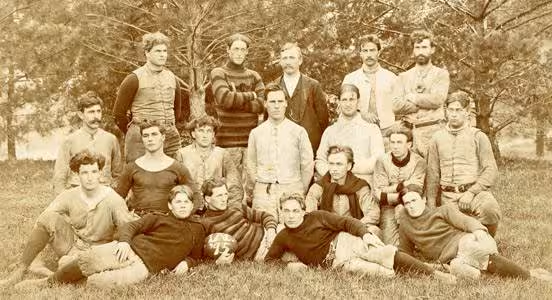
Student-athlete Ira C. Brownlie introduced organized football to the Ames campus in 1892, serving simultaneously as head coach, team captain, and starting end. That inaugural squad played just two contests against non-collegiate opponents on a campus field where Parks Library stands today. Iowa State opened with a 6–6 tie against a town team from State Center on July 1, 1892, before earning its first victory, a 30–0 shutout of the Des Moines YMCA, finishing 1–0–1. By 1894, the program entered intercollegiate competition, defeating the University of Iowa 16–8 in Iowa City in the inaugural meeting of the Cy-Hawk rivalry.
The “Cyclones” Nickname Origin
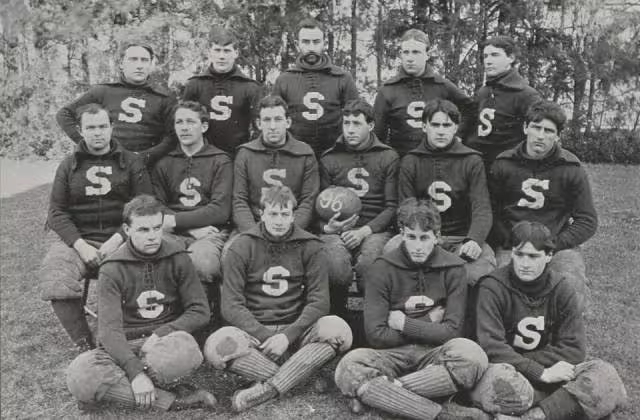
Originally known informally as the Cardinals—a nod to the school’s cardinal and gold colors—the team earned its enduring moniker during a landmark upset in 1895. That year, Iowa had been battered by an unusually high number of devastating tornadoes, then commonly called cyclones. On September 28, 1895, Iowa State traveled to Evanston, Illinois, as heavy underdogs against Northwestern University and shocked the hosts 36–0. The next morning, the Chicago Tribune ran the headline: “Struck by a Cyclone: It Comes from Iowa and Devastates Evanston Town,” declaring that Northwestern “might as well have tried to play football with an Iowa cyclone”. The nickname stuck immediately.
Early Coaches and Stars
The program’s early credibility owed much to Glenn “Pop” Warner, who began his legendary college coaching career at Iowa State in 1895. Under a split-season arrangement, Warner coached in Ames during August and September before heading south to coach Georgia in October and November—a setup that lasted through 1899. Later, Clyde Williams (1907–1912) elevated the program to its peak of early success, capturing back-to-back Missouri Valley Conference co-championships in 1911 and 1912—still the only football conference titles in school history.
Several pioneering athletes defined those formative decades:
- Leigh “Polly” Wallace: A dominant center who earned All-Missouri Valley Conference honors across multiple seasons (1917, 1920, 1921) and became Iowa State’s first consensus All-American in 1920.
- Jack Trice: Iowa State’s first African American varsity athlete. A standout lineman recruited by coach Sam Willaman, Trice sustained fatal internal injuries during his second collegiate game against Minnesota on October 6, 1923, dying two days later. His sacrifice and pregame letter pledging “I will” are permanently honored at Jack Trice Stadium.
Big shoutout and thanks to the information I got here from Iowa State Athletics and the Iowa State Historical Exhibits page.