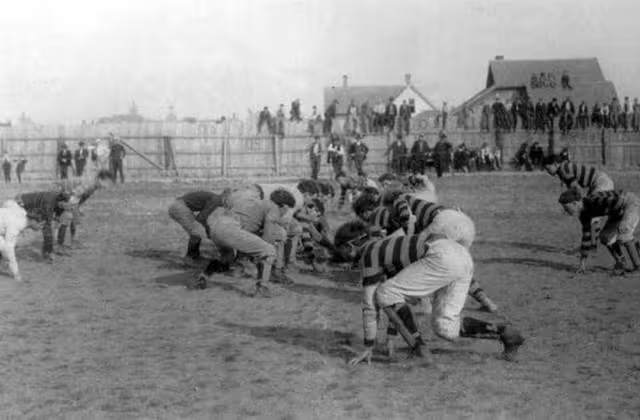
The University of Kentucky football program traces its roots to November 1881, when the school was still known as the Agricultural and Mechanical College of Kentucky (Kentucky A&M). Following an exhibition between neighboring schools a year prior, an enterprising group of Kentucky A&M students assembled the institution’s inaugural squad. With no official coach, standard uniforms, or formal athletic department, the team took the field on November 12, 1881, against cross-town rival Kentucky University (later renamed Transylvania University). The fledgling A&M squad dropped that historic first contest 7¼ to 1 under early rugby-style scoring rules, yet finished their three-game maiden autumn with a 1–2 record.
After that initial flurry, the sport lapsed on campus for nearly a decade until students revived it in 1891. That resurrection cemented Kentucky’s visual identity. Prior to a December matchup against Centre College, students gathered to choose team colors. When someone asked what shade of blue they should use alongside yellow, star lineman Richard C. Stoll famously pulled off his blue necktie and held it high. The student body voted to adopt that royal blue on the spot, later discarding yellow for white in 1892. Stoll would become one of the program’s most revered figures, eventually serving on the university’s board of trustees for more than five decades and lending his name to Kentucky’s longtime home venue, Stoll Field.
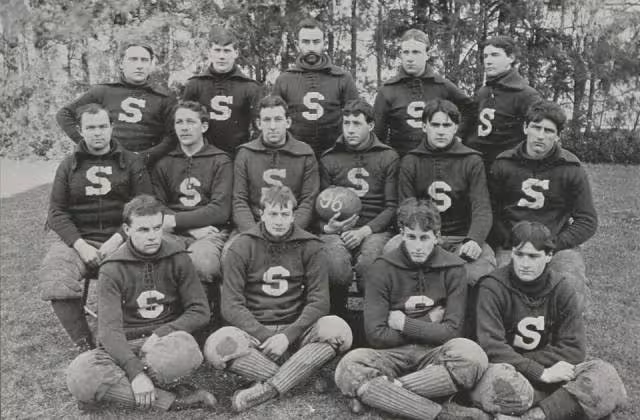
The early coaching lineage began formally in 1892 when geology professor Arthur M. Miller volunteered as the program’s first official head coach. While early coaching tenures were brief, the program reached national prominence in 1898 under head coach William R. Bass. Bass guided the legendary squad known simply as “The Immortals.” Averaging barely 147 pounds per man, the 1898 team went 7–0, outscoring opponents 180–0. To this day, they remain the only undefeated, untied, and unscored-upon team in program history.
Another monumental coaching figure arrived in 1909: Edwin Sweetland, who also served as the school’s first director of athletics. Sweetland brought a disciplined, modern scheme to Lexington, immediately setting the stage for the program’s most defining christening. On October 9, 1909, Sweetland took Kentucky into Urbana to challenge the heavily favored University of Illinois. Kentucky shocked the football world with a gritty 6–2 road upset.
Upon the team’s triumphant return to campus, Commandant Philip W. Carbusier, head of the university’s military department, addressed an enthusiastic assembly during a chapel service. Carbusier passionately told the crowd that the victorious players had “fought like wildcats” against the Midwestern powerhouse. The phrase captivated the campus, local newspapers quickly adopted it in game recaps, and the university soon formalized “Wildcats” as the official athletic moniker.
As the program matured into the 1910s under coach John J. Tigert, individual stars captured regional attention. Chief among them was quarterback William “Doc” Rodes, a dynamic scrambler and punter who earned All-Southern honors in 1916 alongside team captain Charles C. Schrader. Rodes was so electric that legendary Vanderbilt coach Dan McGugin famously proclaimed him the greatest player in the South. From an informal student club in 1881 to an immortal defense and a ferocious nickname, the program built the traditions that still anchor Kentucky football today.