From the historic naming of a rival league to the birth of iconic Super Bowl champions, August 22 marks a monumental day in football history. On this day in 1959, Lamar Hunt and charter organizers officially established the American Football League (AFL), igniting a decade-long war that transformed professional football forever. Combined with Chicago College All-Star Game blowouts, a legendary 131-yard CFL return, and the birthdays of titans like Bill Parcells and Mel Hein, August 22 delivers a deep dive into the sport’s rich, competitive heritage.
August 22 American Football History Timeline
- August 22, 1947 – The College All-Star Game in Chicago is played, as the Chicago Bears, the champions of the NFL, win over the College All-Stars, 16 to 0, at their home stadium, Soldier Field. Claude Young, the running back out of the nearby University of Illinois, was the game’s most valuable player for the College All-Stars.
- August 22, 1948 – The 15th edition of the Chicago College All-Star Game is played in the Windy City at Soldier Field once again. The hometown Chicago Cardinals, then NFL champions, soundly defeated their young opponents, 28 to nil, with a large crowd of 101,220 looking on. The game’s most valuable player, always a College All-Star, was running back J. Rodmeier of the University of Kentucky.
- August 22, 1949 – The Chicago College All-Star Game pitted the champion Philadelphia Eagles, this time, against the College players in a 30- 0 rout by the champs. Notre Dame’s offensive line stalwart, Bill Fisher, was named the All-Stars MVP.
- August 22, 1958 – The Canadian Football League had a record field goal return, when the Toronto Argonauts had two returners combined for 131 yards, as Boyd Carter ran 15 yards, and then lateraled the ball to teammate Dave Mann, who scurried for an additional 116 yards to pay dirt, in a thrilling 15- 14 win over the Montreal Alouettes in Toronto.
- August 22, 1959 – The American Football League is officially named at a meeting in Dallas, Texas, as the charter members, Los Angeles, Houston, Dallas, Denver, Minneapolis-St. Paul, and New York all met to discuss forming the league. Team owners and founding organizers gathered for a historic organizational meeting in Dallas, Texas, where they officially voted to name the new rival circuit the American Football League (AFL). Spearheaded by Lamar Hunt, this crucial administrative milestone established the league’s identity ahead of its inaugural 1960 season and set into motion the decade-long competition that permanently reshaped pro football.
- August 22, 1984 – USFL Owners Vote to Move to a Fall Schedule – In one of the most fateful business decisions in pro football history, team owners of the United States Football League (USFL) voted to abandon their successful spring schedule and transition to an autumn season starting in 1986. Spearheaded by New Jersey Generals owner Donald Trump, the controversial move was intended to challenge the NFL directly on network television and force a merger. Still, it ultimately triggered the antitrust trial and the upstart league’s premature demise.
- August 22, 1988 – Former NBC Football commentator Bob Costas gets his own show on the network called Later.
- August 22, 1994 – Former Buffalo Bills and USC Trojan running back O.J. Simpson is linked to the murder of his wife, Nicole, and friend, Ron Goldman, by the use of DNA evidence.
- August 22, 2003 – Lincoln Financial Field in Philadelphia opens for a preseason game, pitting the New England Patriots against the hometown favorite, the Philadelphia Eagles.
August 22 Hall of Fame Birthdays
Happy Birthday to these legendary gridiron icons and trailblazers! As we look ahead to August 22, we celebrate a lineup featuring early college football pioneers, dual Hall of Fame trench masters, iconic Super Bowl-winning head coaches, and electric record-setting receivers.
Here is the list in order of birth:
- Henry Seibels [1876] – The captain and halfback of Sewanee’s legendary 1899 “Iron Men,” Seibels led his undefeated squad on a grueling six-day road trip that produced five shutout wins over Texas A&M, LSU, Tulane, Ole Miss, and Texas. Inducted into the College Football Hall of Fame in 1973, his leadership anchored one of the most mythical and dominant seasons in Southern football history.
- Don Lourie [1899] – A consensus All-American quarterback for Princeton, Lourie was heralded by Walter Camp as a brilliant field general capable of dissecting opposing defenses at will. Inducted into the College Football Hall of Fame in 1974, he famously pioneered one of the sport’s earliest trick audibles against Yale to score a fake field goal touchdown, later rising to become president of the Quaker Oats Company.
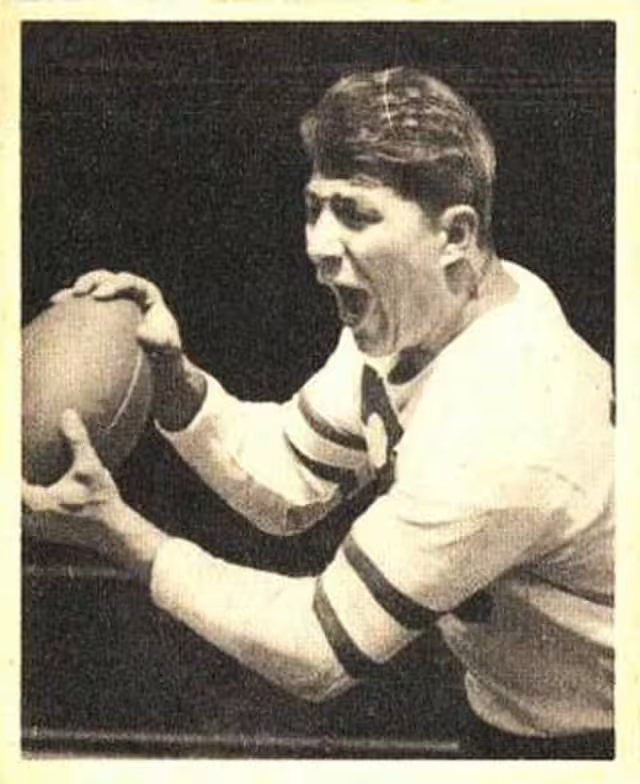
- Mel Hein [1909] – One of the greatest two-way centers and linebackers in football history, Hein played 15 dominant seasons with the New York Giants, earning eight consecutive First-Team All-Pro selections (1933–1940) and the 1938 NFL MVP award. A charter member of the Pro Football Hall of Fame (1963) and a College Football Hall of Fame inductee (1954), he was selected to the NFL’s 50th, 75th, and 100th Anniversary All-Time Teams.
MEL HEIN
- Bill Parcells [1941] – Known as “The Big Tuna,” Parcells built a Hall of Fame coaching legacy defined by mental toughness and tactical discipline, guiding the New York Giants to two Super Bowl championships (XXI and XXV). Enshrined in Canton in 2013, he achieved the rare feat of leading four different franchises (Giants, Patriots, Jets, and Cowboys) to the postseason while serving as a franchise-building architect.
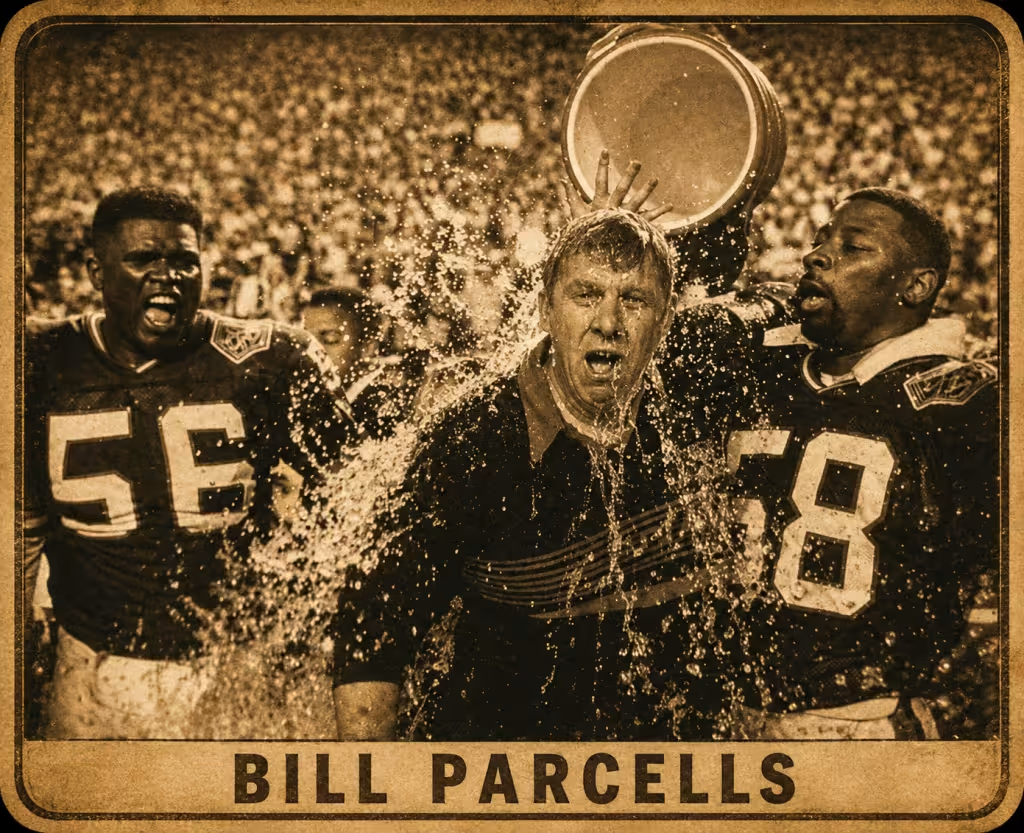
BILL PARCELLS
- Wes Chandler [1956] – An explosive, playmaking wideout for the Florida Gators and a College Football Hall of Fame inductee (2015), Chandler brought his electric speed to the NFL primarily as a centerpiece for Don Coryell’s “Air Coryell” aerial assault with the San Diego Chargers. A four-time Pro Bowler, he retired ranked 12th in all-time NFL receiving yards, highlighted by a historic 1982 strike-shortened campaign where he averaged 129 receiving yards per game.
Additional Birthday of note:
- Maxx Crosby [1997] – Selected in the fourth round of the 2019 NFL Draft out of Eastern Michigan, Crosby quickly emerged as a cornerstone pass rusher and defensive leader for the Raiders. A multi-time Pro Bowler and All-Pro edge defender known for his relentless motor, he has consistently ranked among the league leaders in sacks and tackles for loss.
Conclusion
The milestones of August 22nd showcase football’s evolution through grassroots innovation, organizational warfare, and individual greatness. From the tactical brilliance of Sewanee’s Iron Men to the championship culture forged by “The Big Tuna,” this date bridges the sport’s earliest pioneer days with modern gridiron dominance. Remembering these foundational events and Hall of Fame legends highlights how bold leadership and relentless competitive fire continue to shape the game we celebrate today.