The 1982 American football season was one of the most unusual and dramatic years in the history of the sport. The NFL navigated a historic labor dispute that fundamentally altered its season, while college football delivered legendary performances and what is arguably the most famous single play in gridiron history.
The NFL Strike and the “Super Bowl Tournament”
In the NFL, the season was defined by a 57-day players’ strike that began after Week 2. The dispute over revenues and player compensation forced the league to cancel seven weeks of games, resulting in an abbreviated nine-game regular season.
- The Super Bowl Tournament: To accommodate the shortened schedule, the NFL temporarily abandoned its divisional structure. Instead, the top eight teams from both the AFC and NFC were seeded into a special 16-team playoff bracket, officially dubbed the “Super Bowl Tournament.”
- Super Bowl XVII: The Washington Redskins, led by head coach Joe Gibbs and the power running of John Riggins, defeated the Miami Dolphins 27–17 at the Rose Bowl. Riggins was named Super Bowl MVP after a legendary 43-yard touchdown run on fourth down.
- A Kicker Wins MVP: In one of the most bizarre footnotes in NFL history, Washington placekicker Mark Moseley was named the NFL’s regular-season Most Valuable Player—the first and only time a pure kicker has won the award.
College Football: Penn State’s First Title and “The Play”
The 1982 college football season featured dominant teams, incredible individual talents, and an unforgettable rivalry game.
- Penn State’s Championship: Head coach Joe Paterno led the Penn State Nittany Lions to an 11–1 record. They claimed the consensus National Championship by defeating the undefeated Georgia Bulldogs 27–23 in the Sugar Bowl.
- Heisman Trophy: Georgia’s superstar running back Herschel Walker won the Heisman Trophy after a dominant junior season, amassing 1,752 rushing yards and 16 touchdowns. Stanford quarterback John Elway finished second in the voting.
- “The Play”: On November 20, 1982, the California Golden Bears and Stanford Cardinal played a game that ended with the most chaotic sequence in sports history. Trailing 20–19 with four seconds left, Cal fielded a squib kick and executed five lateral passes on the return. Believing the game was over, the Stanford marching band rushed onto the field. Cal’s Kevin Moen received the final lateral, weaved through the confused musicians, and famously ran over trombonist Gary Tyrrell in the end zone to secure a 25–20 walk-off victory.
1982 Gridiron Memorable Moments
Beyond the champions and the historic moments, 1982 offered plenty of other incredible highlights:
- The Snowplow Game: In December, a snowy game between the New England Patriots and Miami Dolphins was decided when Patriots head coach Ron Meyer ordered a stadium worker (a convict on work release) to drive a John Deere tractor onto the field to sweep a clean spot for kicker John Smith. The 3–0 win infuriated the Dolphins and led the NFL to ban the practice.
- John Elway’s Farewell: Stanford’s legendary quarterback John Elway finished his college career without ever playing in a bowl game—denied by “The Play”—but ultimately became the number one overall pick in the famous 1983 NFL Draft.
- The Los Angeles Raiders: This was the first season the Raiders played in Los Angeles after relocating from Oakland. Behind the standout play of rookie Marcus Allen, they secured the number one seed in the AFC but were upset by the New York Jets in the playoffs.
A Deep Dive into 1982 Football History and Highlights
- January 1, 1982 – The Rose Bowl held its annual game, and the Washington Huskies pounded the Iowa Hawkeyes 28-0, with Jacque Robinson of Washington named Player of the Game.
- January 2, 1982 – In 85-degree Fahrenheit heat, the San Diego Chargers defeated the Miami Dolphins 41-38 in overtime during the AFC Divisional Playoff Game, later known as “The Epic in Miami.” This game set numerous playoff scoring records.
- January 10, 1982 – Riverfront Stadium, Cincinnati –The San Diego Chargers traveled to face the Cincinnati Bengals in the AFC Championship Game. FullPressCoverage.com notes that game-time temperatures were -9°F, with persistent 27 MPH winds creating a wind chill of -59°F. Compared to the 1967 ‘Ice Bowl’ at -13°F, the ‘Freezer Bowl’ is recognized as the coldest NFL game by wind chill. The Chargers, less accustomed to such conditions, struggled, while Bengals head coach Forrest Gregg, who had played in the Ice Bowl, prepared his team well. Leveraging home-field advantage, the Bengals defeated the Chargers, 27-7.
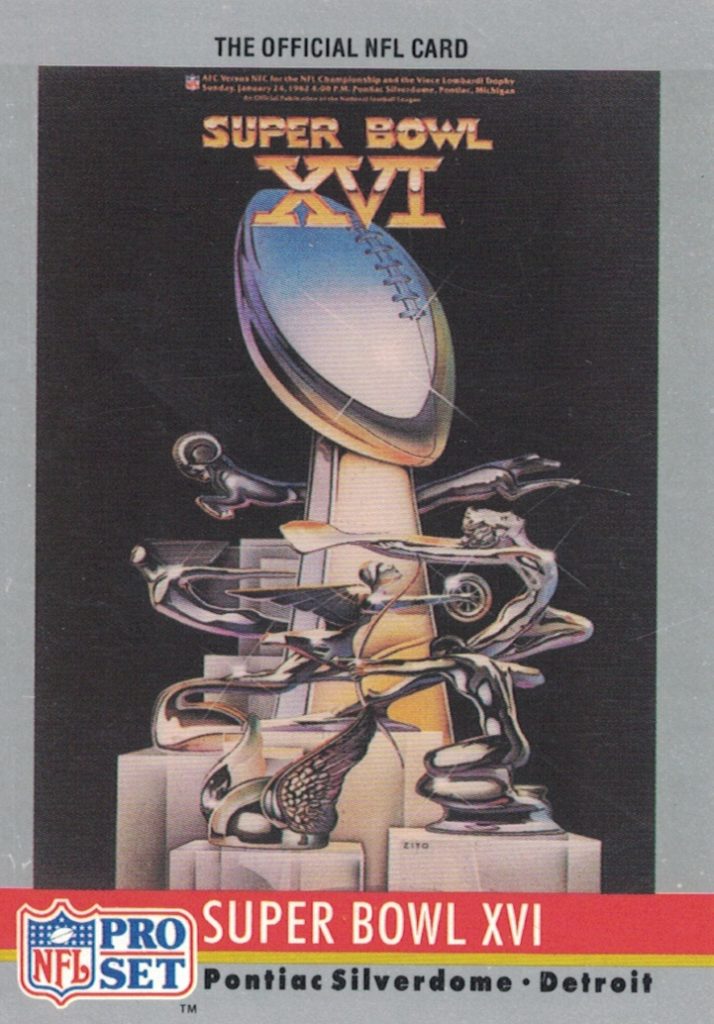
- January 24, 1982 – Pontiac Silverdome, Detroit, Michigan –Super Bowl XVI featured the Cincinnati Bengals against the upstart San Francisco 49ers. For this story, we go to StadiumsofProFootball.com, which says this was the first time the Big Game was moved to a traditionally cold-weather venue. 49erswebzone.com fills us in on the other details: after a sizable first-half lead of 20-0, the 49ers watched as the Bengals heated up in the second half to score 21 points of their own. But two Ray Wersching field goals in the fourth quarter preserved the San Francisco victory over the Bengals, 26-21. Niners legend Joe Montana was named the game’s MVP after throwing for 1 TD and posting a QB rating of 100.0.
- January 31, 1982 – The NFL Pro Bowl was played at Aloha Stadium in Honolulu. The final score was an AFC victory over their NFC counterparts, 16-13. There were Co-MVPs in this game as Kellen Winslow Sr., the tight end of the San Diego Chargers, shared the honor with Lee Roy Selmon, the standout defensive end of the Tampa Bay Buccaneers.
- March 5, 1982 – The First NFL Scouting Combine: While the modern “Combine” as we know it is a massive TV event, the foundation was laid on March 5, 1982, when the National Football Scouting (NFS) held its first centralized camp in Tampa, Florida. It brought 163 players together for medical exams and drills, forever changing how teams evaluate talent.
- April 27, 1982 – The League’s annual disbursement of college players kicked off in New York for the 1982 NFL Draft. University of Texas defensive end Kenneth Sims was the first pick by the New England Patriots.
- July 31, 1982 – Teams from Germany, France, Austria, and Italy formed the American European Football Federation (AEFF).
- August 7, 1982 – The Pro Football Hall of Fame enshrined the following football legends:
Doug Atkins, Sam Huff, George Musso, and Merlin Olsen. - September 19, 1982 – That’s the very first time the New Orleans Saints posted a road shutout in the franchise’s history, and that shutout was against the Chicago Bears, when they blanked the Bears 10-0 on this day.
- September 21, 1982 – NFL players began a 57-day strike on this day. The strike forced the NFL to shorten the usually 16-game schedule to a condensed 9-game regular season and placed 16 teams into a special playoff format. Eight teams from each Conference were seeded, and divisional standings were ignored. The Detroit Lions and the Cleveland Browns each made the playoffs with losing records. The NFL champion was still decided in a final game, though, as Super Bowl XVII, played at the Rose Bowl, was won by the Washington Redskins 27-17 over the Miami Dolphins.
- September 25, 1982 – Northwestern University breaks its 34-game losing streak by knocking off Northern University 31-6. Dennis Green coached the Wildcats, and his preparation led to his Northwestern squad overcoming the longest losing streak in Division I football.
- November 16, 1982 – The 1982 NFL players’ strike officially ended. The strike lasted 57 days and shortened the season from 16 to just 9 regular-season games.
- November 20, 1982 – The Play or The Stanford Band Game – Stanford Cardinal Quarterback John Elway moved his team down the field and into field-goal range with just eight seconds remaining, allowing Mark Harmon to kick a 35-yard field goal and give Stanford the lead at 20-19. It looked like the Cardinal had the upset victory in the bag, according to history.com’s segment on the play. Elway and friends may have scored just a hair too fast, as the Cardinals still would need to kick the ball to Cal. They did so in squib-kick fashion, and Cal players used everything in the book on this final play of the game, lateralling the ball five times just as they were about to be tackled. Cal’s Kevin Moen received the final backward toss and started running down the field, when the Stanford band ran out onto the field to celebrate what they thought was a Cardinal victory. Moen weaved through the extra traffic of musicians, even banging into a trombone player, before he finally made it to the end zone! The Bears claimed a come-from-behind victory in the most memorable of fashions!
- November 27, 1982 – Legion Field, Birmingham –“Bo Over the Top” The 47th Iron Bowl was one that maybe best defines the Auburn/Alabama rivalry. Bleacher Report put together a nice article on the game that has all the details, but here are the highlights, according to their story. The setting before the game is that Alabama had basically owned the series for about 25 seasons with Bear Bryant at the helm of the Tide. The Crimson squad seemed poised to chalk up another “W” for their seasoned coach as they outgained the Tigers 507 to 257 total yards in Bryant’s final Iron Bowl before his untimely passing in the upcoming offseason. The stats don’t tell the whole story, though, unless you look at a young Tigers halfback named Bo Jackson, who racked up 144 yards and a TD near the end to seal a 23-22 Auburn victory over their rivals. This was Auburn’s first win in the Iron Bowl in 10 years! Bo knows how to break streaks!
- November 28, 1982 – CFL Grey Cup, CNE Stadium, Toronto: Edmonton Eskimos’ record 5th straight Championship; defeat Toronto Argonauts, 32-16.
- December 4, 1982 – The Heisman Trophy went to the University of Georgia’s outstanding running back, Herschel Walker.
- December 5, 1982 – Cleveland Municipal Stadium –Cleveland Browns’ Quarterback Brian Sipe set a new franchise record when he had 33 pass completions on 48 attempts for 338 yards with one touchdown and 2 interceptions. The Chargers backfield tandem of Chuck Muncie and James Brooks each had two touchdown runs as San Diego stole this one 30-13 per Pro-Football-Reference.com.
- December 12, 1982 – The Snow Plow Game – The New England Patriots defeated the Miami Dolphins in a Foxborough snowstorm with a last-second field goal aided by a grounds crew member on a tractor to clear snow.
- December 19, 1982 –A memorable moment in Redskins lore occurred when kicker Mark Moseley set a then-NFL record by making his 21st consecutive field goal — a 42-yard game-winner that helped Washington enter the playoffs.