The 1949 American football season was a pivotal year of transition, dominance, and impending structural change across both professional and collegiate grids. It marked the final chapter of a bitter pro-sports war. It also marked the continuation of legendary college dynasties.
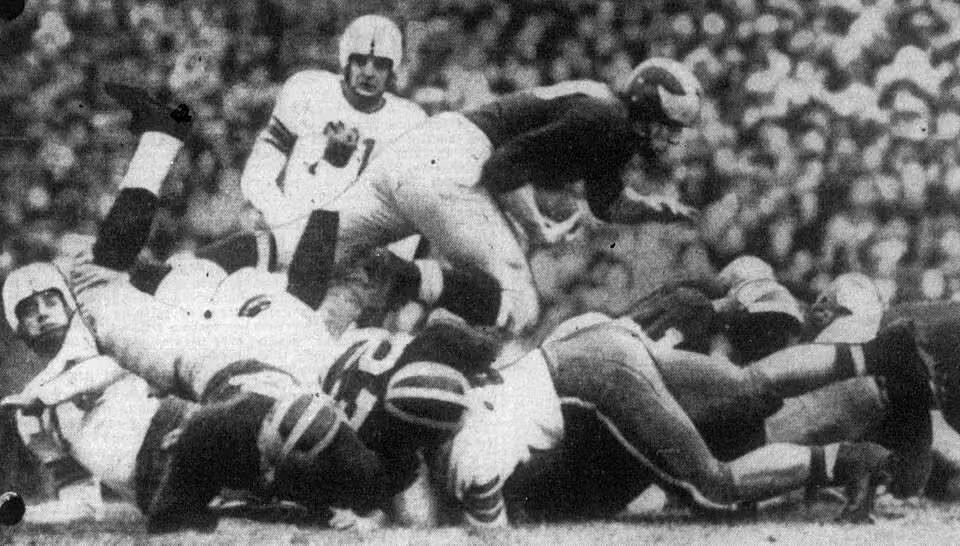
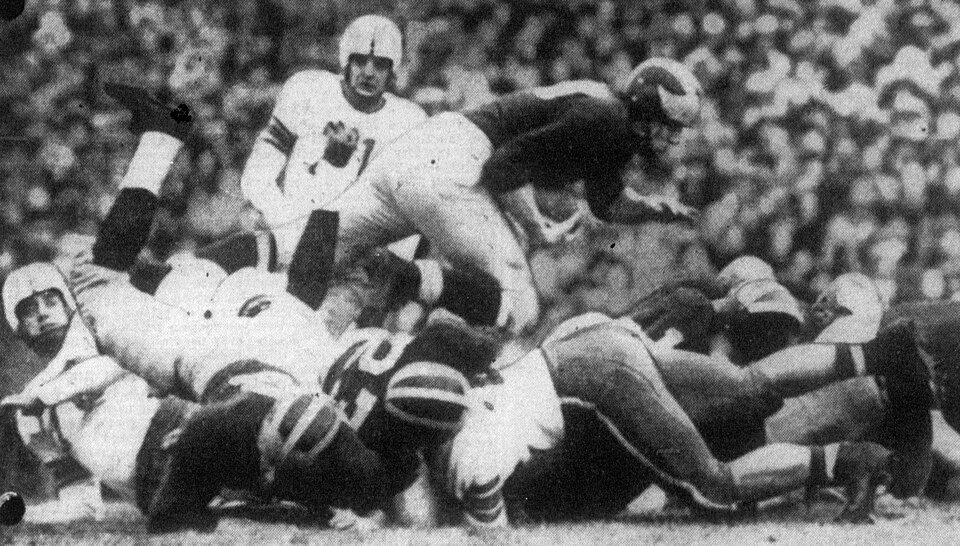 Chuck Ortmann (center, with ball) picks up five yards during a game against the Ohio State Buckeyes on November 19, 1949 at Michigan Stadium in Ann Arbor, Michigan.” class=”wp-image-19589″ style=”width:628px;height:auto”/>
Professional Football: The End of an Era
The biggest storyline of 1949 was the conclusion of the costly four-year war between the established National Football League (NFL) and the upstart All-America Football Conference (AAFC).
The NFL Championship
In the NFL, the Philadelphia Eagles successfully defended their title. Led by head coach Greasy Neale and star running back Steve Van Buren, the Eagles braved a torrential mudslide of a game. They defeated the Los Angeles Rams 14–0 in the NFL Championship Game on December 18, 1949. Van Buren rushed for a championship-record 196 yards in the pouring rain.
The AAFC’s Final Stand
Meanwhile, the AAFC played its final season. The Cleveland Browns, coached by Paul Brown and quarterbacked by Otto Graham, cemented their absolute dominance by winning their fourth consecutive AAFC title. They did this by defeating the San Francisco 49ers 21–7. Deciding that competition was cannibalizing profits, the two leagues struck a peace deal on December 9, 1949. The AAFC dissolved. Importantly, three of its teams—the Cleveland Browns, San Francisco 49ers, and Baltimore Colts—were absorbed into the NFL for the 1950 season.
College Football: Notre Dame’s Unbeaten Run
On the collegiate side, the Notre Dame Fighting Irish ruled supreme under legendary head coach Frank Leahy.
- The National Championship: Notre Dame completed a perfect 10–0 season, capturing the AP National Championship. They outscored their opponents 360 to 86.
- The Heisman Trophy: Notre Dame’s star end, Leon Hart, won the Heisman Trophy. He remains one of only two linemen in college football history to win the award.
- The Bowl Games: In the Rose Bowl on January 2, 1950, Ohio State defeated California 17–14. Meanwhile, undefeated Oklahoma capped a stellar season by crushing LSU 35–0 in the Sugar Bowl.
A Deep Dive into 1949 Football History and Highlights
The 1949 season fundamentally reshaped the landscape of American football. The merger of the AAFC and NFL consolidated professional football under one definitive banner. Consequently, this set the stage for the modern NFL’s explosive growth in the 1950s. In college football, Notre Dame’s dominance and Leon Hart’s historic Heisman win closed out the decade with unforgettable individual and team milestones.
- January 1, 1949 – The Rose Bowl played its 35th game, and it was a good one. The Northwestern Wildcats survived the Cal Golden Bears on a game-winning fourth-quarter touchdown.
- January 21, 1949 – According to the Pro Football Hall of Fame, this marks the day that the New York Bulldogs/Yanks franchise began.
- July 12, 1949 – The LA Rams sign Quarterback Norm Van Brocklin to a contract.
- August 12, 1949 – The 16th annual NFL-Chicago College All-Star game was played at Soldier Field as the champion Philadelphia Eagles blanked the All-Stars 38-0 in front of 93,780 paying fans. The most valuable player, always given to the college player team, was Bill Fisher, the offensive lineman from Notre Dame.
- August 22, 1949 – The Chicago College All-Star Game pitted the champion Philadelphia Eagles, this time, against the College players in a 30- 0 rout by the champs. Notre Dame’s offensive line stalwart, Bill Fisher, was named the All-Stars MVP.
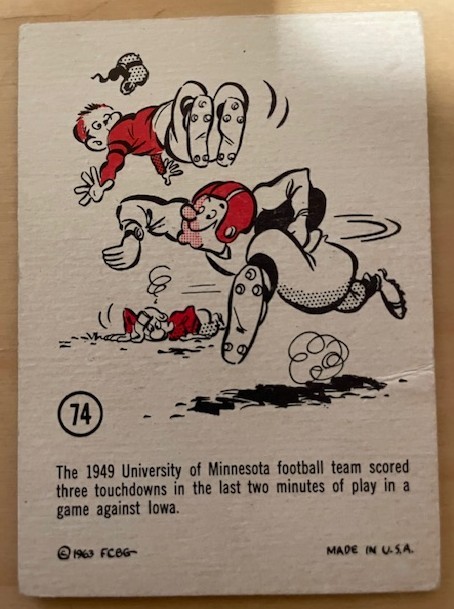
- November 5, 1949 – After suffering two consecutive losses to Michigan and Purdue and getting knocked out of the national rankings, the Minnesota Golden Gophers faced another Big 10 powerhouse in number 15 Iowa in Minneapolis. The Gophers put on an offensive display, winning 55-7 after scoring three touchdowns in the final two minutes. Three Minnesota players were drafted in the first round of the 1950 NFL Draft: Leo Nomellini, Bud Grant, and Clayton Tonnemaker. An additional 10 others were drafted later in the 1950 NFL Draft. (Source)
- November 26, 1949 – Varsity Stadium, Toronto – Our friends at NinetyNineyards.com are all over this story. The Montreal Alouettes outplayed the Calgary Stampeders, 28-15, for their first Championship. Make sure you check out the great piece the Ninety Nine Yards has on this game by clicking their highlighted name.
- November 26, 1949 – Grant Field, Atlanta, Georgia – Georgia Tech was a seven-point favorite at home against their rivals from the University of Georgia, per a report by georgiatechticketstubs.com. The Bulldogs recovered a fumble in the second quarter and then cashed it in to take a 6-0 lead. That is when the cavalry came to the rescue of the stagnant Tech offense. Jim Southard, their injured starting quarterback, came off the bench and breathed a little bit of life into the Yellow Jackets. It finally paid off when, after multiple long drives, the Ramblin’ Wreck finally put the ball across the goal line and made the point after. It was just enough as the final score read Georgia Tech 7, Georgia 6, the victory that started “The Drought” for the Bulldogs and initiated Bobby Dodd’s eight-year mastery of Georgia.
- December 3, 1949 – One win, Auburn edged out their highly-ranked rivals Alabama 14-13 in the 14th Iron Bowl after the Crimson Tide missed a game-tying extra point with less than two minutes remaining.
- December 4, 1949 – Playing for the Pittsburgh Steelers, Bob Gage set an NFL record with a 97-yard touchdown run. Gage executed a fake punt from his own 3-yard line against the favored Chicago Bears and raced for the score.
- December 7, 1949 – The 15th Heisman Trophy Award went to Leon Hart, who played for Notre Dame as an end.
- December 9, 1949 – the NFL absorbed the franchises of the Cleveland Browns, San Francisco 49ers & Baltimore Colts from the rival League, the AAFC, which dissolved due to poor finances. A great story in Sporting Chance Press details the merger: NFL Commissioner Bert Bell reached an agreement for the NFL to merge the Colts, Browns, and Niners into the League. Meanwhile, the other AAFC teams would disband.
- December 11, 1949 – The 1949 AAFC Championship Game was the final title game in the history of the All-America Football Conference. The Cleveland Browns defeated the San Francisco 49ers 21-7 to claim their fourth and final league title before entering the NFL.
- December 18, 1949 – LA Memorial Coliseum, Los Angeles, CA -The LA Rams and the Philadelphia Eagles met for the 1949 National Football League Championship Title. Weather conditions were dreadful, with driving rain turning the grassy field into quite a quagmire. A 1988 Pro Football Researchers Association article on the game in the Coffin Corner Volume 10 shares the story. Over an inch of rain fell in the LA area, and many called for the game to be postponed until Christmas Day. NFL Commissioner Bert Bell had nothing to do with any postponement and ordered the game to go on as scheduled. The Eagles, with their solid defense, were a 7-point betting odds favorite in the contest. What they did was double the win margin as their stifling defense shut down the Rams in a 14-0 victory. The Eagles offense put one touchdown on the board, but the rest was all defense as the Rams were held to a record 21 total rushing yards, and special teams blocked a punt in the second half for the other Philly score.