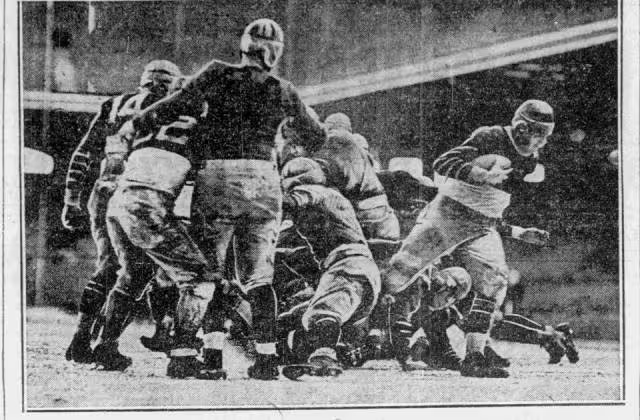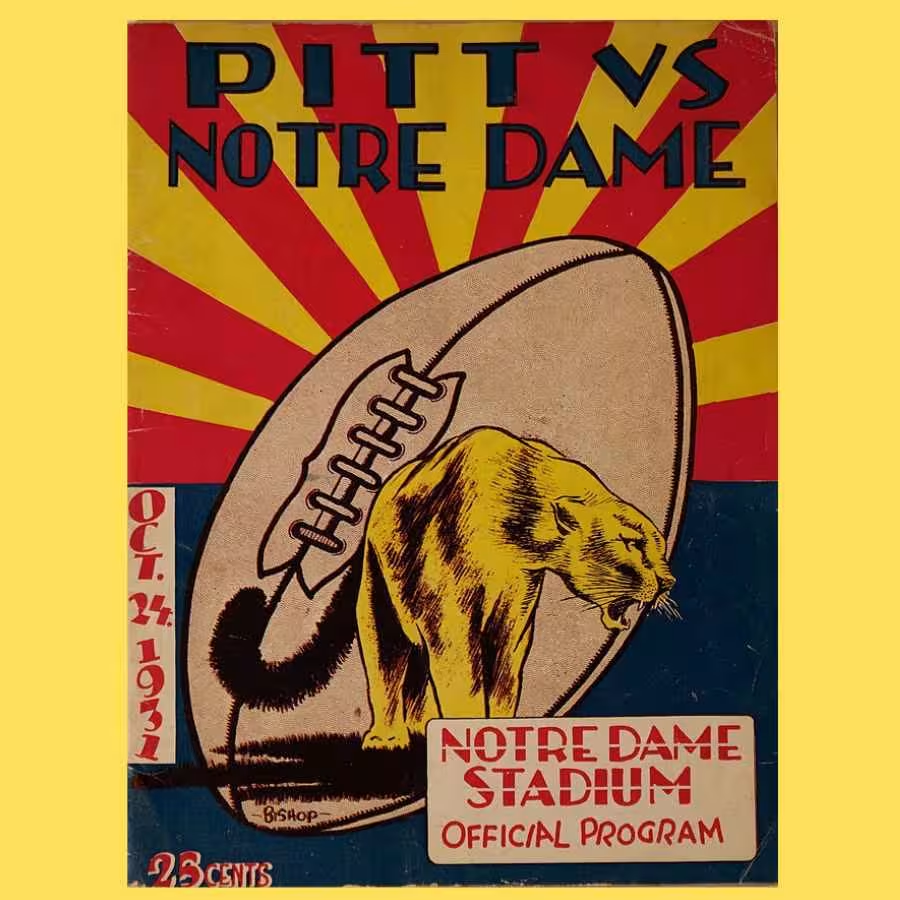
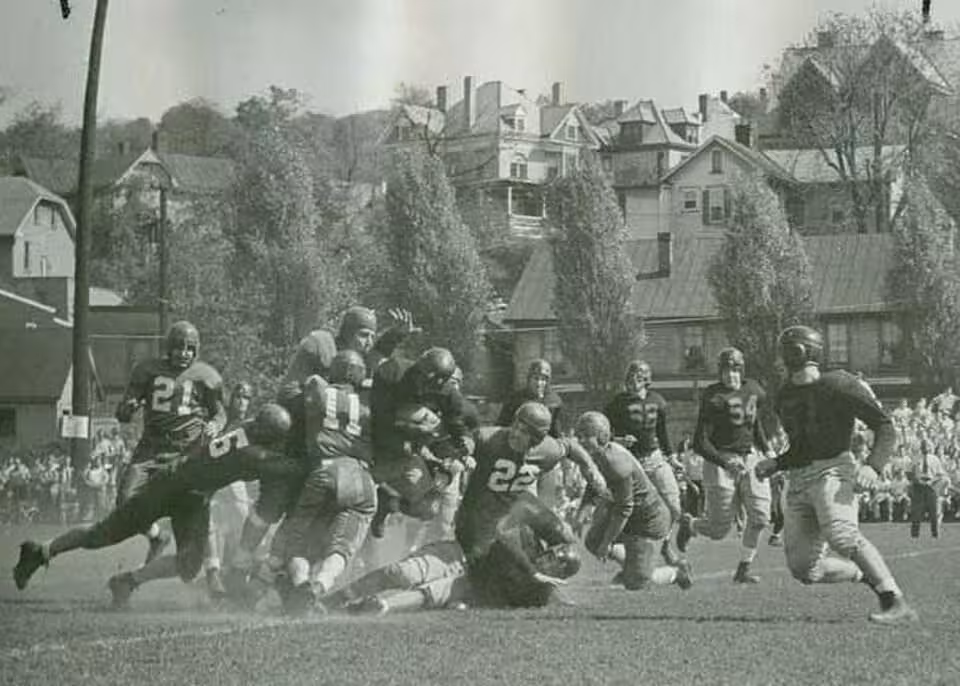
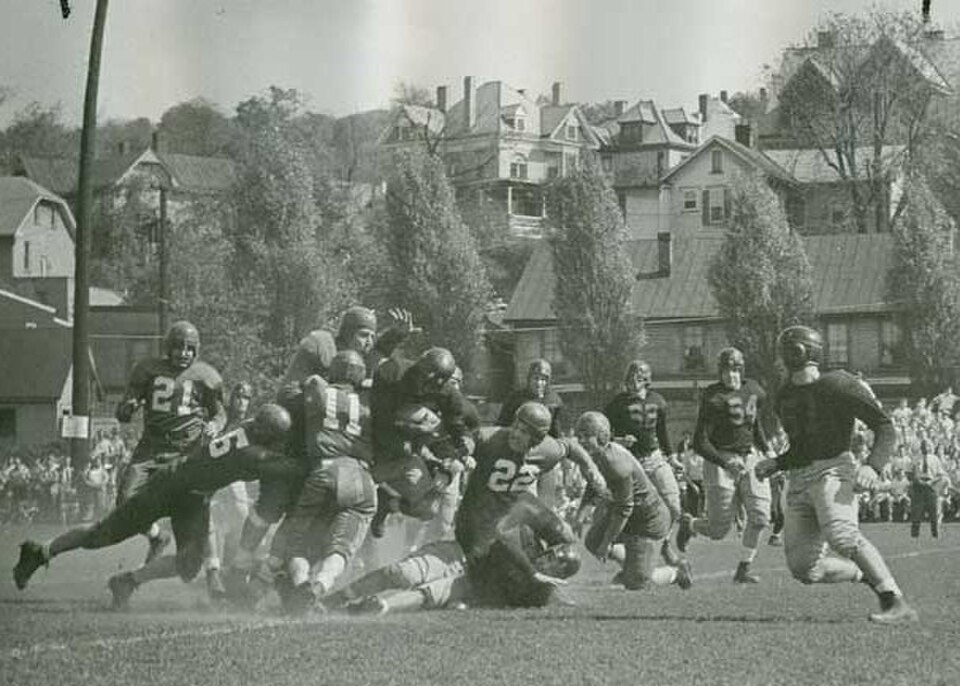
The 1946 American football season was a pivotal, transformative year for both college and professional ranks, heavily influenced by the end of World War II. As millions of servicemen returned home, the sport experienced an unprecedented surge in talent, attendance, and structural evolution.
Professional Football: The Genesis of a Rivalry
- The NFL’s Return to Power: With star players returning from military service (such as organic talent like Sid Luckman and Bob Waterfield), the NFL saw a massive spike in popularity. The Chicago Bears defeated the New York Giants 24–14 in the NFL Championship Game before a record crowd at New York’s Polo Grounds.
- The Birth of the AAFC: The All-America Football Conference (AAFC) launched in 1946 as a direct competitor to the NFL. It featured eight teams, including the Cleveland Browns, coached by Paul Brown and quarterbacked by Otto Graham. The Browns won the inaugural AAFC title, kicking off a dominant dynasty and introducing innovations like advanced scouting and facial guards.
- Integration: The 1946 season marked the reintegration of professional football. The Los Angeles Rams signed Kenny Washington and Woody Strode, breaking the NFL’s color barrier, while the AAFC’s Cleveland Browns signed Marion Motley and Bill Willis.
College Football: The Gridiron Powerhouse Year
- The Return of the Veterans: College rosters were stacked with mature, battle-tested veterans returning via the G.I. Bill. This created some of the most physically dominant teams in college history.
- The National Championship: The Notre Dame Fighting Irish, coached by Frank Leahy and led by Heisman Trophy winner Johnny Lujack, were crowned national champions by the AP Poll.
- The “Game of the Century”: On November 9, 1946, #1 Army and #2 Notre Dame played to a legendary 0–0 tie at Yankee Stadium. Army featured the famous “Touchdown Twins,” Doc Blanchard and Glenn Davis.
- Bowl Games: In the Rose Bowl on January 1, 1947, Illinois dominated UCLA 45–14, representing the first game in the exclusive Big Nine (later Big Ten) and Pacific-5 agreement.
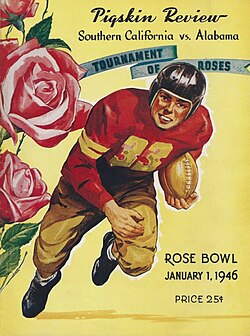 Harry Gilmer, and Pigskin Dispatch archives.” class=”wp-image-19545″ style=”width:400px;height:auto”/>
A Deep Dive into 1946 Football History and Highlights
- January 1, 1946 – The 32nd edition of the Rose Bowl in Pasadena saw the Alabama Crimson Tide derail the USC Trojans, 34-14, with Harry Gilmer voted as the game MVP.
- On January 11, 1946, the NFL announced that Bert Bell had been named the league’s second Commissioner. The Pro Football Researchers Association, in their 1996 Volume 18 edition of the Coffin Corner Magazine, shared a story from the Pro Football Hall of Fame detailing this transition. Elmer Layden, the first Commissioner, ended his tenure when Brooklyn owner Dan Topping withdrew his team to join the All-America Football Conference (AAFC).
- January 12, 1946 – The NFL approved the move of the League Champion Cleveland Rams to Los Angeles.
- January 14, 1946 – The NFL Draft for the 1946 season had Frank Dancewicz, the flashy quarterback from the University of Notre Dame, selected first by the Boston Yanks.
- August 23, 1946 – The Chicago College All-Star game took place on this date at Soldier Field. They shocked the NFL champion Los Angeles Rams 16-0 in front of a crowd of 97,380 fans. The game’s MVP was the college player Elroy “Crazy Legs” Hirsch, a running back from Wisconsin University. And it’s kind of ironic that Crazy Legs Hirsch ended up being a Los Angeles Ram, one of their great wide receivers.
- September 8, 1946 – The San Francisco 49ers make their debut in regular-season professional football as they play the New York Yankees in an AAFC tilt. The Yanks win 21-7.
- September 29, 1946 – The Rams franchise plays its very first game representing the city of Los Angeles.
- October 8, 1946 – The infamous AAFC Miami Seahawks take flight… well sort of.
- October 20, 1946 – Polo Grounds, New York City – Frank Seno returns a kickoff 105 yards for the Chicago Cards vs. the NY Giants. T.J. Troupe wrote a nice piece on Frank Seno on the Pro Football Researchers website in which he writes: “The 1946 Cardinals were a team on the upswing, and on October 20 in the Polo Grounds against the contending Giants in one of the most thrilling contests of the year, Frank Seno set an NFL record with his 105-yard kickoff return for a touchdown. His coast-to-coast return gave the Cardinals a short-lived 24 to 21 lead.” Short-lived indeed as the Giants stormed back with a Howie Livingston 5-yard scamper for a score to lift the New York squad to a 28-24 win over the Cards.
- October 26, 1946 – Knoxville, Tennessee – The Wake Forest Demon Deacons knocked off the highest-ranked opponent in the football program’s history when they defeated the No. 4 in the nation, the Tennessee Volunteers, 19-6. The website godeacs.com has an excellent recount of the game. The Wake Forest line was a block of granite against the Tennessee running attack. Bob Leonetti and Ed Royston, guards; Boyd Allen, center; and Sidney Martin, tackle, refused to let the Vol backs loose for any damaging gains. The Deacon forwards were also terrific in rushing Vol passers. The Deacons scored first in the opening period, and then came back in the third period to register two quick touchdowns to ice the ball game after the Vols had scored their lone marker in the second period to tie the score at 6-6.
- November 9, 1946 — Second-ranked Notre Dame fights to a 0-0 tie with No. 1 Army at Yankee Stadium to snap the Cadets’ 25-game winning streak. The Charlotte Observer’s article goes on to say that the Irish defense holds Army’s running backs, Doc Blanchard and Glenn Davis, to a combined 79 yards.
- November 23, 1946 – The traditional rivalry game between the Pittsburgh Panthers and the Penn State Nittany Lions concluded with a hard-fought 7-7 tie. This result capped Penn State’s undefeated 6-0-2 season, setting the stage for its historic Rose Bowl appearance the following year.
- November 30, 1946 – Notre Dame clinched the first of two straight national titles by romping past USC 26-6 at Notre Dame Stadium.
- November 30, 1946 – The Annual Army-Navy game had National Championship implications. Under legendary coach Red Blaik, the undefeated Black Knights were widely considered the nation’s best team, boasting a tie against rival Notre Dame as their only blemish. Their opponent, the Navy Midshipmen, entered the Municipal Stadium in Philadelphia with a dismal 1-7 record. However, in front of a massive crowd of 102,500—including President Truman, the Chief Justice, and much of the Cabinet—what unfolded was a taut, dramatic struggle that saw Army win the battle but lose the war for the national championship.
- November 30, 1946 – CFL Grey Cup, Varsity Stadium, Toronto: Toronto Argonauts claim 7th Championship and retain title with 28-6 win over Winnipeg Blue Bombers.
- December 3, 1946 – Army halfback Glenn Davis won the 12th Heisman Trophy, recognizing his dominant senior campaign that included 13 touchdowns, over 700 rushing yards, and over 300 receiving yards.
- December 15, 1946 – At the Polo Grounds in New York City, the Chicago Bears defeated the New York Giants 24-14 in the National Football League Championship before a record crowd of 58,346.
- December 16, 1946 – Bob Fenimore, from the University of Notre Dame, was the first pick in the 1947 NFL Draft by the Chicago Bears.
- December 22, 1946 – Cleveland Municipal Stadium – The AAFC championship game was played as the New York Yankees Football club invaded Cleveland to face the Browns for the AAFC Title. The Browns came out victorious as they defeated the Yankees 14-9 in a close one.
- December 28, 1946 – The original Baltimore Colts franchise was formed in the All-America Football Conference (AAFC) as the professional football team representing Baltimore. This Colts team, along with the Cleveland Browns and San Francisco 49ers, was absorbed into the NFL in 1950 when the AAFC dissolved.