Every legendary college football program has an origin story, and Vanderbilt’s began with a cross-town dare. The Vanderbilt football early history starts during a time when, in November 1890, Vanderbilt students were focused on baseball, bicycling, and track. Football was completely foreign to the campus—until Peabody Normal School (the University of Nashville) sent over a formal challenge for a Thanksgiving Day showdown.
Peabody already had years of intramural football experience under its belt, making the invitation feel like a trap. Chemistry professor Dr. William Lofland Dudley thought otherwise. Viewing the challenge as a matter of university pride, Dudley gathered roughly 150 students in the campus gymnasium to debate the offer. Despite concerns over having almost no time to prepare, the student body refused to back down from their neighborhood rivals. Student P.M. Estes made a motion to accept, and the room unanimously tapped Elliott Jones—a student who had previously played the game in Boston—to serve as organizer, captain, and head coach.
With barely any practice time and outfitted in makeshift, shoddy burlap uniforms, Jones’s hastily assembled squad took the field at Nashville’s YMCA Athletic Park (later known as Sulphur Dell) on November 27, 1890. Not only was it Vanderbilt’s debut, but it also marked the first college football game ever played in the state of Tennessee.
Any fears of an embarrassing blowout quickly vanished—at least for Vanderbilt. Led by Jones at fullback and top scorer Horace E. Bemis, the Commodores dominated from start to finish. Under 1890 scoring rules, where touchdowns counted for four points and extra points or field goals were worth two, Vanderbilt piled up an astonishing 40–0 shutout victory.
Local press coverage the next day was understated; the Nashville Banner casually noted that a large crowd watched the contest and that “no one was hurt seriously though some were more or less bruised.” Yet on campus, a gridiron tradition had been born. By accepting a Thanksgiving dare in burlap uniforms, Vanderbilt launched a football legacy that still thrives in the SEC today.
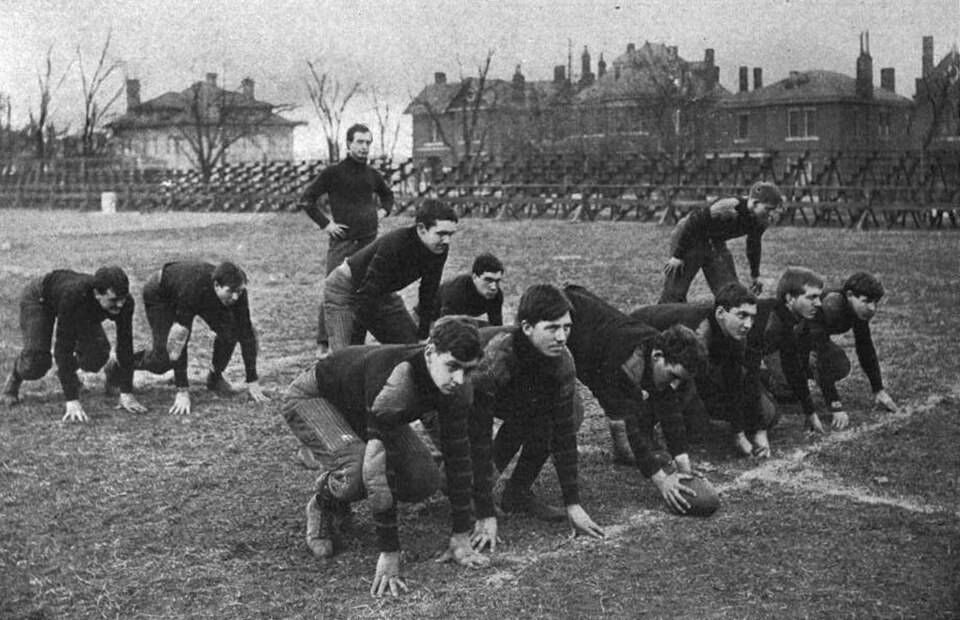
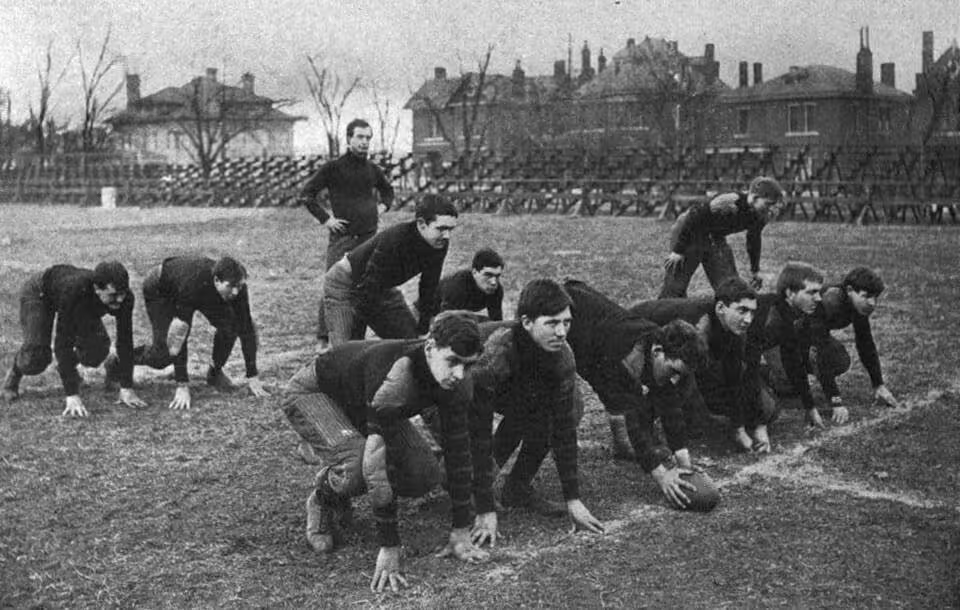
on the line, left to right: Owsley Manier (right end); J. Hamilton Brown (right guard); Robert C. Patterson (center); Stein Stone (left guard); Hillsman Taylor (left tackle); Innis Brown (left end).
in the backfield, left to right: Honus Craig (right halfback); Ed Hamilton (fullback); Frank Kyle (quarterback) (and behind him is Coach Dan McGugin), capt. Irish Graham (right tackle); and Dan Blake (left halfback).
This image came from the legendary Fielding Yost.
1891 Season and the Commodore Name
The Thanksgiving Day game sparked such an interest in football that the school fielded an official team in 1891. On November 7, 1891, the Vandy team traveled and then took the field against Sewanee, defeating the Tigers 22-0 and starting a long rivalry.
Vanderbilt University’s football team adopted the nickname Commodores to honor the university’s founder, Cornelius Vanderbilt. In 1873, Vanderbilt donated $1 million to establish the school in Nashville. Before building his railroad empire, he amassed a fortune in shipping and commanded the largest schooner on the Hudson River, earning the nickname “the Commodore”—the highest U.S. Navy rank of that era.
In the late 1890s, former Vanderbilt quarterback and Nashville Banner newspaperman William E. Beard began referring to the school’s athletes as the “Commodores”. The name stuck, eventually inspiring the uniformed naval mascot known today as Mr. C.
Here Are More Stories of Vanderbilt Commodore Football Legends
- Bill Spears: Vanderbilt’s Bounding Hall of Fame QB
- Josh Cody: Vanderbilt Football Legend & Hall of Famer
- The Anchor of the Iron Men: The Legend of Carl Hinkle
- John Tigert: The Vanderbilt Halfback Who Invented the Athletic Scholarship
- Lynn Bomar: The Tennessee Terror and Vanderbilt’s First All-American Legend