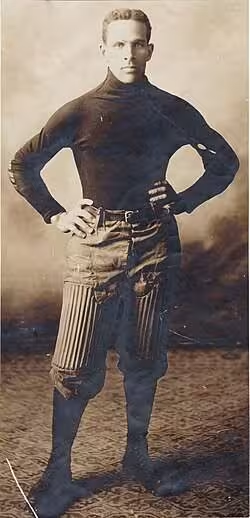
- A brilliant, diminutive field general who pioneered early gridiron strategy and led both the Carlisle Indians and Northwestern Wildcats with legendary poise.
James E. “Jimmy” Johnson was born on June 6, 1879, in Edgerton, Wisconsin. Despite standing just 5 feet 7 inches tall and weighing 138 pounds, the Stockbridge Indian native became one of the most crafty, formidable, and revered field leaders of college football’s early gridiron era.
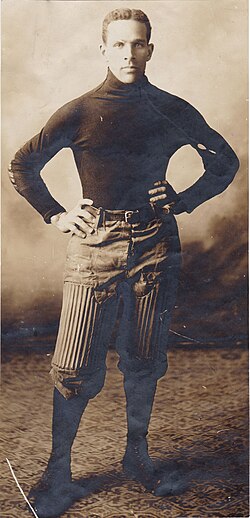
College Career
Johnson played college football for a remarkable seven seasons. He first burst onto the national scene at the Carlisle Indian Industrial School, where he starred from 1899 to 1903 under legendary head coach Glenn “Pop” Warner. As the quarterback and team captain, Johnson’s fiery leadership turned the entirely American Indian squad into an absolute national powerhouse.
Following his stellar career at Carlisle, Johnson enrolled in Northwestern University’s School of Dentistry. Taking advantage of early rules that allowed graduate students to continue playing, he suited up for Northwestern during the 1904 and 1905 seasons. Once again, his elite command earned him the role of team captain, guiding a depleted Wildcats roster to a series of resilient, historic victories.
Road After Playing the Game
Unlike players of the modern era, Jimmy Johnson did not pursue a professional playing career in the NFL, which did not yet exist during his prime. Instead, his “pro route” was defined by a commitment to leadership and intellect.
Following his playing days, he briefly returned to Carlisle in 1906 to serve as an assistant coach under Pop Warner, passing his tactical knowledge down to the next generation of players. From there, Johnson pivoted entirely to his professional calling outside of sports, graduating with his dental degree in 1907 and establishing a highly successful career as a dental surgeon in San Juan, Puerto Rico.
Football Legacy
Johnson’s legacy is defined by unmatched cunning, elite field generalship, and a historic knack for theater. He was the quarterback who famously executed the legendary “hidden ball trick” against Harvard in 1903, where he slipped the football up the back of teammate Charles Dillon’s jersey during a kickoff return.
His ability to orchestrate complex offenses and inspire his teammates solidified him as one of the defining faces of early twentieth-century football. Decades after his passing in 1942, his gridiron mastery was forever enshrined when he was posthumously inducted into the College Football Hall of Fame in 1969.
Accolades, Awards, and Career Stats
Because official statistical tracking was minimal during the turn of the century, Johnson’s greatness is preserved through historic game milestones and premium national awards:
- College Football Hall of Fame: Inducted in 1969.
- 1903 All-American: Named a First-Team Consensus All-American by Walter Camp, who selected Johnson after witnessing his masterful, gritty performance against Harvard.
- 1901 All-American: Selected as a Third-Team All-American.
- Team Captaincy: Served as team captain for both Carlisle (1903) and Northwestern (1905).
- The 200-Yard Milestone: On October 28, 1905, he ran for 200 yards and scored a touchdown to help dedicate Northwestern’s new Central Street stadium in an 18-2 blowout against Beloit.
- The Illinois Decider: Scored the game-winning touchdown in 1904 to defeat Illinois 12-6 in the final football game ever played at Sheppard Field.