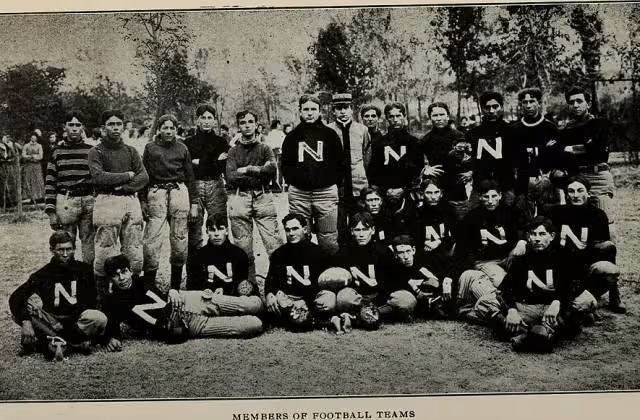
We recount the rediscovery of a largely forgotten contest that illuminates an overlooked chapter of early American collegiate football. Our guest Timothy Brown describes how a real-photo postcard prompted an inquiry into the 1908 University of Denver team that claimed the Rocky Mountain crown. We recount the season arc: Denver’s modest records in preceding years, the arrival of key recruits from Butte, Montana, upset victories over Utah and Colorado Mines, and the ensuing accusation by the University of Colorado that Denver fielded ineligible players—an allegation that effectively froze their rivalry for several seasons.
Tim then narrates the political drama that nearly prevented a marquee intersectional game when the Commissioner of Indian Affairs halted Carlisle’s travels to Colorado; I explain how sustained political pressure, including correspondence directed toward President Roosevelt, compelled the commissioner to relent. We conclude by summarizing the confrontation itself: legendary figures such as Amos Alonzo Stagg and Walter Eckersall officiated, Jim Thorpe appeared as a sophomore, and Carlisle prevailed 8–4 by two field goals, each worth four points at the time. I underscore the paradox that both institutions ultimately ceased to field football teams, yet the episode endures through archival research and the labor of historical recovery.
The conversation is based on Tim's recent article titled: 1908 University of Denver Rocky Mountain Champs.
⏰ Chapter Times ⏰
00:13 Timothy P. Brown and the Lost Game of College Football
00:24 Unearthing the 1908 University of Denver Rocky Mountain Champions
04:14 Commissioner’s Ban and the Political Fight to Play Carlisle
06:12 University of Denver: Hockey Dominance and the End of Football
08:07 Reviving Forgotten Football History
08:29 Subscribe & Explore: FootballArchaeology.com
Do you want more football history? Grab a copy of our Award-Winning book, "The World's Greatest Pro Gridiron Team: The 1903 Franklin All-Stars" at https://amzn.to/4rG6uVe
Don't forget to check out and subscribe to the Pigskin Dispatch YouTube channel for additional content and the regular Football History Minute Shorts.
Miss our football by the day of the year podcasts, well, don't, because they can still be found at the Pigskin Dispatch website.
Do you want more football history? Test your Gridiron Knowledge, we feed you Daily with our new FREE activity, The Pigskin Trivia Drive.
Grab a copy of our latest book, "Marooned," on the 1925 Pottsville Maroons NFL franchise saga.
*OR* Grab a copy of our book on Western Pennsylvania football history, "World's Greatest Gridiron Team" on the 1903 Franklin All-Stars
Drop us a line at PigskinDispatch@gmail .com and check out and subscribe to the Pigskin Dispatch YouTube channel.
Contact us directly at Pi*************@***il.com
Miss our football by the day of the year podcasts, well, don't because they can still be found at the Pigskin Dispatch website.
Transcript
What if I told you there was once a game that's sort of been lost to history where four great legends of college football participated in Walter Eckersol, Pop Warner, Amos Alonzo Stagg and Jim Thorpe.
Speaker A:Now that's something to pay attention to.
Speaker A:And our friend Timothy P. Brown of Football Archaeology joins us to tell us all about it.
Speaker B:Darren, look forward to chatting and doing a little bit of talking about the King of the Hills.
Speaker A:The King of the Hills.
Speaker A:if I remember correctly, the:Speaker A:That's hard to say all in one sentence and I'm sure it's a great story.
Speaker B:Yeah, you know, this is one that I, you know, I basically kind of latched onto this story because I, I bought an RPPC, right.
Speaker B:hoto postcard that showed the:Speaker B:So then, you know, obviously dug into the before I bought it, I dug in enough to know that there's some stories there, but they're, you know, an interesting team.
Speaker B:And you know, generally I don't think people from a football history standpoint, the whole Rocky Mountain area doesn't get a lot of attention, you know, you know, there wasn't a lot of population out there, you know, at the time.
Speaker B:But you know, we tend to focus on like Callan, Stanford and you know, and maybe a few other schools a little bit later USC and then even later UCLA on the west coast and then, you know, east coast, south and obviously the Midwest with Big Ten and you know, what became the Big Eight, you know, Missouri Valley Conference.
Speaker B:So anyways, I think these guys kind of get lost in the shuffle a lot of times.
Speaker B:So that's part of the reason why I'm attracted to them.
Speaker B:But they, so Denver private school in surprisingly in Denver they had a coach, guy named John Pete Kohler, maybe he might have been called Cold Kohler because he's from Wisconsin.
Speaker B:in:Speaker B:in:Speaker B:But for the:Speaker B:They got a couple kids from Butte, Montana who ended up, you know, being a couple of their best, best guys.
Speaker B:And so they start out the season really strong.
Speaker B:They're four.
Speaker B:No, they had a, they upset Utah and then they beat the four time Rocky.
Speaker B:Well, four time Colorado state champion.
Speaker B:Color Colorado Mines school and then they played Colorado, you know, University of Colorado, who accused Denver of playing ineligible players though that none of that ever got proven.
Speaker B:id not play denver until like:Speaker B:So they've.
Speaker B:Through:Speaker B:They.
Speaker B:They refused to play them.
Speaker B:And the fact that Denver won 14 and nothing probably had something to do with that.
Speaker B:Anyways, then they, they were able to set up like midway through October, they set up a game of season under against Carlisle.
Speaker B:So, you know, Carlisle was a school that, you know, they would travel all over the place to play football.
Speaker B:And so they were on a trip where they had beaten.
Speaker B:They lost to Minnesota.
Speaker B:Then they went and beat Nebraska pretty handily.
Speaker B:They might.
Speaker B:I think they played, I think they played not Xavier.
Speaker B:Anyways, I'm blanking on the, the school in Omaha.
Speaker B:But.
Speaker B:So they had another game and then.
Speaker B:But they, they were supposed to finish the season at Colorado.
Speaker B:But as the season stretched on, there was a new guy in charge.
Speaker B:It was new Commissioner of Indian Affairs.
Speaker B:And he looked at and said, okay, these guys are away from school for like three weeks.
Speaker B:I think we're overemphasizing football.
Speaker B:And so he put a stop to the game.
Speaker B:But then, you know, everybody from Colorado, the governor, the senators, state reps, you know, whatever, you know, there were letters and the tidbit includes letters written to, written to the, to President Roosevelt, trying to see if he can intervene and allow Carlyle to come out and play.
Speaker B:So one way or another, the political pressure worked and so the commissioner reconsidered his decision and you know, let Carla go out there and play.
Speaker A:Probably saved his job.
Speaker B:Yeah,.
Speaker A:That's.
Speaker B:An important thing.
Speaker A:Right?
Speaker B:So anyways, they end up playing.
Speaker B:It was kind of an unusual game.
Speaker B:You know, Stag was the referee, Eckersal was the field judge.
Speaker B:Jim Thorpe played, he was a sophomore and then he didn't play the next two years.
Speaker B:But so Thorpe was in the game.
Speaker B:You know, it didn't do anything spectacular.
Speaker B:But Carlisle ended up winning 8 to 4 on two field goals, which, you know, were worth four points at the time.
Speaker B:And you know, the, the coach later left for Marquette.
Speaker B:But, you know, it ended up.
Speaker B:At the end of the day, they were still.
Speaker B:They were.
Speaker B:They'd beaten everybody in Colorado.
Speaker B:So they the Colorado champions.
Speaker B:Then by beating Utah, they were considered the Intermountain or Rocky Mountain champions, which, you know, is one of those.
Speaker B:It was a big deal back then to be, you know, to be the Rocky Mountain champions.
Speaker B:So they, you know, University of Denver was.
Speaker B:Now, you know, nowadays are known Much more for their, they, they have more NCAA hockey championships than anybody else.
Speaker B:y dropped in either after the:Speaker B:I've covered them separately in the dropping football series.
Speaker B:But anyways, just kind of a cool little odd story about this team that doesn't play football anymore.
Speaker B:t get to play the big game in:Speaker A:Yeah, I mean, I just think it's such a remarkable story of that game, you know, when you can get two guys from Chicago and Stag and Eckersol who are pretty busy guys in their own rate doing stuff, you know, it's not like Chicago and Denver are across the street from each other really.
Speaker A:Had to be a, at least a few day trip for them each way to get out there.
Speaker A:And then you have a team that's, you know, as famous as Carlisle, who is, you know, pretty, pretty big deal back then playing this school that hardly anybody's heard of in the realm of football.
Speaker B:And for them it was like, you know, that's, that was the first time, you know, Carlisle had been out to play somebody in that region.
Speaker B:You know, they'd been out to California once or twice, but you know, so for them that was a, you know, it was a big deal.
Speaker B:You know, before intersectional games became common.
Speaker B:If you had a chance to play Carlisle who was playing the best of the east, you know, that was a big deal.
Speaker A:Yeah, something to put hang your hat on if you can beat them, huh?
Speaker B:Yeah,.
Speaker A:And they.
Speaker B:Lost, but they played, played a good game.
Speaker B:So.
Speaker A:Yeah, 8 to 4 is nothing to know.
Speaker A:Lose by a field goal.
Speaker A:That's nothing to be ashamed of for sure.
Speaker A:Yeah.
Speaker A:But you know, this is a great piece and a great example of how you go back and you take events that occurred and then you bring them back to life again, you know, because, you know, who would have ever known about this?
Speaker A:Man, I read a lot of football history books.
Speaker A:I've never heard of this game before until I read your tidbit.
Speaker A:And you do this a lot in your tidbits and maybe you could share with people how they could get connected to you and your tidbits.
Speaker B:Yeah, just go to footballarchaeology.com it's a substack site so you can subscribe, in which case you'll get an email.
Speaker B:Every time I publish.
Speaker B:That includes all.
Speaker B:Well, it includes the article and the link to the site, otherwise, you know, bookmark it.
Speaker B:I've also got books available on Amazon and so, you know, come and consume.
Speaker B:Consume the stuff however you'd like.
Speaker B:And just remember that the site has a search function.
Speaker B:So, got questions about some kind of oddball football history thing?
Speaker B:There's a decent chance I've covered it at some point.
Speaker A:Most definitely.
Speaker A:I use it quite a bit and I find it very helpful and very, very well done.
Speaker A:So we appreciate that and we appreciate you coming on and sharing the history with us.
Speaker A:And we'd love to talk to you again next week.
Speaker B:Very good.
Speaker B:Just send me an invitation.