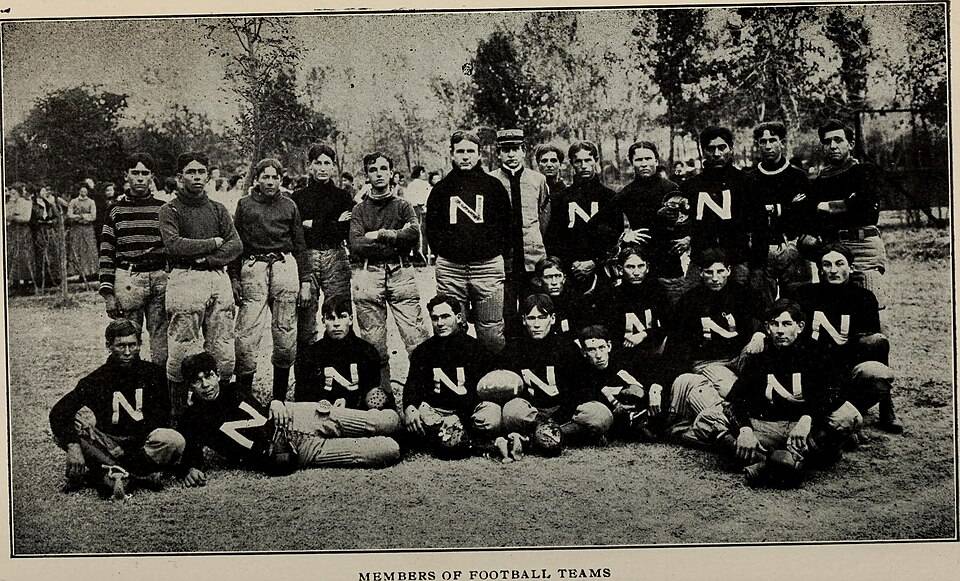
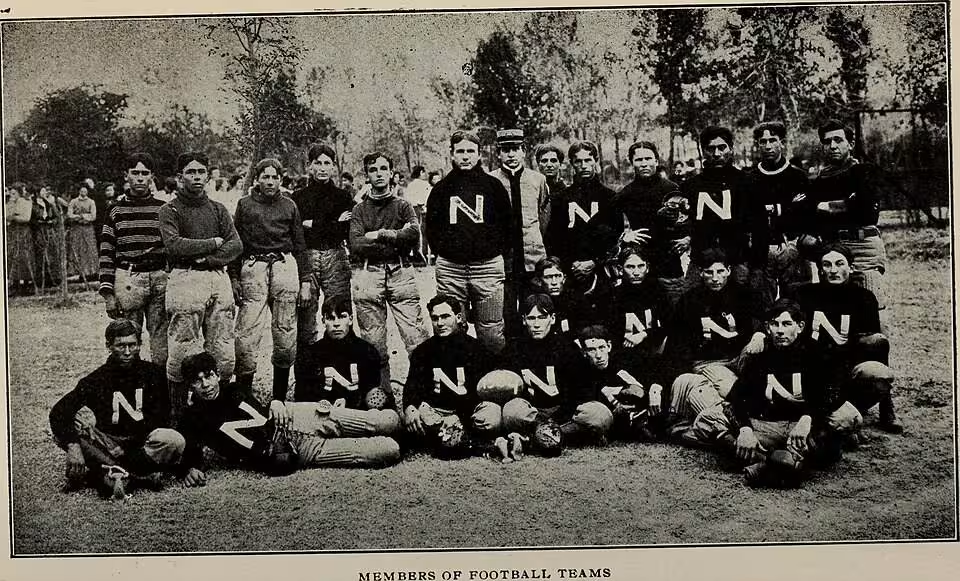
When a faculty member and students at Arizona State decided to organize a football team, it couldn’t have been any more “normal.” Literally, the school in 1897 was called the Arizona Normal School, and the team’s nickname was the Normals. The “State” part of the modern name couldn’t have happened because Tempe was in the Arizona Territory, as statehood didn’t occur until 1912.
Fredrick M. Irish, a recent graduate of the University of Iowa, had taken a teaching job at Arizona Normal and spread the news to his students about the excitement of football sweeping through his alma mater and other Midwestern colleges. Irish helped organize the inaugural teams, then coached the players on the basics in a “practice season of 1896.
Fredrick was a Science and military tactics professor who pieced together the school’s first squad out of an all-male student body of just 61. Because none of the students had ever played organized football, Irish taught them the fundamentals from scratch.
Student Walter Shute became the first captain when the Normal team invited the nearby Phoenix Indian School to a game. The Native Americans took advantage of their host’s inexperience, defeating the Normals 38-20 on October 16, 1897, to establish the first gridiron game in school history. That was the only game played in season number 1, but Professor Irish would lead the team for its first seven seasons on the football field.
The First Games and Early Stars
Known early on as the Normals (and later the Owls and Bulldogs), the program broke through on Thanksgiving Day in 1899. Playing in the newly formed Arizona Football League, the Normals defeated the University of Arizona 11–2 in Tucson to claim the inaugural Territorial Cup, the oldest rivalry trophy in college football.
Early standout players included team captain Walter Shute, halfback Charles Haigler—often cited as the program’s first gridiron star—and quarterback Bill Woolf, all of whom helped anchor the 1899 Territorial Cup victory. By the 1940s and early 1950s, the program began attracting national talent, led by dynamic halfback Morrison Warren and future Pro Football Hall of Fame running back John Henry Johnson.
Coaching Foundations
Irish served as head coach through 1906, compiling a 12–8 record and laying the program’s foundation. Over the next few decades, coaches such as Aaron McCreary (1923–1929) and Ted Shipkey (1930–1932), who led the school to its first Border Conference title in 1931, steadily raised competitiveness. Dixie Howell (1938–1941) guided the program to back-to-back conference championships and its first bowl appearances in the 1940 and 1941 Sun Bowls. Later, Dan Devine (1955–1957) went 27–3–1 and mentored his young assistant Frank Kush, who took over in 1958 and transformed Arizona State into a national powerhouse.
Origin of the “Sun Devils”
For decades, Arizona State’s teams lacked a distinct regional identity, cycling through the Normals, Owls, and Bulldogs. In 1946, following a campaign in the student newspaper (The State Press) for a nickname unique to the Southwest, track coach Donn Kinzle found inspiration while jogging along the dry Salt River bed. Watching a desert whirlwind—locally called a dust devil or “sun devil”—dance across the sand, Kinzle proposed the name. On November 8, 1946, the student body voted 819 to 196 to adopt the Sun Devils, and the university officially approved the change on November 20. Soon after, former Disney illustrator and alumnus Bert Anthony sketched the pitchfork-wielding mascot, Sparky, cementing the program’s enduring identity.