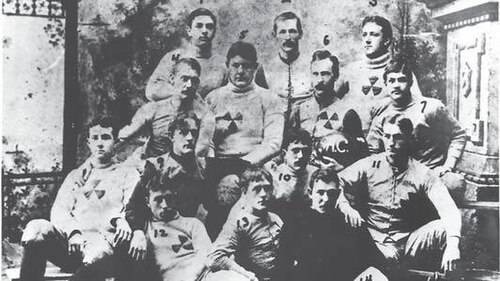
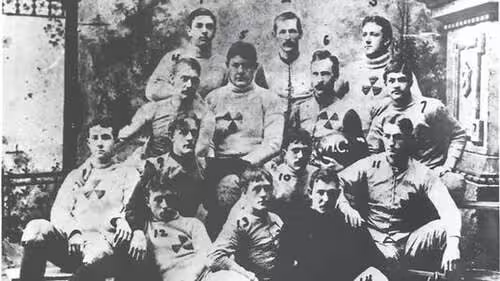
Tulane University’s athletic traditions began on the gridiron, brought to New Orleans by brothers Thomas Levingston Bayne Jr. and Hugh Aiken Bayne, who had learned the sport while attending Yale University. On New Year’s Day in 1890, Tulane students divided into two squads to play the first organized football game in both New Orleans and the state of Louisiana.
Intercollegiate play officially launched in the autumn of 1893 with Thomas Bayne serving as Tulane’s inaugural head coach. After dropping its varsity debut 12–0 to the Southern Athletic Club on November 18, Tulane hosted Louisiana State University on November 25, 1893, in Louisiana’s first intercollegiate football game. Because Bayne had also traveled to Baton Rouge to help train LSU’s cadets, he wound up serving as the game’s umpire while LSU’s coach acted as referee. Led by team captain John Lombard and fueled by Hugh Bayne—who scored the first touchdown in program history—Tulane dominated LSU in a 34–0 rout.
Early Turmoil and Conference Rivalries
In 1895, Tulane joined the Southern Intercollegiate Athletic Association (SIAA), the first southern athletics conference, and posted its first winning record (3–2) under a returning Bayne. However, rapid coaching turnover—the program cycled through seven head coaches in its first seven seasons—and heated eligibility disputes soon defined the era.
The most notorious clash occurred during the 1896 season under head coach Harry Baum. With Tulane leading SIAA champion LSU 2–0, a Tulane player named Depleche suffered an injury and was replaced by George H. Brooke, an incoming student who had not yet officially enrolled. After LSU ran another play for five yards, officials and LSU players recognized Brooke. Following a lengthy debate, the referee ruled Brooke ineligible. When Tulane captain Louis Genella refused to continue without him, the referee awarded LSU a forfeit victory. SIAA commissioner Dr. William Dudley upheld the forfeit and banned Tulane from intercollegiate competition in 1897—the only year since 1893 that the university did not field a team.
Breakout Seasons, Early Stars, and Records
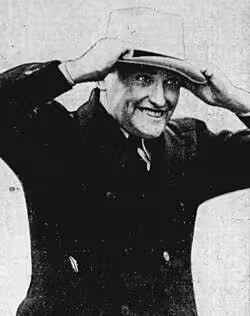
Tulane returned to the field in 1898 under player-turned-coach John Lombard and two-year team captain Charles Eshleman, who later became the first 19th-century athlete inducted into the Tulane Athletics Hall of Fame. After suffering a winless and scoreless 1899 campaign that included a loss to the legendary “Iron Men” of Sewanee, the program engineered a dramatic turnaround.
In 1900, head coach H.T. Summersgill led the “Olive and Blue”—named after the school’s official colors—to a pristine 5–0 season and an SIAA co-championship. Captained by Hugh Krumbhaar, Tulane outscored the Southern Athletic Club, Alabama, Millsaps, LSU, and Ole Miss by a combined 105–0, never allowing an opponent to cross its goal line.
The following decade brought wild swings in fortune:
- 1905–1906: Under coaches John Tobin and John Russ, Tulane failed to win a single game, sparking a bitter feud with LSU over player eligibility that halted their rivalry until 1911.
- 1908–1910: Tulane rebounded in 1908, losing only to Baylor while accusing undefeated rival LSU of fielding professional players. In 1909, the squad traveled to Havana, Cuba, to compete in the Bacardi Bowl, before enduring another winless campaign in 1910.
- 1912–1915: In 1912, Tulane demolished Southwestern Louisiana, setting all-time school records with 15 rushing touchdowns and 95 points that remain intact today. A year later, tackle Carl Woodward booted a 52-yard field goal against St. Louis that stood as a program benchmark for 51 years. Stability finally arrived in 1915 with the hiring of head coach Clark Shaughnessy, who went on to win 59 games and revolutionize offense as the “father of the T-formation.”
Origin of the “Green Wave” Nickname
For its first quarter-century, Tulane’s athletic squads were referred to simply as the “Olive and Blue.” In 1919, a student newspaper, the Tulane Weekly, began calling the football team the “Greenbacks” and “Greenies” in reference to their green jerseys.
The lasting identity emerged the following autumn. On October 20, 1920, Tulane Hullabaloo editor Earl Sparling published a football fight song in the student paper titled “The Rolling Green Wave.” Sportswriters and fans quickly embraced the imagery, and “Green Wave” soon became the official nickname of Tulane athletics. [Source]