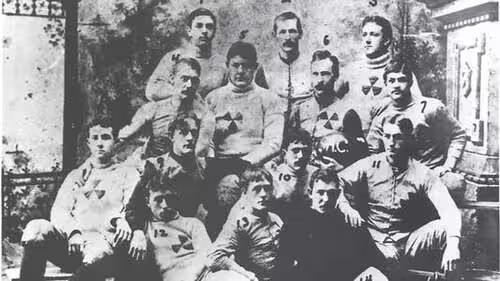
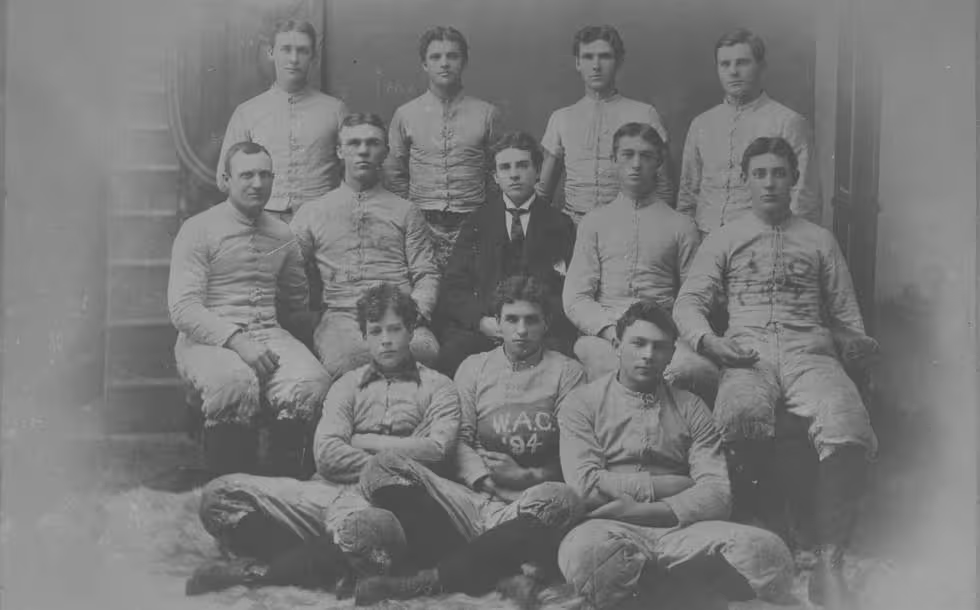
Washington State University’s football program began in 1894, just two years after the institution opened its doors in Pullman as the Washington Agricultural College and School of Science. With no athletic budget and no paid staff, students organized the inaugural team themselves, captained by Fred W. Long. To learn the rules of the game, they recruited William Goodyear, a newspaper editor in nearby Palouse and former Williams College football player, who volunteered to commute to Pullman after work to coach the squad free of charge.
The First Game and Early Coaches
The program played its first official game on November 18, 1894, traveling across the border to Moscow to face the University of Idaho. Washington Agricultural College won 10–0, launching the long-running “Battle of the Palouse” rivalry. Eleven days later, the team fell 18–0 to Spokane High School to finish its debut season at 1–1.
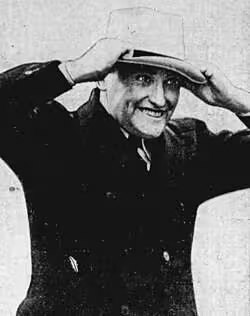
During its first decade, the program relied on short-term, often unpaid coaches—including Fred Waite (1895) and David Brodie (1896)—before hiring its first paid head coach in 1900. In the 1910s, Washington State College (renamed in 1905) established a distinctive coaching pipeline from Pennsylvania’s Carlisle Indian Industrial School, hiring Carlisle alumni Frank Shively, William “Lone Star” Dietz, and Gus Welch. Under Dietz in 1915, the program achieved national prominence by going 7–0 and defeating Brown University 14–0 in the 1916 Rose Bowl—the first in the continuous annual series. Later, O.E. “Babe” Hollingbery took over in 1926, guiding the team to another Rose Bowl berth in 1930 and becoming one of the winningest coaches in school history.
Early Stars
Several standout players shaped the program’s formative decades:
- Benton Bangs, Carl Dietz, and Asa “Ace” Clark: Key leaders of the undefeated 1915 squad. Halfback Benton Bangs provided explosive speed, team captain Ace Clark anchored the line, and fullback Carl Dietz scored a rushing touchdown in the 1916 Rose Bowl triumph.
- Herbert “Butch” Meeker: A 5-foot-5, 135-pound quarterback from Spokane in the late 1920s whose relentless grit earned him campus-wide fame—and a permanent place in school lore.
Origin of the “Cougars” Nickname
For its first 25 years, Washington State lacked an official nickname. Sportswriters informally called the teams the Farmers, Aggies, Hayseeds, or Indians (during the Carlisle coaching era).
That changed in October 1919. After Washington State upset the California Golden Bears in Berkeley, an Oakland newspaper cartoonist depicted the victorious Pullman squad as fierce Northwest cougars mauling the Golden Bears. Days later, on October 28, 1919, the student body officially adopted “Cougars” as the school’s nickname and mascot. In 1927, Washington Governor Roland Hartley presented the university with a live cougar cub; at the governor’s suggestion, students named the cub “Butch” in honor of scrappy quarterback Herbert “Butch” Meeker, establishing the mascot tradition that continues today.