College football has been around since the late 19th century, but the game’s golden age came during the Roaring Twenties. Much like today, big splash offensive plays generated by a pass captured the nation’s attention.
One of these happened in 1925, when fishwraps spread across the country as the Army’s then-head coach, Captain John J. McEwan, shared his knowledge and breakdowns of the previous 1924 season’s best passing plays. He titled his 48-part series the “Greatest Forward Pass Plays in Modern Time,” and it appeared six times a week in participating local papers (no Sundays).
For those of you who follow Pigskin Dispatch and read our books, you know how highly we regard the 1924 season, which was magical with the likes of Red Grange, the Four Horsemen of Notre Dame, Ernie Nevers, Wildcat Wilson, and more.
The Play
The 2-1-1 Chicago Maroons, in Amos Alonzo Stagg’s 33rd season, lost their opener to Missouri and tied Ohio State the week before their November meeting with 3-1 Purdue. Chicago dominated Purdue for most of the 1924 meeting. With less than a minute remaining, it seemed as if the Maroons had stymied the Boilermakers once again, as Purdue set up to attempt a field goal from the Maroon 30-yard line by going into a drop-kick formation.
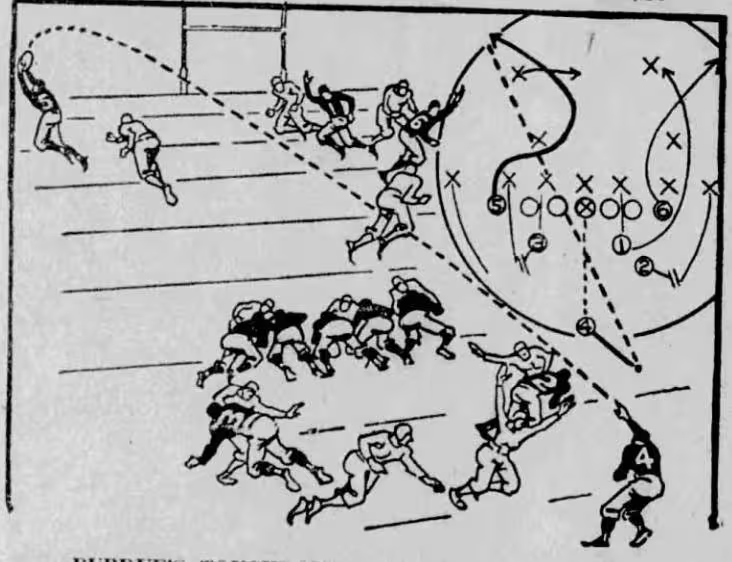
Purdue caught a seemingly complacent Stagg team flat-footed, as the drop-kick appearance was a facade. The regular Boilermaker passer, Wellman, lined up in what we would call, in modern terms, one of the “personal protector” slots.
The ends both tore downfield as if to cover the kick, then veered toward the goalpost, then abruptly turned toward their respective sidelines and met in the middle of the field. This let left end Hagan break away from his defensive back. The snap went directly to Wellman, who rolled right and launched the spiral to Hagan. Hagan caught the ball in the end zone wide open for the score.
Purdue missed the ensuing extra point attempt, and the Maroons won 19-6.
The Aftermath
Purdue and Chicago both won the remainder of their games after their meeting in the 1924 season.
The Maroons went on to win the Big Ten Conference title with a 4–1–3 record, and outscored their opponents 88 to 40.
The Boilermakers’ 5-2 final record was good enough for fifth place in the Big10.
It is interesting that Coach McEwan picked this play and even suggested the Boilermakers should have deployed it earlier. It may not have worked earlier because they may not have had a chance to kick a field goal, unless Coach McEwan suggests they should have run it on a fake punt.
We have more to come from Captain John McEwan’s review of the Greatest Pass plays of 1924 in upcoming posts in this series.
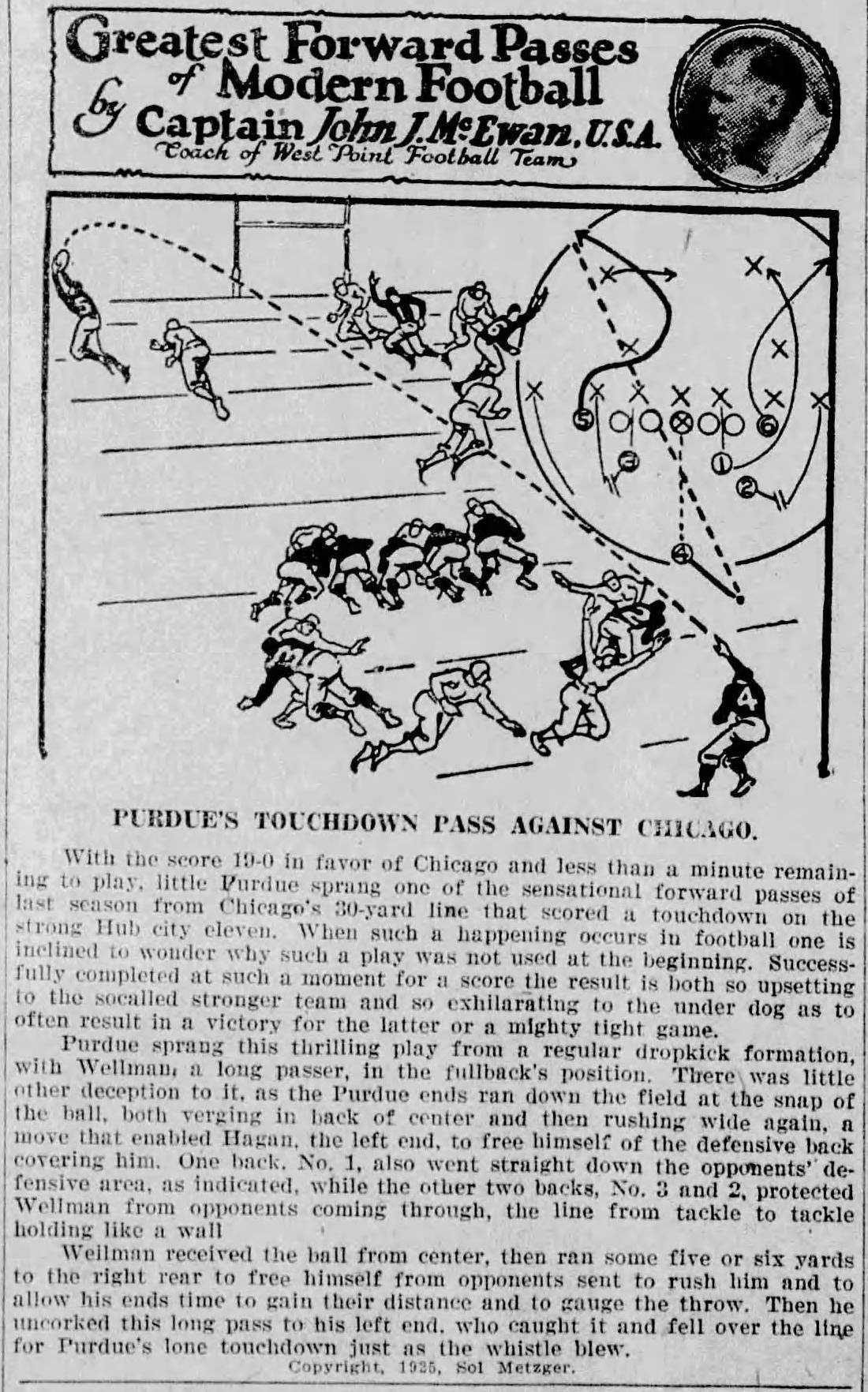
Here is the complete post written in the October 7, 1925 article from Cp McEwan.
Greatest Forward Passes by of Modern Football Captain West John U.S.A. of Point Football Teams XXX PURDUE’S TOUCHDOWN PASS AGAINST CHICAGO. With the score 19-0 in favor of Chicago and less ing to than a minute remainplay, little sprang one of the sensational forward last season from Chicago’s 30-yard line that passes of strong Hub scored a touchdown on the inclined city When such a happening occurs in football one is eleven. to wonder why such a play was not used at the beginning. Successfully completed at such a moment for a score the result is both to the socalled led stronger team and so exhilarating so upsetting often to the under dog as to result victory for the latter or a mighty tight game.
Purdue sprang this thrilling play from a regular dropkick with a long passer, in the fullback’s position. formation, There was little other deception to it, as the Purdue ends ran down the field at the snap of the ball, both verging in back of center and then rushing wide again, A move that enabled Hagan, the left end, to free himself of the defensive back covering him. One back. No. 1, also went straight down the opponents’ defensive area, as indicated, while the other two backs, No.
3 protected Wellman from opponents coming through, the line from tackle to tackle holding like a wall Weilman received the ball from center, then ran some five or six yards to the right rear to free himself from opponents sent to rush him and to allow his ends time to gain their distance and to gauge the throw. Then he uncorked this long pass to his left end. who caught it and fell over the line for Purdue’s lone touchdown just as the whistle blew. Copyright, 1925, Sol Metzger.
Celebrate Football History With Your Collection
"Heads up: A few links in this description are affiliate links. That means if you click through and grab something, I might get a small cut that helps keep the lights on here—at zero additional cost to you!"