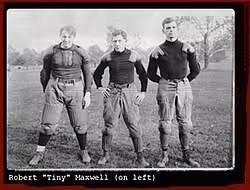
Bob “Tiny” Maxwell took a brutal beating on the gridiron in 1905, but his bloodied face ultimately forced President Theodore Roosevelt to revolutionize football’s safety rules and legalize the forward pass.
Football Bio
September 7, 1884 – Robert “Bob” “Tiny” Maxwell, the former guard who played for the University of Chicago and Swarthmore College, a private liberal arts school in Swarthmore, Pennsylvania, was born.
Legendary University of Chicago coach Alonzo Stagg recruited Bob Maxwell for his size, and he was not as tiny as his nickname would later suggest. Maxwell was 240 pounds in 1902, and in that era the average lineman weighed less than 200 pounds.
Maxwell played for Stagg and the Maroons in 1902 and 1903 and set records in college football and in track and field’s hammer throw. Bob was accepted into Swarthmore College in 1904, and that is when his teammates are believed to have adopted the moniker “Tiny” as a nickname for him. [National Football Foundation]
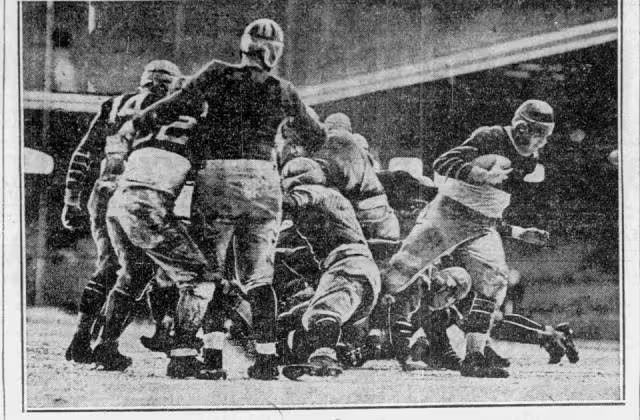
The 1905 game against Penn brought Maxwell to the forefront as a face of football. During the contest, Penn had put three blockers on Maxwell to nullify his influence in the game. This triple-team line play was a slugfest from start to finish, and tiny Maxwell took the brunt of it.
Legend has it that President Theodore Roosevelt was presented with a photo of Bob’s bruised, bloodied, and swollen face after the game was over as a representation of how brutal the game had become. Allegedly, Roosevelt had become so enraged about the appearance of Tiny’s photo and the fact that 18 young men had died that season from football injuries that he called the most prominent men overseeing the game in college football in an effort to meet and to improve the safety of players. Interestingly, this story has been added to history, but is probably not completely true. No one has ever found evidence of the image, and by the time the story was first publicized, both Roosevelt and Maxwell had been dead for years.
Maxwell did play in a rough era, though, as brutal play caused injuries and even death.
As a result, those changes did come in 1906, and they changed football forever. The rule revisions were many, but the big hitters were adopting the legal forward pass, with a severe penalty for incompletions, and moving the line to gain from five to ten yards, as it is today.
One of the people we have is Tiny Maxwell, who sacrificed his body for the game he loved and made the game better, possibly with the help of the President.
Bob “Tiny” Maxwell transformed the very fabric of American football, turning a near-fatal, unregulated contest into the modern sport we recognize today. The football world continues to honor his massive historical impact and physical sacrifice through the prestigious Maxwell Award, ensuring his name forever represents college gridiron greatness.
Accolades and Football Accomplishments
- Inducted into the College Football Hall of Fame in 1974.
- Namesake of the prestigious Maxwell Award, presented annually since 1937 to the College Football Player of the Year.
- Catalyst for the pivotal 1906 football rule changes, which introduced the legal forward pass and the 10-yard first down requirement.
- Starred as a dominant lineman for the University of Chicago (1902–1903) under legendary coach Amos Alonzo Stagg.
- Served as a highly respected college football referee and the sports editor for the Philadelphia Public Ledger following his playing career.
Celebrate Football History With Your Collection
"Heads up: A few links in this description are affiliate links. That means if you click through and grab something, I might get a small cut that helps keep the lights on here—at zero additional cost to you!"
- Walter Steffen: Player, Coach, Innovator
- Paul Des Jardien: Chicago’s Two-Time All-American Center
- Amos Alonzo Stagg: College Football Coaching Legend
- Clarence Herschberger: Chicago’s First All-American
- Walter Eckersall: Chicago’s First Football Superstar
- Andy Wyant: The Ironman of Early College Football History
- Jay Berwanger: The First Heisman and the Draft Pick That Never Was
- The Original Game of the Century: How Chicago’s Safety Ended Michigan’s 56-Game Streak
- Football History of October 28