The 1984 American football season was a landmark year, marked by shattered offensive records in the professional ranks, unprecedented controversy, and miraculous finishes in college football.
Here is a glimpse of what football looked like in 1984:
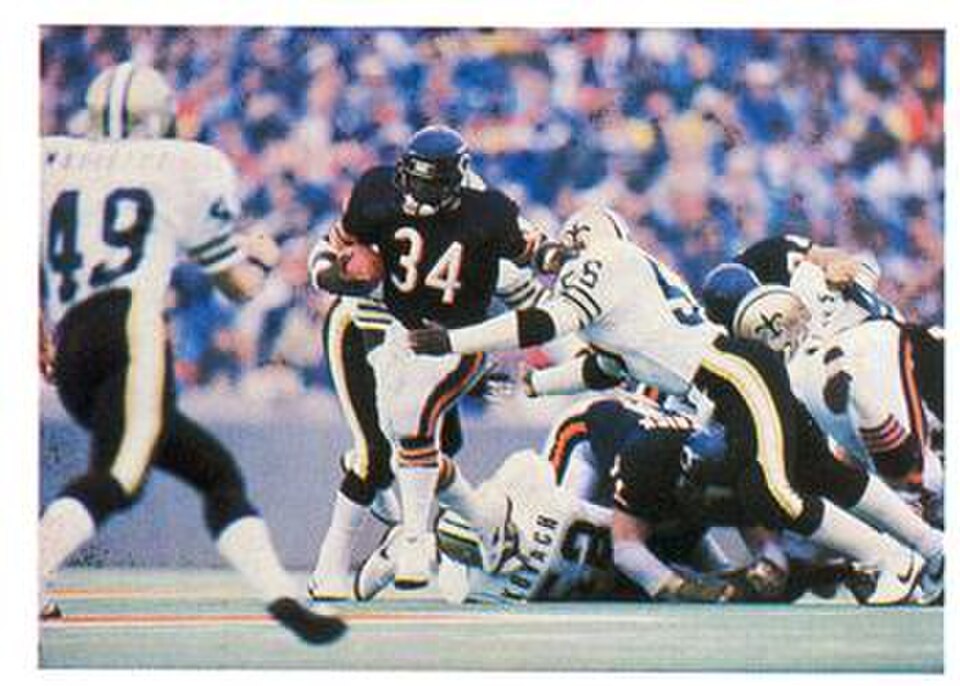
The card is numbered #12 in the set.
The back of the card reads:
THE NUMBER ONE RUSHER IN NFL HISTORY
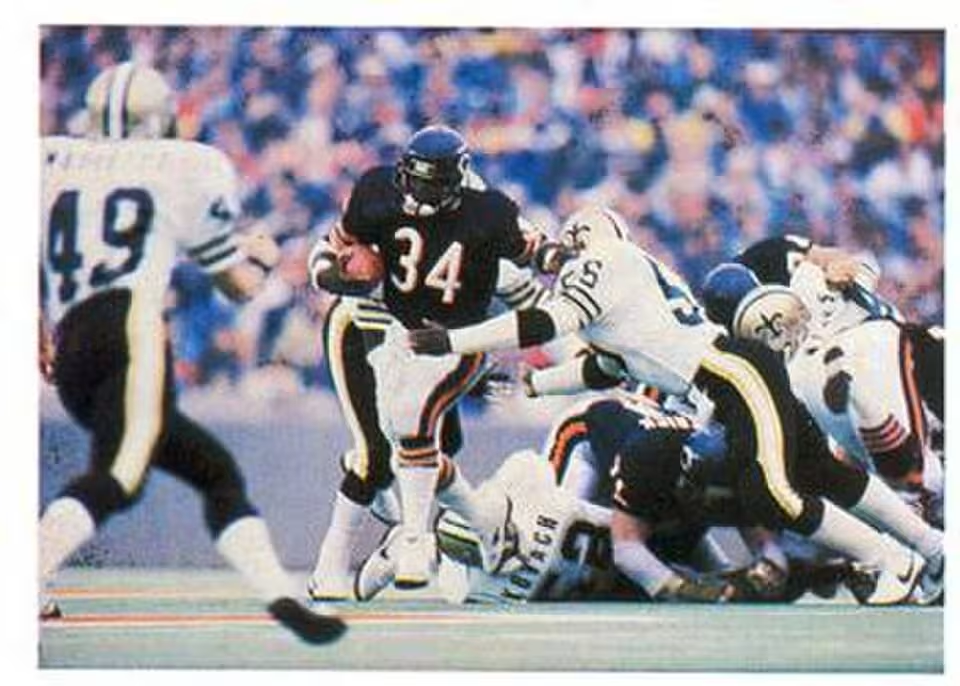
Elusive Walter Payton runs out of the arms of a New Orleans defender on his way to a 154-yard day in 1984 that sent him past Jim Brown to become the NFL’s all-time leading rusher. Payton entered the 1986 season with 14,860 yards, more than a mile ahead of Brown’s 12,312.
NFL: The Year of the Offense
The 1984 NFL season saw individual and team performances that rewrote the professional record books.
- Dan Marino‘s Aerial Assault: Miami Dolphins quarterback Dan Marino became the first player to pass for over 5,000 yards in a single season (5,084) and set a then-record 48 touchdown passes in just his second year in the league.
- Eric Dickerson‘s Rushing Record: Los Angeles Rams running back Eric Dickerson rushed for 2,105 yards, establishing a single-season NFL rushing record that still stands today.
- The 49ers’ Dominance: The San Francisco 49ers became the first team in NFL history to win 15 games in a 16-game regular season, finishing 15–1.
- Super Bowl XIX: The season culminated in a highly anticipated matchup between Joe Montana‘s 49ers and Marino’s Dolphins. The 49ers dominated, winning 38–16 at Stanford Stadium to secure their second Super Bowl title.
Beyond the primary leagues, 1984 also marked significant shifts and milestones in the broader football landscape:
- Walter Payton‘s Milestone: On October 7, 1984, Chicago Bears running back Walter Payton broke Jim Brown‘s all-time NFL career rushing record of 12,312 yards, cementing his legacy as one of the sport’s greatest running backs.
- The USFL’s Star Power: The United States Football League (USFL) played its second spring season, expanding to 18 teams. It featured high-profile, record-breaking talent like Steve Young (L.A. Express) and Jim Kelly (Houston Gamblers), aggressively competing with the NFL for top collegiate draft picks before eventually pushing for a doomed transition to a fall schedule.
College Football: Miracles and a Mid-Major Champion
The 1984 NCAA season is remembered for one of the most iconic plays in sports history and a deeply debated national champion.
- “Hail Flutie”: On November 23, 1984, Boston College quarterback Doug Flutie completed a 48-yard desperation Hail Mary pass to Gerard Phelan as time expired to defeat the defending champion Miami Hurricanes 47–45. Flutie secured the Heisman Trophy later that season.
- BYU’s Unlikely Title: The Brigham Young University (BYU) Cougars, playing in the Western Athletic Conference (WAC), finished as the only undefeated Division I-A team (13–0). Despite playing a lighter schedule and defeating a 6–5 Michigan team in the Holiday Bowl, BYU was voted the consensus National Champion—the last time a team outside the modern major conferences claimed the title.
A Deep Dive into 1984 Football History and Highlights
- January 2, 1984 – The UCLA Bruins romped in the Rose Bowl as the PAC-10 champs overwhelmed the Illinois Illini , 45-9.
- January 2, 1984 – At the 50th edition of the Orange Bowl: #5 Miami (FL) beats #1 Nebraska, 31-30. Trailing most of the game, Nebraska made a run at the end to make it interesting. Trailing 31-24, Husker wideout Irving Fryar dropped a sure TD to make it 4th and 8 for the country’s top team. Coach Tom Osborne called for an option play to the right side with Jeff Smith in the game for Heisman winner Mike Rozier. Smith took the late pitch and ran the sideline, then dove for the pylon to make the score 31-30 Miami. Osborne left the offense on the field and went for two, but the Miami D batted down the conversion pass and won the school’s first title.
- January 8, 1984 – Los Angeles Memorial Coliseum –The Los Angeles Raiders defeated the Seattle Seahawks, 30-14, to win the AFC Championship and capture the Lamar Hunt Trophy to represent the Conference in the Super Bowl.
- January 8, 1984 – RFK Stadium, Washington, D.C. –At the NFC Championship game, the Washington Redskins outlasted the San Francisco 49ers, 24-21. WashingtonFootball.com notes the Niners were down by 21 points in the fourth but staged a comeback. Two questionable penalties and a field goal ended their run as Washington advanced to their second consecutive Super Bowl.
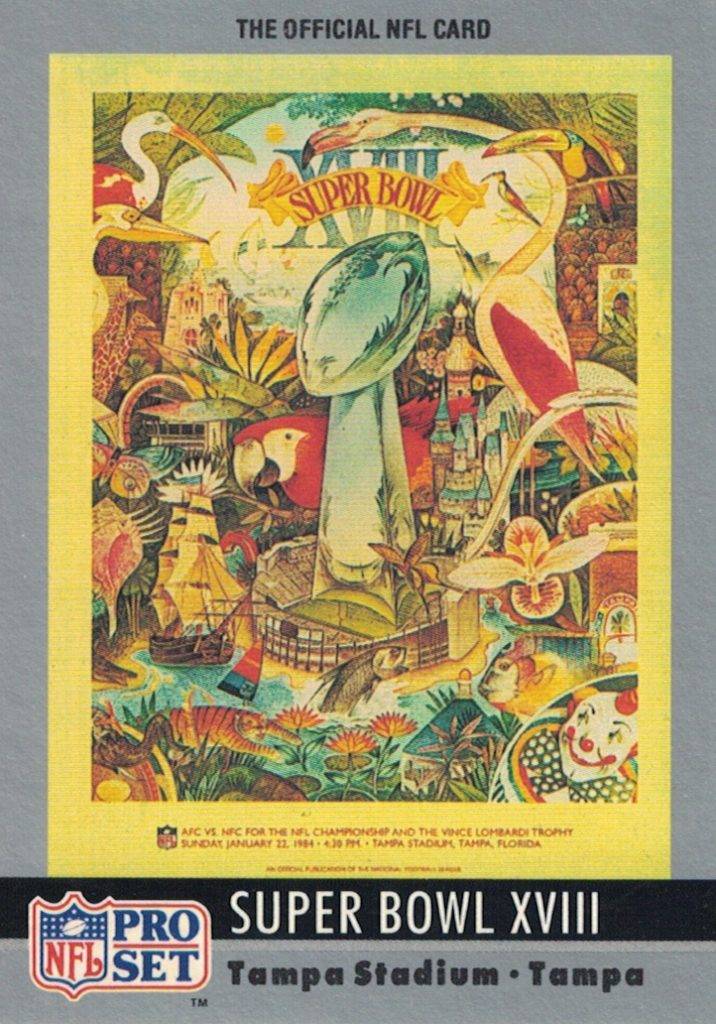
- January 22, 1984 – Tampa Stadium, Tampa, Florida –The Los Angeles Raiders battled the Washington Redskins in Super Bowl XVIII. A Raiders.com article covers the game. The Raiders featured star players likeLyle Alzado, Marcus Allen, and quarterback Jim Plunkett. Allen had one of the greatest Super Bowl runs ever. He took a Plunkett handoff on a play designed to go left, but Washington plugged all the rushing lanes. Marcus cut back instantly and reversed field. He found a hole in the middle and dashed 74 yards for a touchdown. The linked article includes a great video of the play. The LA Raiders beat Washington, 38-9. The game’s MVP was Marcus Allen, the running back of Los Angeles.
- January 29, 1984 – Aloha Stadium, Honolulu –At the NFL Pro Bowl for the 1983 season, it was once again the NFC that triumphed over their AFC counterparts in a big way, 45-3. The MVP of this game was Quarterback Joe Theismann of the Washington Redskins.
- March 28, 1984 – The Colts relocated from Baltimore to Indianapolis. Reports say that franchise owner Bob Irsay moved the Colts in the middle of the night after renovations to Memorial Stadium in Baltimore were not made, as he thought they should be. A Baltimore Sun article by Jon Morgan in 1997 says that Mr. Irsay became a nemesis of then City mayor William Donald Schaefer and, when he later became Maryland’s governor, converted the outrage into the political will to build Camden Yards. Irsay had acquired the club in 1972, a year after they won Super Bowl V, when he traded his rights to the LA Rams to former Colts owner Carroll Rosenbloom. The Colts had a new stadium, the RCA Dome (originally called the Hoosier Dome), which served as their home in Indianapolis for 24 seasons before Lucas Oil Stadium was built. Since the Colts moved to Indy, they have made 2 Super Bowl appearances, including Super Bowl XLI, won by Tony Dungy as coach and Peyton Manning under center.
- May 1, 1984 – Nebraska wide receiver Irving Fryar was the first pick by the New England Patriots in the 1984 NFL Draft. In my research, I cannot find any record of any member of this draft class being enshrined in Canton, Ohio. It is interesting that another Cornhusker offensive player was selected at the number 2 spot by the Houston Oilers: Dean Steinkuhler. Pro Football Reference provided the information above.
- May 27, 1984 – Tells a story about the success of the new USFL football league, luring quality players such as Herschel Walker, Steve Young, and Anthony Carter. Still, some of its franchises were struggling. As a result, many predicted an almost identical story to that of 35 years prior, when the rival AAFC faced a similar fate. The NFL swooped in, absorbed the three strongest franchises, and let the other teams dissolve. The leaders of the NFL merger were the deep-pocketed, owner-owned New Jersey Generals and owner Donald Trump. Also leading were the LA Express and their even wealthier owner, J. William Oldenburg. In addition, the franchise with the highest average attendance was the Jacksonville Bulls, at over 51,000 per game. The Stallions of Birmingham drew 42,092 spectators per contest. Moreover, the Tampa Bay Bandits sold over 45,000 tickets per game. We now know that things didn’t quite play out as the experts predicted for the USFL.
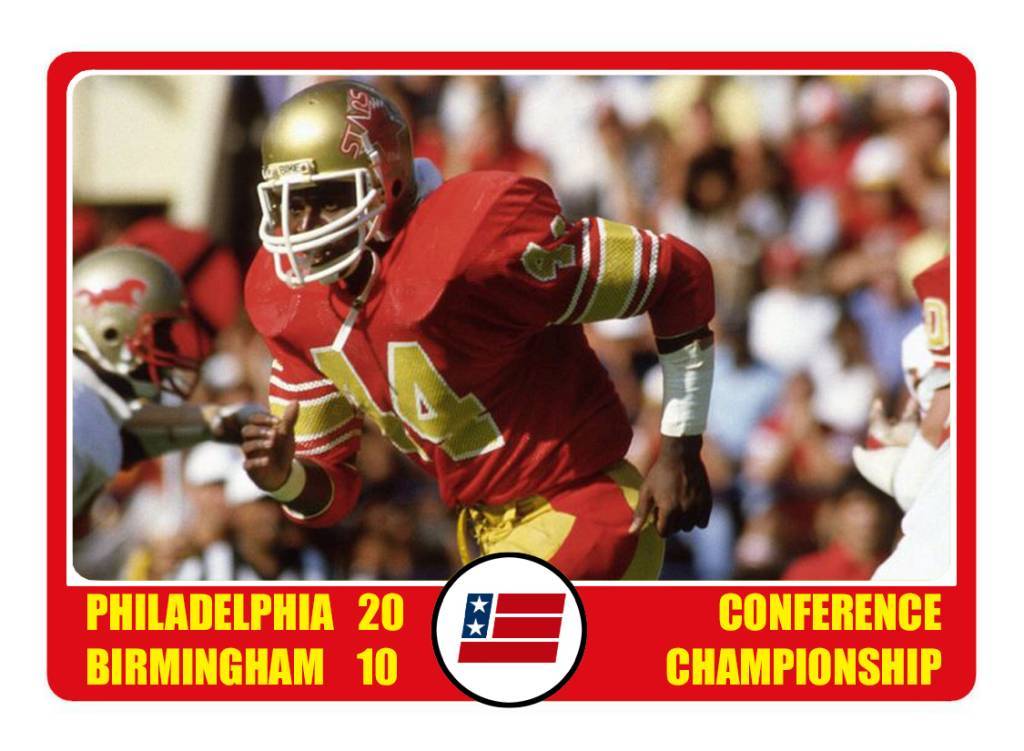
- July 8, 1984 – Franklin Field, Philadelphia – The USFL Eastern Conference Championship game had the Philadelphia Stars defeat the Birmingham Stallions 20-10.
- July 15, 1984 – USFL Title Game – The Philadelphia Stars defeated the Arizona Wranglers 23-3 in the USFL Championship Game, controlling the ball for over 43 minutes. [Source]
- July 28, 1984 – The Pro Football Hall of Fame conducted the enshrinement of the following NFL legends: Willie Brown, Mike McCormack, Charley Taylor, and Arnie Weinmeister.
- August 22, 1984 – USFL Owners Vote to Move to a Fall Schedule – In one of the most fateful business decisions in pro football history, team owners of the United States Football League (USFL) voted to abandon their successful spring schedule and transition to an autumn season starting in 1986. Spearheaded by New Jersey Generals owner Donald Trump, the controversial move was intended to challenge the NFL directly on network television and force a merger. Still, it ultimately triggered the antitrust trial and the upstart league’s premature demise.
- September 1, 1984 – NCAA College Football, Willie Totten of Mississippi State University passed for over 536 yards and 9 touchdowns, setting a record for Division I-AA college football. The leading receiver in that game, catching Totten’s passes? Well, it was none other than the legendary Jerry Rice, who dragged in 17 catches and a total of 294 yards and 5 trips to the end zone for the great receiver Jerry Rice.
- September 23, 1984 – The great Joe Montana missed his first start with the San Francisco 49ers in 49 games. Montana, who was unable to play due to an injury, was replaced by backup Matt Cavanaugh. Cavanaugh stepped in and threw for 252 yards and 3 touchdowns to lead the Niners to a 21-9 victory over the Philadelphia Eagles.
- October 7, 1984 – Chicago Bears running back Walter Payton broke Jim Brown’s all-time NFL career rushing record of 12,312 yards, cementing his legacy as one of the sport’s greatest running backs.
- October 21, 1984 – Riverfront Stadium, Cincinnati, Ohio – Cleveland Browns’ Steve Cox sets club record with a 60-yard field goal. The amazing thing was that Cox was the punter and kickoff guy on the Browns’ roster that season; Matt Bahr was the field goal and extra-point kicker. Bahr had booted a 50-yarder earlier in the first quarter, but with time waning in the 2nd stanza, the Brown’s faced a fourth down and were just out of the range of Bahr’s accuracy. Since Cox had a powerful kickoff leg, Cleveland decided to trot him out there for the attempt. That rule requiring the NFL to place the ball at the spot the specialist kicked it from after a missed field goal did not exist in that era, so the worst result of a miss with 28 seconds remaining would probably be a touchback. Cox’s kick went through and knotted the game at the half 6-6. The Bengals, however, came on in the second half and won 12-9.
- October 27, 1984 – Per the NFF website, 2005 College Football Hall of Famer Willie Totten of Mississippi Valley State passes for 599 yards against Prairie View, the third-best single-game performance in I-AA history. Totten threw for over 530 yards in a single game four times in his collegiate career.
- November 10, 1984 —Per a post on the website gowyo.com, University of Wyoming’s Kevin Lowe rushed for 302 yards, and Rick Wegher of South Dakota State put up 231 yards on the ground to set an NCAA record for most yards gained by two opposing players. The Wyoming Cowboys were too much for the SDSU Jackrabbits that day, though, as it showed in a 45-29 final score of the contest.
- November 10, 1984 —Maryland completes the biggest comeback in NCAA history, overcoming a 31-0 halftime deficit to find victory over the University of Miami 42-40 in the Orange Bowl. A great NCAA.com story reports that the Terrapins outscored Jimmy Johnson‘s Hurricanes 42-9 in the second half to win the game. It was the largest comeback in NCAA history at the time. Led by backup quarterback Frank Reich, the Terrapins scored on six consecutive drives in the second half. One of the biggest plays of the game was when the Terps’ defense stuffed the Hurricanes’ running back, Melvin Bratton, ‘s two-point conversion attempt on the goal line late in the fourth quarter, which would have led to a tie score. Frank Reich was masterful at coming off the bench to lead his teams out of deep holes. Just look at his NFL career.
- November 18, 1984 – Commonwealth Stadium, Edmonton –The 72nd Grey Cup was played. This CFL championship game was special because it was the first-ever Grey Cup game played in Edmonton, according to the bluebombers.com website. The game also marked the first time in nearly two decades that the Winnipeg Blue Bombers had made it to the title game of the CFL. Their opponent was a very gritty Hamilton Tiger-Cats squad led by former Bomber quarterback Dieter Brock, who had just been traded to the Ticats a year earlier. The Cats struck first with Brock sneaking the ball into the end zone for the early lead. At one point early in the second quarter, their lead had extended to 17-3, but that Hamilton momentum was short-lived. Winnipeg would pop off 27 points in the second quarter, setting a Grey Cup record, and rattle off the final 44 points of the game. What at first seemed to be all Hamilton quickly turned into a Bombers blowout with the Winnipeg Blue Bombers defeating the Hamilton Tiger-Cats, 47-17. Quarterback Tom Clements, the very player Brock was traded for, was named the offensive MVP; running back Sean Kehoe was the top Canadian, while the top defender was Tyrone Jones, who set a Grey Cup record with four quarterback sacks.
- November 23, 1984 – The “Hail Flutie” play occurred- Boston College quarterback Doug Flutie completed a 48-yard desperation Hail Mary pass to Gerard Phelan as time expired to defeat the defending champion Miami Hurricanes 47–45. Flutie secured the Heisman Trophy later that season.
- November 26, 1984 – John W. Mercom Jr. announced that the New Orleans Saints were up for sale for $75 million, per the onthisday website. It would be in May of 1985 that Tom Benson would purchase the Saints for $70,204,000. (source)
- December 1, 1984 –Boston College Quarterback Doug Flutie was announced as the Heisman Memorial Trophy winner for the 1984 season per Heisman.com.
- December 1, 1984 – Legion Field, Birmingham –The 49th Iron Bowl will unfortunately always be remembered for a snafu from one of the game’s star players as much as it was for the great sports spectacle that it was. In the 1982 Iron Bowl, Bo Jackson was the hero as he went over the top for the winning score. Bo in 1984 was not so much the game’s hero. According to AL.com, with 3:27 to play and Auburn trailing 17-15, the ball went to running back Brent Fullwood on that fourth-and-goal play from the 1. Jackson, who misheard the call, ran left while the play went right, without a lead blocker. Fullwood was run out of bounds by an Alabama defender short of the goal line. The Tide held on, and the final score was Alabama 17, Auburn 15, and the game has been remembered as “Wrong Way Bo.”
- December 2, 1984 – Miami Dolphins quarterback Dan Marino broke the NFL single-season touchdown pass record with his 37th scoring strike, though his team lost 45-34 to the Oakland Raiders.
- December 9, 1984 – Eric Dickerson of the Los Angeles Rams broke the NFL single-season record by running 2,105 yards on the year. Dickerson did it in style, rushing for 215 yards against the Houston Oilers, per Rams.com. The dominant performance helped the Rams secure the 27-17 win.
- December 21, 1984 – Jack Murphy Stadium, San Diego –Brigham Young University wins their school’s first National Title. BYU knocked off a very tough University of Michigan team by the score of 24-17 in the Holiday Bowl to remain undefeated and secure the NCAA Division I-A football title.