The 1981 American football season was a transformative year that ushered in a new era of offensive innovation and legendary defensive dominance. From the birth of a professional dynasty in the Bay Area to record-shattering collegiate rushing performances, the season produced some of the most enduring moments in the sport’s history.
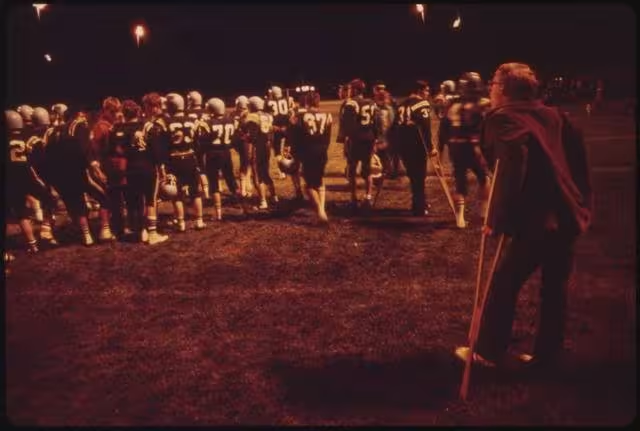
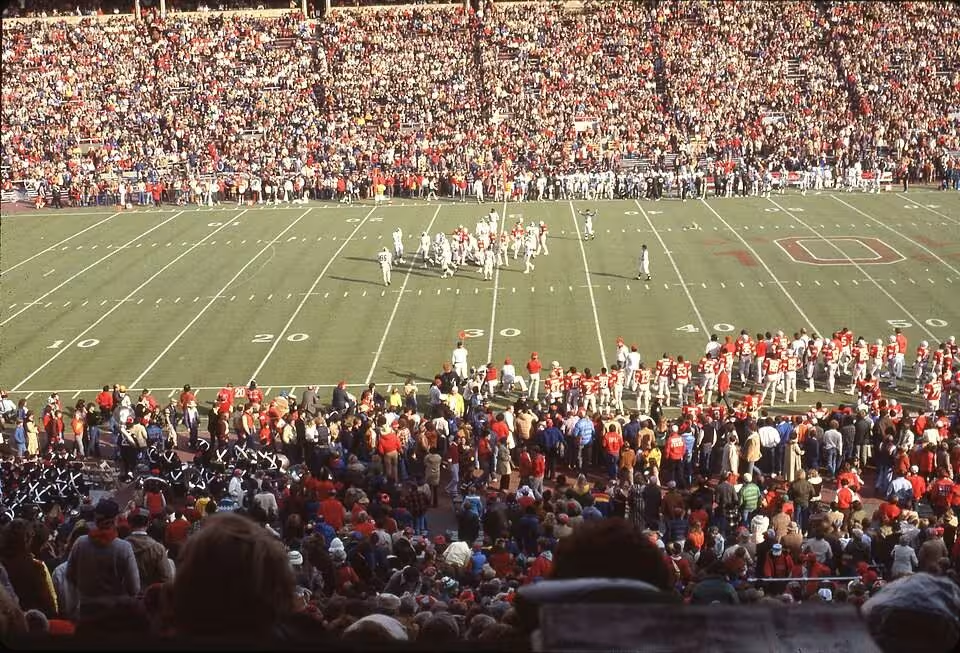
Here is a glimpse of what football looked like in 1981:
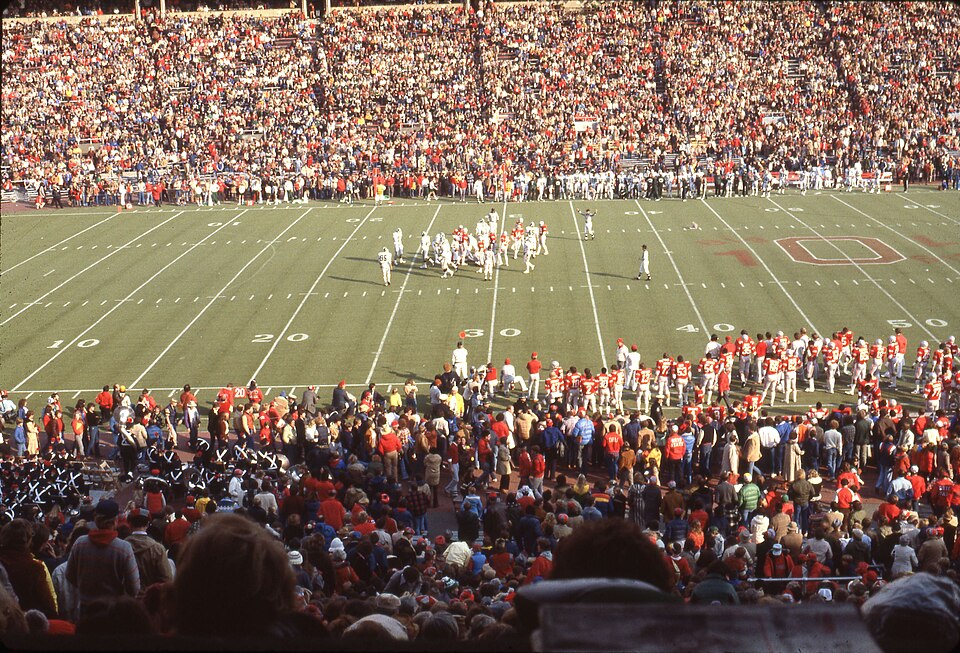
Courtesy of Wikimedia Commons uploader David E. Lucas.
The NFL: “The Catch” and the Birth of a Dynasty
The 1981 NFL season is best remembered for marking a changing of the guard. The old powerhouses of the 1970s made way for the tactical brilliance of head coach Bill Walsh and the precision of the “West Coast Offense.”
- “The Catch”: The defining moment of the season occurred during the NFC Championship Game on January 10, 1982. San Francisco 49ers quarterback Joe Montana threw a high pass to the back of the end zone, famously hauled in by tight end Dwight Clark. The play defeated the powerhouse Dallas Cowboys 28–27 and signaled the start of the 49ers’ decade of dominance.
- Super Bowl XVI: The 49ers capitalized on their momentum by defeating the Cincinnati Bengals 26–21 at the Pontiac Silverdome in Michigan. It was the first of five Super Bowl titles the franchise would win over the next 14 years.
- The Arrival of L.T.: The New York Giants drafted linebacker Lawrence Taylor, fundamentally changing how defense was played. Taylor’s unprecedented combination of size and speed allowed him to sweep both the Defensive Rookie of the Year and the NFL Defensive Player of the Year awards—a feat never accomplished before.
- MVP Honors: Cincinnati Bengals quarterback Ken Anderson took home the NFL MVP award after leading the league in passer rating (98.4) and carrying his team to their first Super Bowl appearance.
College Football: Clemson’s Rise and Marcus Allen’s Milestone
The 1981 collegiate landscape was defined by an unexpected championship run in the South and a historic individual achievement on the West Coast.
- Clemson’s Perfect Season: Under the guidance of 33-year-old head coach Danny Ford, the Clemson Tigers shocked the college football world. Entering the season unranked, the Tigers fielded a stifling defense featuring All-American Terry Kinard. They capped a perfect 12–0 season by defeating the heavily favored Nebraska Cornhuskers 22–15 in the Orange Bowl to secure their first-ever National Championship.
- Marcus Allen’s Historic Heisman: USC Trojans running back Marcus Allen achieved what was previously thought impossible: he became the first player in NCAA history to rush for over 2,000 yards in a single season. Finishing the regular season with 2,342 rushing yards, Allen won the Heisman Trophy in a landslide over Georgia’s Herschel Walker and BYU’s Jim McMahon.
Milestone Moments
Beyond the championships, the 1981 season delivered individual records and games that pushed the physical limits of the sport:
- The Epic in Miami: Often cited as one of the greatest football games ever played, the AFC Divisional Playoff game between the San Diego Chargers and the Miami Dolphins on January 2, 1982, was a masterpiece of endurance. Played in sweltering Florida heat, the Chargers eventually won 41–38 in overtime. The enduring image of the game is Chargers tight end Kellen Winslow—who caught 13 passes for 166 yards and blocked a crucial field goal—being helped off the field by his teammates, utterly exhausted and dehydrated.
- Air Coryell’s Aerial Assault: The Chargers’ offense, engineered by head coach Don Coryell, continued to break barriers. Quarterback Dan Fouts set an NFL single-season record with 4,802 passing yards, pushing the boundaries of what a pass-first offense could achieve.
- A Year of Parity: In the NFL, 1981 was a remarkable year for competitive balance. Three of the four teams that reached the conference championship games (the 49ers, Bengals, and Chargers) had missed the playoffs entirely the previous season.
A Deep Dive into 1981 Football History and Highlights
- January 1, 1981 – It was a fairly lopsided game in the 67th edition of the Rose Bowl Game. The Big 10’s Michigan Wolverines pummelled the PAC-10 representative Washington Huskies, 23-6. The Game MVP was Butch Woolfolk (Michigan RB).
- January 1, 1981 – The 47th edition of the Sugar Bowl was set up to become a classic. The undefeated Georgia Bulldogs had their perfect season on the line against the one-loss Notre Dame Fighting Irish. The Dogs prevailed in a thriller 17-10, powered by game MVP running back Herschel Walker’s 2-TD runs.
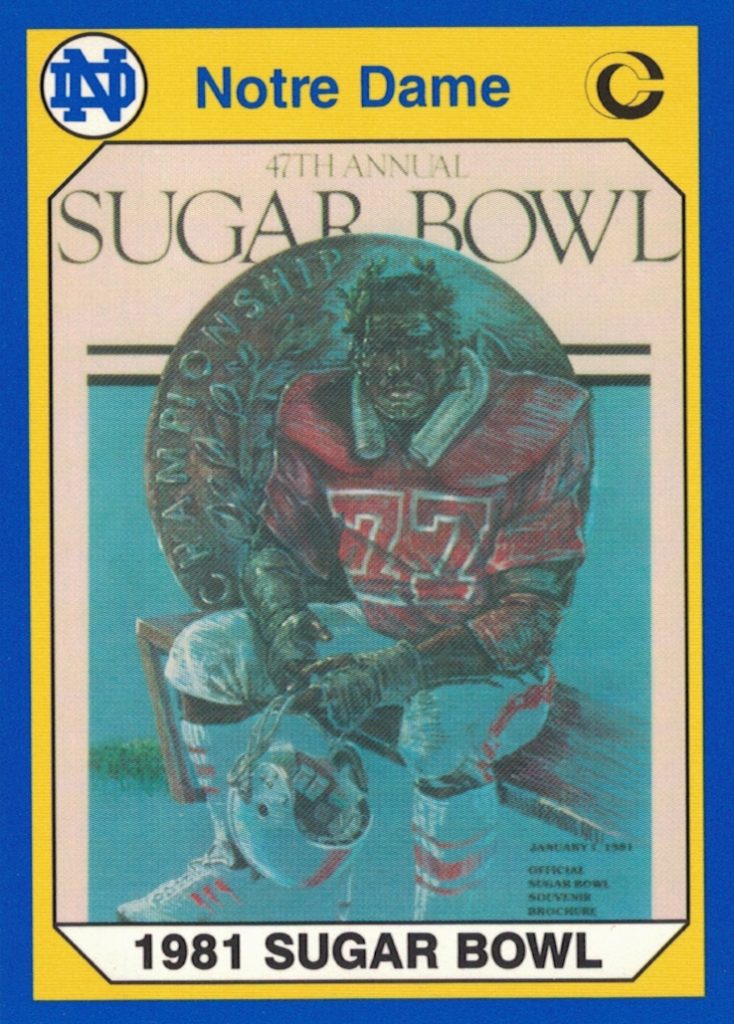
#31 – 1981 Sugar Bowl – Notre Dame Fighting Irish vs Georgia Bulldogs. Darin Hayes’ personal collection.
- January 4, 1981 – In Cleveland, Ohio, a Browns comeback bid against the Raiders was thwarted when the famous “Red Right 88” play was run. We have a full article link here.
- January 4, 1981 –The Atlanta Falcons were stymied by Danny White and Tony Dorsett of the Cowboys, who led Dallas back from a steep deficit. Full story on the Dallas Comeback.
- January 11, 1981 – The AFC Championship was played at San Diego’s Jack Murphy Stadium. The AFC West dominated the NFL’s American Conference when the Chargers hosted the Oakland Raiders. The Oakland Raiders defeated the San Diego Chargers, 34-27.
- January 11, 1981 – Veterans Stadium, Philadelphia –The NFC Championship: Philadelphia Eagles beat the Dallas Cowboys, 20-7.
- January 22, 1981 – O. Andrew “Bum” Phillips became head coach of the New Orleans Saints. Coach Phillips had 6 pretty successful years with the Houston Oilers. However, he could never win the big game against the division rival, the powerful Pittsburgh Steelers dynasty of the 1970’s. In Houston, Bum had a 55-35 record according to Pro Football Reference. In his 5 seasons with the Saints, his teams went 27-42.
- April 29, 1981 – South Carolina’s George Rogers was the first pick by the New Orleans Saints in the NFL Draft after an outstanding college career.
- August 1, 1981 – Four Gridiron Giants Enshrined in Canton: The Pro Football Hall of Fame welcomed a legendary four-person enshrinement class: pioneer two-way end Morris “Red” Badgro, ageless quarterback and scoring legend George Blanda, Green Bay Packers defensive end anchor Willie Davis, and multi-time champion center Jim Ringo.
- August 18, 1981 – University of Georgia running back Hershel Walker takes out a $1 million insurance policy through Lloyd’s of London for compensation in the event he would get injured before the big payday as a professional. The great rusher would eventually start his career in the USFL before later playing in the NFL.
- September 13, 1981 – The Atlanta Falcons tied a record when they scored 31 points in the fourth quarter against the Green Bay Packers at the start of the final stanza. It looked like Green Bay had found its offense again at one point, as they moved the ball with passes from Lynn Dickey to wide receiver James Lofton. However, a back-breaking fumble by running back Turtle Middleton and the subsequent 57-yard scoop-and-score by Falcons linebacker Joel Williams kept the momentum with Atlanta, ultimately leading to the final score. 31:17.
- October 18, 1981 – Kingdome, Seattle, Washington -NY Giants kicker Joe Danelo tied an NFL record of 6 field goals in a game, per Pro-Football-Reference.com, as the G-men cruised to a comfortable 32-0 shutout of the Seahawks. Successful Danelo kicks from 29, 54, 21, 47, 31, and 37 yards helped pad the Giants’ score in the rout.
- October 18, 1981 –Do you remember this gem? The Saints’ star rookie runner, George Rogers, had a 79-yard touchdown run against the Cleveland Browns.
- October 24, 1981 – Chapel Hill, NC – In this “Battle of the Carolinas” edition, the number 3 in the nation, 6-0 North Carolina Tarheels hosted the unranked South Carolina Gamecocks, whose record stood at 4-3 on the season. The Gamecocks were a year removed from Heisman Trophy winner George Rogers and in flux, having lost their identity when their great runner had moved on. The Tarheels, on the other hand, were riding high with a stingy defense that, thus far into the season, was giving up a mere 14 points per game. The Gamecocks jumped out early, taking the opening kickoff and driving the ball into the end zone in three minutes for a 7-0 lead. They then collected multiple turnovers from their hosts and extended their lead even further, but the North Carolina squad fought back just before half with a backup quarterback to keep it a one-score game at 14-7. The second half was all Gamecocks as the University of South Carolina upset the 3rd-ranked University of North Carolina, 31-13.
- November 22, 1981 – Olympic Stadium, Montreal, Quebec –The Edmonton Eskimos won their 4th consecutive CFL Grey Cup. CBC.ca’s internet page gives us all the scoop on the game. Rough Rider Quarterback J.C. Watts brought his team out on fire as they stormed to an early 19-point lead. But the one loss, the Eskimos were not left out in the cold yet. The Edmonton team showed the grit that brought them CFL Championship titles over the previous three years by delivering what some have called the greatest comeback in Grey Cup history. It was Eskimo kicker Dave Cutler’s 27-yard field goal with six ticks on the clock that completed the comeback as Edmonton defeated the Ottawa Rough Riders, 26-23. J.C. Watts was the Offensive MVP, while John Glassford was the Defensive Most Valuable Player, and Neil Lumsden was voted as the Most Valuable Canadian. (source)
- November 28, 1981 – Legion Field, Birmingham –The Crimson Tide defeated Auburn 28-17 in the 46th Iron Bowl. The victory gave Alabama’s Bear Bryant his 315th win, surpassing Amos Alonzo Stagg to become college football’s coach with the most victories.
- December 5, 1981 – Marcus Allen, the graceful running back from the University of Southern California, won the 47th Heisman Trophy Award.