The 1973 American football season was marked by unprecedented rushing milestones, the cementing of an NFL dynasty, and a massive structural reorganization in collegiate athletics. It remains a definitive year for the ground game in both the professional and college ranks.
Here is what football looked like in 1973:
The NFL: 2,000 Yards and a Dolphins Repeat
The NFL season was defined by historic dominance on the ground and the continuation of the Miami Dolphins’ early-70s dynasty.
- The 2,000-Yard Barrier: Buffalo Bills running back O.J. Simpson became the first player in NFL history to rush for over 2,000 yards in a single season. He finished with exactly 2,003 yards—a feat made even more incredible because he accomplished it in a 14-game season, averaging an astonishing 143.1 yards per game.
- Super Bowl VIII: The Miami Dolphins followed up their perfect 1972 season by going 12-2 in 1973. They utterly dominated the Minnesota Vikings 24-7 in Super Bowl VIII at Rice Stadium in Houston. Dolphins fullback Larry Csonka was named MVP after rushing for 145 yards and two touchdowns on 33 carries.
College Football: The NCAA Split and a Classic Sugar Bowl
The 1973 collegiate season fundamentally changed how college sports were governed, while delivering one of the most legendary bowl games of the era.
- The Divisional Split: In August 1973, the NCAA completely restructured itself. It abolished the old University Division and College Division format, splitting its member schools into the modern, three-tier system: Division I, Division II, and Division III.
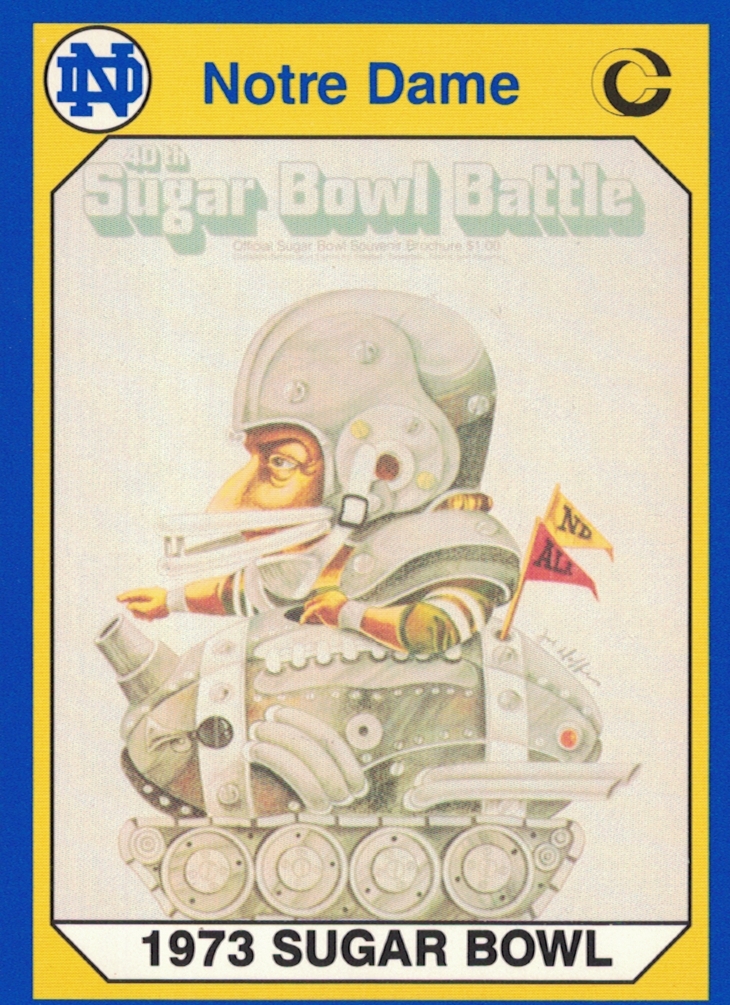
- The Sugar Bowl Showdown: The season culminated in an epic New Year’s Eve clash between the undefeated Notre Dame Fighting Irish (coached by Ara Parseghian) and the undefeated Alabama Crimson Tide (coached by Bear Bryant). Notre Dame narrowly defeated Alabama 24-23 in the Sugar Bowl, securing the AP National Championship.
- Heisman Trophy: Penn State running back John Cappelletti won the Heisman Trophy after rushing for 1,522 yards and 17 touchdowns. He famously dedicated the award to his younger brother Joey, who was dying of leukemia.
Highlights of the 1973 Season
Beyond the box scores, the 1973 season featured critical changes to the rulebook and adaptations to the sociopolitical climate of the United States.
- Jersey Number Standardization: The NFL implemented a strict numbering system based on a player’s primary position, ending the era of wide receivers wearing numbers in the 20s or quarterbacks wearing numbers in the 40s. Quarterbacks and kickers were assigned 1–19, running backs and defensive backs 20–49, centers and linebackers 50–59, and linemen 60–79.
- The Energy Crisis and the TV Blackout: The 1973 oil crisis directly impacted the NFL. To encourage citizens to stay home and conserve fuel on Sundays, the U.S. Congress passed experimental legislation lifting the local television blackout for games that were sold out 72 hours in advance. This temporary measure ultimately became a permanent fixture of NFL broadcasting.
- The Rise of the Steel Curtain: While they didn’t win the Super Bowl in 1973, the Pittsburgh Steelers defense began truly establishing its terrifying reputation. Defensive tackle Joe Greene won his first NFL Defensive Player of the Year award, laying the groundwork for Pittsburgh’s late-70s dominance.
A Deep Dive into 1973 Football History and Highlights
- January 1, 1973 – The USC Trojans had no trouble with the Ohio State Buckeyes in the 59th Rose Bowl Game, dispatching the OSU squad by the score of 42-17. Trojan running back Sam Cunningham was awarded the MVP nod.
- January 1, 1973 – In the 1973 Orange Bowl, the ninth-ranked Nebraska Cornhuskers dominated the twelfth-ranked Notre Dame Fighting Irish with a decisive 40-6 victory. Heisman Trophy winner Johnny Rodgers led the way in his final collegiate game by scoring four touchdowns and throwing for another, securing a victorious send-off for retiring Nebraska head coach Bob Devaney.
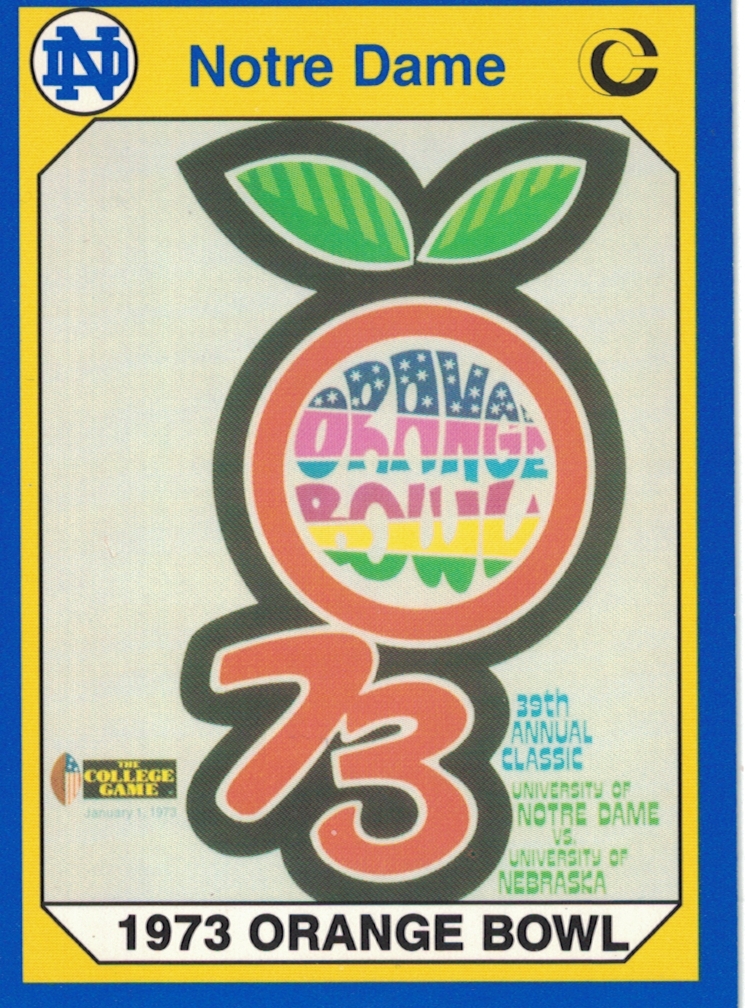
#85 – 1973 Orange Bowl – Notre Dame Fighting Irish vs Nebraska Cornhuskers. Darin Hayes’ personal collection.
- January 14, 1973 – LA Memorial Coliseum, Los Angeles, California -Super Bowl VII featured a team on a mission, mentioned multiple times in this series: the Miami Dolphins. The franchise that stood in the way of gridiron immortality was the Washington Redskins. It was a hard-hitting game, and the Dolphins used running back Larry Csonka to fuel their offense. He pounded out a game-high 112 yards on the ground against the fierce Redskin defense. The game got pretty exciting late in the contest, according to a story on the WashingtonPost.com. The Dolphins held a 14-0 lead with over two minutes remaining. Washington forced Miami to attempt a 42-yard field goal to ice the game, but instead the kick was blocked, and the loose ball ended up in kicker Garo Yepremian’s hands, and he unwisely tried to toss it forward, but after a tip of the pass, Washington’s Mike Bass grabbed the errant throw and found the end zone at the 2:07 mark in the final quarter. The Dolphins were forced to punt after a three-and-out, and Washington was in business at their own 30-yard line with 1:14 remaining. The Dolphin defense came in and put an end to the comeback bid, and the clock expired with two Miami defenders piled up on Redskin quarterback Billy Kilmer. The final score was Miami 14-7, a thrilling finish to complete the first and so far the only undefeated championship season in the Super Bowl era. The game’s MVP was Miami Safety, Jake Scott.
- January 21, 1973 – Texas Stadium, Irving, Texas –The 23rd NFL Pro Bowl was covered once again by the American Football Database. In the contest, the Steelers’ Chuck Noll coached the AFC and faced the man in the fedora, Tom Landry, who was coaching the NFC. The AFC edged out the NFC, 33-28. The game’s MVP was O. J. Simpson, the running back of the Buffalo Bills. The winners cashed out $2000 per man while the NFC players got $1500 in the loss.
- January 30, 1973 – Each NFL team’s front offices assembled in New York for the 1973 NFL Draft. John Matuszak from the University of Tampa was the first overall pick by the Houston Oilers. The Pro Football Reference data shows that Hall of Famers from this class with busts in Canton are John Hannah, Ray Guy, and Joe DeLamielleure.
- March 24, 1973 – San Francisco 49ers President Lou Spadia proposed expanding the NFL to 30 teams, according to profootballhof.com. This came just four years after the AFL-NFL merger, which expanded the league to 26 teams. Some franchises expressed concern about spreading talent too thin, while others supported expansion to continue the league’s momentum. Ultimately, the league awarded franchises to Tampa Bay and Seattle, bringing the total to 28. Further expansion in the 1990s brought Jacksonville, Carolina, Houston, and Cleveland, bringing the league to 32 teams.
- April 5, 1973 – The National Football League revises its rules to adopt the jersey numbering system with quarterbacks having numbers from 1-19, etc, 1-19: Quarterbacks and specialists: 20-49: Running backs and defensive backs; 50-59: Centers and linebackers; 60-79: Defensive linemen and offensive linemen other than centers; 80-89: Wide receivers and tight ends.
- July 27, 1973 – The Chicago College All-Star game was played in Chi-Town Soldier Field as 5,400-103 fans watched as the champion Miami Dolphins knocked off the All-Stars 14-3. The most valuable player award was always given to the college player who happened to play best for the All-Stars that year; Ray Guy, the punter from Southern Miss. We know Ray Guy went on to be a great Oakland Raider legend.
- July 28, 1973 – The Pro Football Hall of Fame conducted the enshrinement of the following NFL legends: Raymond Berry, Jim Parker, and Joe Schmidt.
- August 14, 1973 – Legendary NFL quarterback Johnny Unitas sued the franchise he formerly played 17 seasons for, the Baltimore Colts, for $725,000. The lawsuit claimed that the Baltimore Colts were in breach of a contract with Unitas that was made in 1970. The contract said that Johnny U would be with the team in some capacity, either playing or on staff, for 10 years, but the team benched him and then traded him to San Diego after only a couple of years. Reports say that the Colts organization did pay their former signal caller $30,000 per year for 10 years after he retired, as agreed.
- September 10, 1973 – The NFL’s leading receiver, Don Maynard, is traded by the New York Jets to the St. Louis Cardinals.
- September 16, 1973 – Buffalo’s O.J. Simpson rushes for a then-NFL record 250 yards in Buffalo’s 31-13 win at New England.
- September 30, 1973 – St Louis Cardinals receiver Mel Gray starts his streak of 121 straight NFL games with a reception. Who would have known that the game in which Gray had only 2 receptions for 35 yards in a 45-10 loss to the Dallas Cowboys would be part of something much larger, 120 games in the future?
- October 20, 1973 –The White House. Washington D.C.- Proclamation 4209—Jim Thorpe Day. President Nixon proclaimed Jim Thorpe the greatest athlete of the 1st half of the Twentieth century in a written proclamation to the country.
- October 21, 1973 – Los Angeles Memorial Coliseum – Fred Dryer of the then Los Angeles Rams became the first player in NFL history to score two safeties in the same game. In an article on barstoolsports.com, it is found that going into the 1973 Week 6 matchup with the Packers, the LA Rams were 5-0, while the Packers were 2-1-2. By the fourth quarter, the Rams were in a comfortable position, taking a 20-7 lead. As the game was winding down, Fred Dryer took down quarterback Scott Hunter in the end zone. On the next possession, Dryer sacked backup Jim Del Gaizo for another safety for a final score of 24-7. A few days later, Fred Dryer was named NFL Defensive Player of the Week.
- October 27, 1973 – NFF tells us 1988 College Football Hall of Famer Lee Roy Selmon and his brothers Lucious and Dewey combined for 26 tackles as Oklahoma downs Kansas State 56-14 in the 16th game of a 37-game unbeaten streak for the Sooners.
- November 3, 1973 – Cougar Stadium, Provo, Utah –Brigham Young University wide receiver Jay Miller set an NCAA football single-game record with 22 catches for 263 yards as the Cougars went on to snatch a 56-21 victory over the University of New Mexico.
- November 4, 1973 – The New Orleans Saints earned their first shutout victory, blanking the Buffalo Bills 13-0.
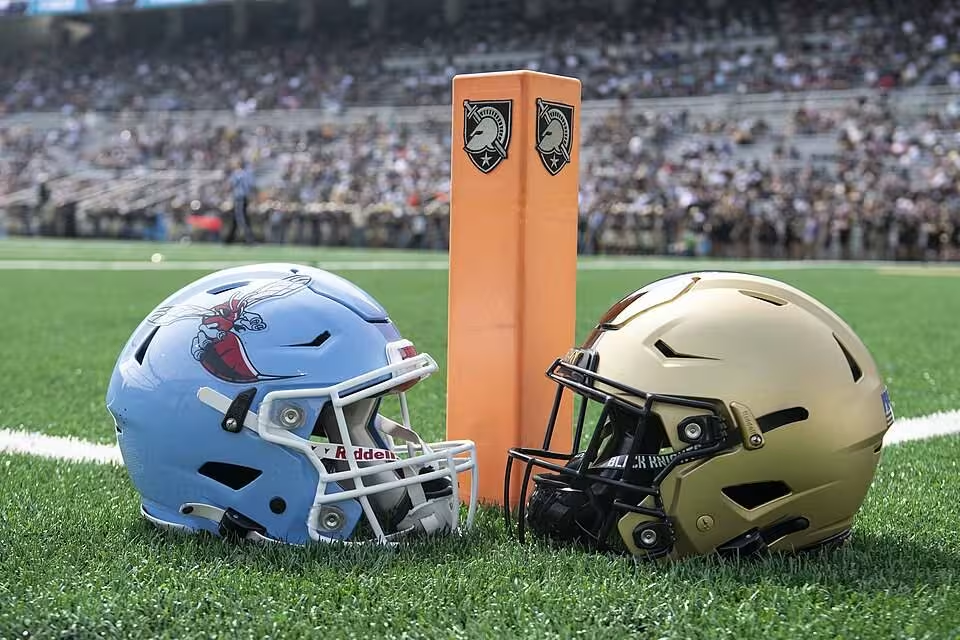
- November 10, 1973 – Kent, Ohio – According to a 2015 post on footballfoundation.org, a 1973 matchup pitting the No. 17-ranked Miami of Ohio RedHawks and the Kent State Golden Flashes marked the first-ever meeting of ranked MAC teams, putting the MAC title on the line. Redhawks fullback Chuck Varner fueled the offense with a two-yard touchdown plunge and a nine-yard touchdown reception to help Miami establish a 17-10 lead. Kicker David Draudt finished off the defending MAC champion Golden Flashes with a school-record 52-yard field goal in the final quarter. Final score: Redhawks 20, Golden Flashes 10. Miami finished the season with an 11-0 record, its first perfect season since 1955, and a No. 15 ranking at the end of the season. Kent State finished up its season with a 9-2 record.
- November 24, 1973 – The Michigan-Ohio State game was amped up more than usual, as the teams were ranked.
- November 25, 1973 – CNE Stadium, Vancouver – The 61st CFL Grey Cup was played, with the Ottawa Rough Riders earning their 8th Championship by defeating the Edmonton Eskimos 22-18, per cbc.ca. Charlie Brandon was the Most Valuable Player, and Garry Lefebvre was the Most Valuable Canadian.
- December 1, 1973 – The 38th Iron Bowl might sound like a broken record, but the fact is that Alabama beat Auburn with another shutout victory, this time 35-0 in Birmingham.
- December 8, 1973 – The Movie Something for Joey captured the heart of a nation as it told the tale of Penn State running back John Cappelletti playing his butt off for his ill younger brother Joe. The performance on the gridiron earned Cappelletti the 39th Heisman Trophy Award as he rushed for 1522 yards and 17 touchdowns to become the first Nittany Lion to win the Trophy. His quest included 3 straight late-season 200-yard-plus games, according to Heisman.com. Other accolades received by John were the Maxwell Trophy, and he was selected as Player-of-the-Year by ABC-TV, United Press International, the Philadelphia Sports Writers Association, the Walter Camp Foundation, and the Washington Touchdown Club. The LA Rams used the 11th overall pick in the 1974 NFL Draft to select Cappelletti, and his NFL career lasted 10 seasons with both the Rams and the Chargers.
- December 13, 1973 – Penn State running back John Cappelletti delivered his emotional Heisman Trophy acceptance speech, according to historyofcollegefootball.com. As previously reported in Football History Headlines, Cappelletti movingly dedicated the award to his younger brother, Joey, who was battling leukemia.
- December 16, 1973 – O.J. Simpson became the first NFL running back to rush for 2,000 yards in a season, and he did it in a 14-game regular season.
- December 30, 1973 – Miami Orange Bowl –The AFC Championship had the Dolphins hosting the Oakland Raiders. The Miami squad became the first team to play in 3 consecutive Super Bowls, knocking off the Raiders, 27-10, powered by 3 touchdown runs by Larry Csonka, according to a barstoolsports.com article. Meanwhile, on the very same day, the NFC would see its own decisive clash.
- December 30, 1973- Texas Stadium, Irving – The NFC Championship game also ended 27-10. The Pro-Football-Reference.com site shows that Bobby Brown had a 63-yard scoop-and-score to help seal the Super Bowl invitation for the Minnesota Vikings as they beat the Dallas Cowboys to earn the right to play in the big game. Moving into the following decades, December 30 continued to host memorable moments in football history.
- December 31, 1973 – Sugar Bowl De facto Championship –The 40th annual Sugar Bowl featured a highly anticipated matchup between the undefeated, top-ranked Alabama Crimson Tide and the third-ranked Notre Dame Fighting Irish. In a thrilling, back-and-forth contest that saw six lead changes, Notre Dame secured a 24–23 upset victory sealed by a late game-winning field goal and a legendary 35-yard pass out of their own end zone to run out the clock. The historic win earned head coach Ara Parseghian and the Fighting Irish the 1973 AP National Championship, cementing the matchup’s legacy as one of the greatest games in college football history.