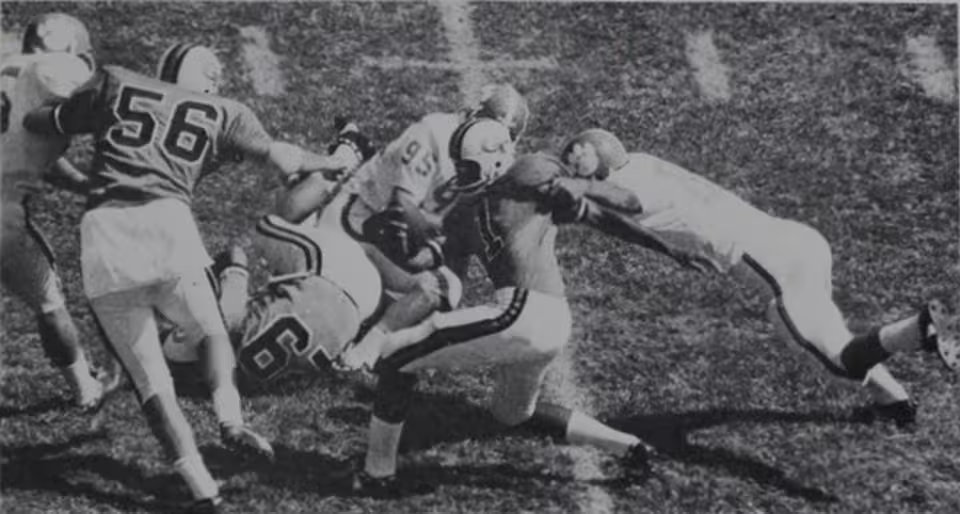
The 1970 season marks one of the most pivotal organizational shifts in professional football history. The long-awaited AFL-NFL merger officially took effect, unifying 26 professional teams under a single shield. This season established the modern structure of the game and introduced broadcasting formats that transformed football into an undeniable American spectacle.
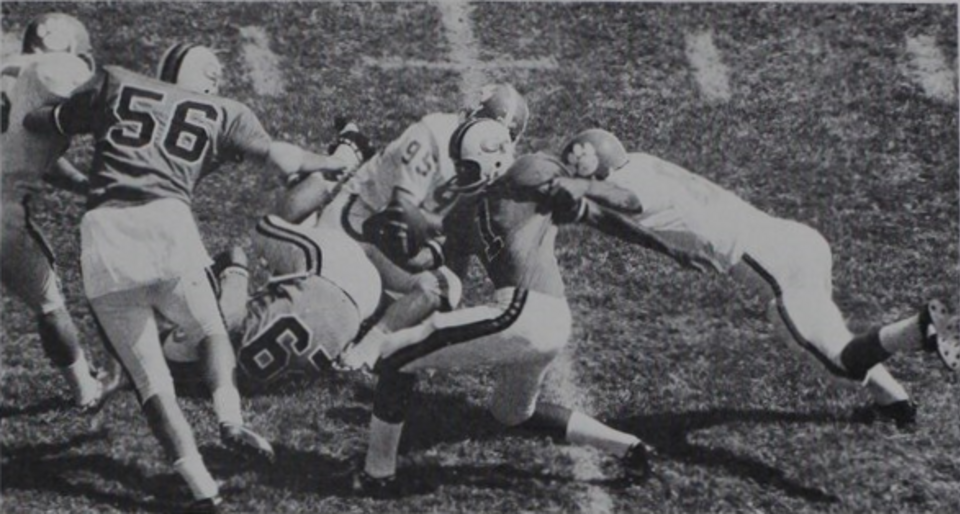
The Merger and the Birth of Primetime
To balance the newly formed conferences after the merger, three established NFL franchises—the Baltimore Colts, Cleveland Browns, and Pittsburgh Steelers—agreed to move to the newly created American Football Conference (AFC) to join the former AFL teams. The remaining 13 NFL franchises formed the National Football Conference (NFC).
Simultaneously, the league dramatically expanded its media footprint with the debut of Monday Night Football on ABC. Broadcasting the game in prime time with the dynamic and often polarizing commentary trio of Howard Cosell, Don Meredith, and Keith Jackson turned the sport into weekly appointment television and a cultural event.
Individual Gridiron Milestones
The 1970 regular season featured two of the most famous individual achievements in NFL history:
- Tom Dempsey’s 63-Yard Field Goal: On November 8, New Orleans Saints kicker Tom Dempsey, who was born without toes on his right foot and wore a custom flat-front shoe, kicked a 63-yard game-winning field goal as time expired. This shattered the previous NFL record by seven yards and stood unmatched for 28 years.
- George Blanda’s Miracle Month: At 43 years old, Oakland Raiders quarterback and kicker George Blanda put together an unprecedented five-game stretch. Over five consecutive weeks, Blanda threw late game-tying or game-winning touchdown passes, or kicked late game-tying or game-winning field goals, earning him the Associated Press Male Athlete of the Year award.
Super Bowl V
The culmination of the 1970 season was Super Bowl V, played on January 17, 1971, at the Orange Bowl in Miami. It pitted the AFC Champion Baltimore Colts against the NFC Champion Dallas Cowboys.
Often referred to as the “Blunder Bowl” due to poor, erratic play, the game was marred by a record 11 combined turnovers and 14 penalties. Despite the sloppy execution, the finish was highly dramatic.
The Colts’ victory provided redemption for their massive upset loss to the Jets in Super Bowl III two years prior, cementing the competitive parity of the newly merged league.
| Team | Final Score | Historic Note |
| Baltimore Colts | 16 | Rookie kicker Jim O’Brien secured the win with a 32-yard field goal with five seconds remaining. |
| Dallas Cowboys | 13 | Linebacker Chuck Howley intercepted two passes and became the first and only Super Bowl MVP from a losing team. |
College Football: Triumphs and Tragedy
The collegiate landscape in 1970 was marked by intense competition and profound heartbreak.
- The National Championship: The college football title remained split among multiple polls, but the Nebraska Cornhuskers emerged as the consensus AP National Champions after finishing 11-0-1 and defeating LSU in the Orange Bowl. The Texas Longhorns and Ohio State Buckeyes also claimed shares of the title in other recognized polls.
- The Marshall University Tragedy: On November 14, 1970, Southern Airways Flight 932 crashed shortly before landing in Huntington, West Virginia. The crash claimed the lives of all 75 people on board, including 37 players of the Marshall University Thundering Herd football team, the coaching staff, and team boosters, marking the deadliest sports-related aviation disaster in U.S. history.
A Deep Dive into 1970 Football History and Highlights
- January 1, 1970 – The Cotton Bowl had the No. 1 Texas Longhorns against the No. 9 Notre Dame Fighting Irish in a thriller. In the 1970 Cotton Bowl, the top-ranked Texas Longhorns faced the Notre Dame Fighting Irish, who were making their first bowl appearance in 45 years following a self-imposed postseason ban. Trailing in the fourth quarter, Texas executed a dramatic comeback highlighted by a crucial fourth-down touchdown pass from James Street to Cotton Speyrer to secure a 21-17 victory. The hard-fought win capped off an undefeated season and cemented the consensus national championship for the Longhorns.
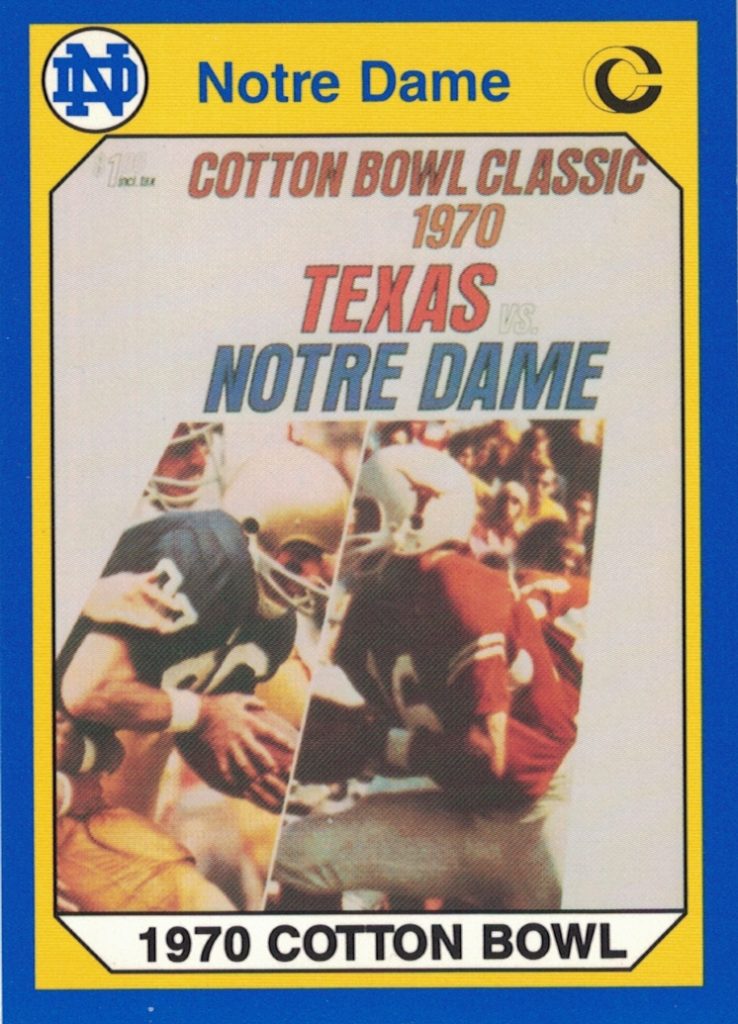
#81 – 1970 Cotton Bowl – Notre Dame Fighting Irish vs Texas Longhorns. Darin Hayes’ personal collection.
- January 1, 1970 – The Rose Bowl provided viewers with its 56th edition of the classic, and pitted the USC Trojans against the Michigan Wolverines. This was a defensive battle that saw Southern Cal come out on top 10-3, with Trojan flanker Bob Chandler named the game MVP.
- January 4, 1970 – Alameda County Coliseum, Oakland –The Kansas City Chiefs met their rivals, the Oakland Raiders, in the 1969 AFL Championship game. The Chiefs’ defense came to play and made it tough sledding for the Raiders all game, forcing 4 interceptions. KC earned the right to advance to the Big Game in a 17-7 victory over the home team.
- January 4, 1970 – Metropolitan Stadium, Bloomington, Minnesota –Meanwhile, at the NFL Championship game to see who would face the Chiefs, it was the Minnesota Vikings who outlasted the Cleveland Browns, 27-7.
- January 11, 1970 – Tulane Stadium, New Orleans, Louisiana –Super Bowl IV had the Minnesota Vikings taking on the Kansas City Chiefs for the right to win the Lombardi Trophy, according to Pro-Football-Reference.com. The Chiefs jumped out to a 16-0 halftime lead based on three Jan Stenerud field goals and a rushing TD by Running Back Mike Garrett. The teams exchanged touchdowns in the third quarter on a Vikings Dave Osborn plunge, and a KC Len Dawson pass connection to Otis Taylor for a 46-yard touchdown. The Chiefs captured the NFL title by knocking off the Minnesota Vikings, 23-7. The game’s Most Valuable Player was Quarterback Len Dawson.
- January 16, 1970, -The NFL realigned into 3 divisions in each Conference after the official merger of the AFL into the NFL, per the American Football Fandom site. As we discussed in earlier posts, the NFL had 16 teams prior to the merger, while the AFL had only 10. The easiest way to balance the conferences was to move three traditionally NFL teams into the new AFC to join the existing AFL squads. So in the realignment, the Baltimore Colts, Pittsburgh Steelers, and Cleveland Browns all joined the old AFL squads in the conference. The divisions were listed as the AFC West, consisting of the Raiders, Chargers, Broncos, and Chiefs. The AFC East consisted of the Bills, Colts, Patriots, Jets, and Dolphins. The Central Division of the AFC placed the Browns, Bengals, Oilers, and Steelers together. Over in the other conference, the NFC East consists of the Eagles, Redskins, Cowboys, Giants, and Cardinals. The NFC Central comprised the Packers, Bears, Vikings, and Lions. The Rams, 49ers, Saints, and Falcons made up the NFC West.
- January 17, 1970 – In Houston’s Astrodome, the 9th and final AFL All-Star Game saw the Western Division defeat the Eastern Division 26-3, with Los Angeles Charger quarterback John Hadl receiving MVP honors.
- January 18, 1970 – Los Angeles Memorial Coliseum –The 20th NFL Pro Bowl featured the Western Conference outlasting the Eastern Conference, 16-13. Chicago Bears legendary halfback Gale Sayers and George Andrie, the defensive end of the Dallas Cowboys, were selected as the game’s Most Valuable Players.
- January 27, 1970 – In the 1970 NFL Draft, the Pittsburgh Steelers chose future Hall of Famer Terry Bradshaw from Louisiana Tech with the first pick of the entire draft. Bradshaw would be the signal-caller who won those 4 Super Bowls for Chuck Noll that we just talked about, and Terry was the MVP of 2 of them!
- February 18, 1970 – The Miami Dolphins announced that Don Shula was their new head coach and vice president. The only problem was that he was still under contract with the Baltimore Colts! Check out the following 1-minute video we have on the story:
- March 18, 1970 – The NFL selected Wilson as the official football & scoreboard for the official time.
- June 16, 1970 – Beloved Chicago Bears running back Brian Piccolo died of embryonal cell carcinoma at the age of 26. His courage and friendship with teammate Gale Sayers inspired the widely acclaimed 1971 television movie Brian’s Song.
- July 2, 1970 – The Birth of the AFL-NFL Merged Schedule: The NFL officially released its regular-season schedule for the historic 1970 season—the very first since the completed AFL-NFL merger. This calendar permanently integrated the old guard and the new upstarts into a unified weekly battle plan, completely changing how fans consumed the game.
- July 16, 1970 – Three Rivers Stadium opens in Pittsburgh, Pennsylvania, establishing a dual-sport home for the Pirates and the Steelers until its closure in 2000.
- July 31, 1970 – The Kansas City Chiefs defeated the College All-Stars 24–3 at Soldier Field in Chicago, where Boston College defensive back Bruce Taylor earned the game’s MVP award.
- August 3, 1970 – The NFL Players Association and the NFL ended an active work stoppage by agreeing to a $19.1 million deal.
- August 8, 1970 – The Pro Football Hall of Fame conducted the enshrinements of the following legends: Jack Christiansen, Tom Fears, Hugh McElhenny, and Pete Pihos.
- September 21, 1970 – ABC aired the first Monday Night Football game, with the New York Jets visiting the Cleveland Browns. Broadcaster Keith Jackson did the play-by-play as Don Meredith and Howard Cosell filled in with color and controversy.
- October 24, 1970 – Wake Forest edged preseason ACC favorite North Carolina 14-13 at Groves Stadium to improve to 4-3 on the season. Wake trailed 13-0 entering the fourth quarter before Larry Russell scored on a quarterback sneak to cut the deficit to 13-7. The Deacons won the game by marching 94 yards in the closing minutes as Larry Hopkins scored on a 3-yard run with just 12 seconds left to tie the game. Tracy Lounsbury added the extra point for the win.
- November 8, 1970 – Tulane Stadium, New Orleans, Louisiana – There were only a couple of ticks left on the clock with the New Orleans Saints behind on the scoreboard by one point to the visiting and heavily favored Detroit Lions. The Lions had just taken a 17-16 lead in the game when Errol Mann booted an 18-yard field goal with 14 seconds remaining. The Saints started their drive from their own 28-yard line and with a quick 17-yard pass from QB Billy Kilmer to wide receiver Al Dodd, who got out of bounds at the Saints 45 with 2 seconds left. The Saints’ brand-new offensive line coach, Don Heinrich, who had just taken over that role, surprisingly called for the field-goal team to come out. There was a hush over the stadium as everyone couldn’t believe they were going to try to kick a field goal from that distance rather than pass to the end zone. After all, they were still on their own side of the 50-yard line! It would be a 63-yard attempt, as the reader must remember that the goal posts were positioned on the goal line in that era of NFL football. Tom Dempsey was the kicker for New Orleans that season, and he was born without toes on his right foot and no fingers on his right hand. To play in the NFL, he had to wear a special, modified shoe with a flattened, enlarged toe surface. All of this culminated in one of the most dramatic moments in NFL history. Tom Dempsey trotted out and calmly kicked the longest field goal in NFL history to win the game against the Detroit Lions 19-17. The si.com article explains how Dempsey surpassed the previous record-long field goal, a 56-yarder by Bert Rechichar, set by the Baltimore Colts in 1953. (source) You may want to see the current 2025 record set in our November 2 post.
- November 14, 1970 – Kenova, West Virginia – Marshall Tragedy – A good portion of the Marshall University football team passed away in the horrible crash of a chartered Southern Airways DC-9. All 75 people on board were killed. According to history.com’s account of the accident, the crash occurred about 2 miles from the Tri-State Airport in Kenova as the group was returning from a football game against East Carolina University. The victims included 37 players of the Thundering Herd, along with the University’s A.D., the team’s coaches, doctor, and about 25 boosters. It was one of the largest tragedies in sports history. https://www.history.com/this-day-in-history/plane-crash-devastates-marshall-university.
- November 27, 1970 – Los Angeles Coliseum – Fighting Irish Quarterback, Joe Theisman throws for a whopping 526 yards against USC in a driving rainstorm. The Trojans were too much, though, as the final score was Southern Cal 38, Notre Dame 28. (source)
- November 28, 1970, CFL Grey Cup, CNE Stadium, Toronto: Montreal Alouettes defeat Calgary Stampeders, 23-10; game marred by woeful field conditions
- November 28, 1970, Legion Field, Birmingham – The Tide jumped out to an early 17-0 lead, but Tigers quarterback Pat Sullivan, wide receiver Terry Beasley, and company were not done yet. 247sports.com tells the tale of how the Auburn Tigers came from behind to get past Alabama’s Crimson Tide 33-28 in a thrilling second half.
- December 5, 1970 – Memorial Coliseum, LA – F64Sports reports that the fine running back of the Los Angeles Rams, Willie Ellison, rushed for an NFL record of 247 yards in a game against the New Orleans Saints. Ellison started the game off with a bang as he took a handoff on the third play from scrimmage and raced around the end for an 80-yard touchdown sprint. The Rams powered their way to a 45-28 victory, charged by the yards on the ground provided by Willie Ellison.
- December 26, 1970 – The lowest-scoring playoff game in NFL history occurred, as the Dallas Cowboys defeated the Detroit Lions 5-0 in an NFC Divisional round matchup at the Cotton Bowl.