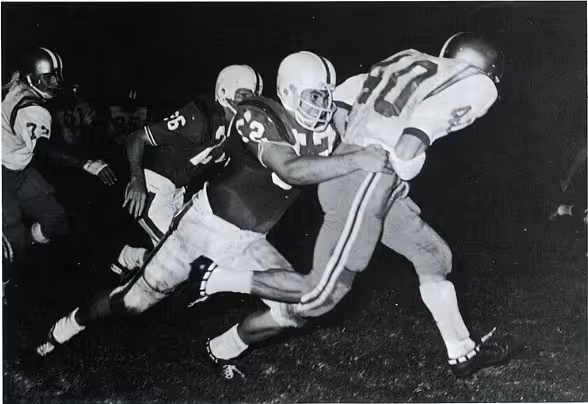
The 1967 American football season was a landmark year that fundamentally shaped the modern landscape of the sport. It marked the first season that concluded with the newly minted AFL-NFL World Championship Game (later retroactively named Super Bowl I) in January 1967, setting the stage for an intense, hyper-competitive regular season later that fall.
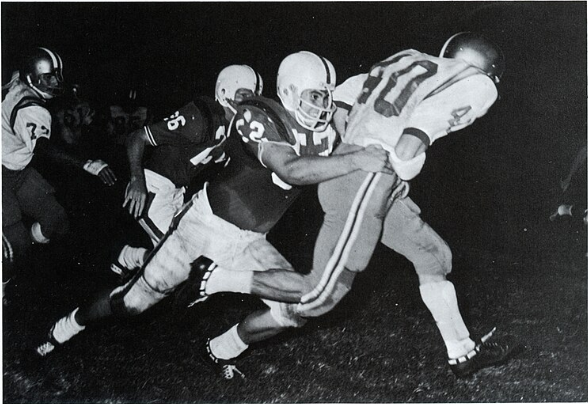
Date 1967
Source Scanned from page 373 of “The 1967 Laguiappe” Louisiana Tech yearbook by User:Swtpc6800 Michael Holley.
The NFL: Lombardi’s Packers Solidify a Dynasty
In the National Football League (NFL), the Green Bay Packers, led by legendary coach Vince Lombardi, continued their absolute dominance. Despite aging veterans and a grueling schedule, the Packers fought their way to the NFL Championship Game.
On December 31, 1967, Green Bay hosted the Dallas Cowboys in what became the most famous game in football history: The Ice Bowl. Played at Lambeau Field in a brutal −13°F (−25°C) deep freeze, quarterback Bart Starr executed a legendary quarterback sneak with seconds remaining to secure a 21-17 victory.
The AFL: The Rise of the Oakland Raiders
Over in the American Football League (AFL), a powerhouse was rising in northern California. Under head coach John Rauch and the guidance of general manager Al Davis, the Oakland Raiders dominated the league with a spectacular 13-1 regular-season record.
Led by quarterback Daryle Lamonica—affectionately nicknamed “The Mad Bomber” for his deep passing game—the Raiders crushed the Houston Oilers 40-7 in the AFL Championship Game to claim the league crown and earn their ticket to the big stage.
College Football: The “Game of the Century”
The collegiate landscape was equally electric in 1967. The national championship race came down to an epic clash on November 18 between rivals USC and UCLA, famously dubbed the “Game of the Century.”
USC, led by star running back O.J. Simpson, won a thrilling 21-20 victory, largely thanks to Simpson’s legendary 64-yard touchdown run. USC went on to win the Rose Bowl and secure the consensus National Championship.
A Deep Dive into 1967 Football History and Highlights
The 1967 season remains a golden era for football historians, serving as the bridge between the old-school grit of the early gridiron and the massive media spectacle the sport would soon become.
- January 1, 1967 – The AFL Championship Game featured the Kansas City Chiefs against the defending champion Buffalo Bills. The Chiefs dethroned the Bills 31-7, at War Memorial Stadium in Buffalo, New York.
- January 2, 1967 – The Rose Bowl’s 53rd playing provided fans a glimpse of the Purdue Boilermakers upending the USC Trojans 14-13 in a thriller. The MVP of the game was Purdue defensive back John Charles.
- January 9, 1967 – The Pro Football Hall of Fame states that New Orleans’ franchise officially adopted the name “Saints. The NFL awarded the 16th franchise to the City of New Orleans on November 1, 1966, “All Saints Day.” We have more on the franchise’s start in our November 1 post.
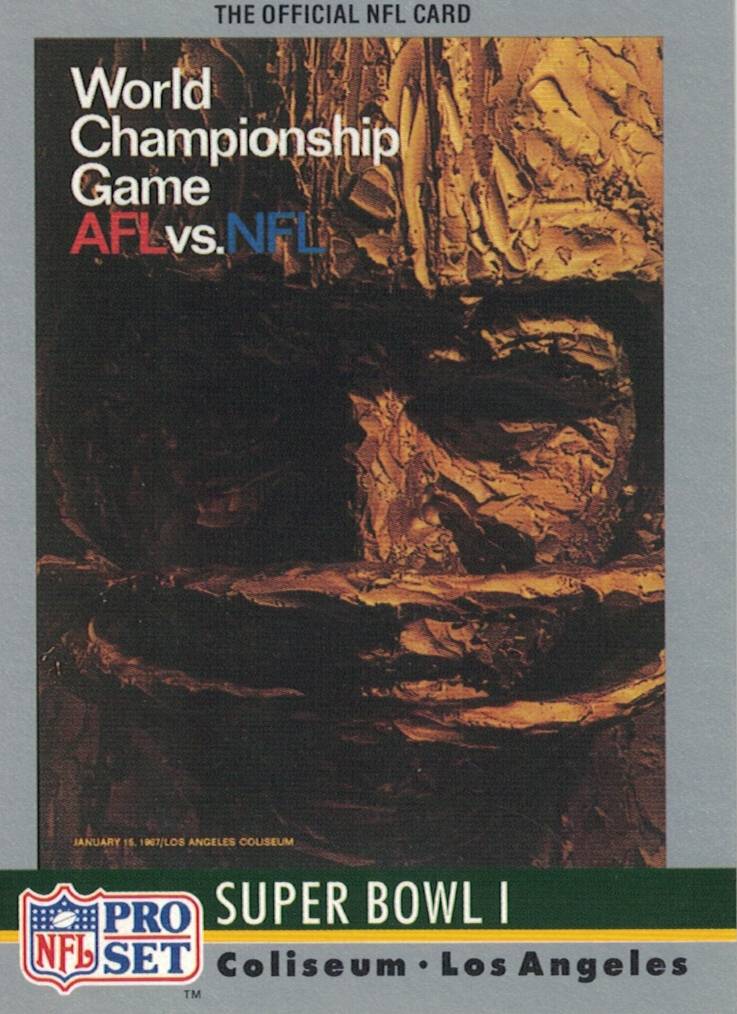
- January 15, 1967 – Los Angeles Memorial Coliseum – The First AFL-NFL World Championship game, later referred to as Super Bowl I, was played. The AFL put up their champ, the Kansas City Chiefs, against the old guard of the NFL, the Green Bay Packers. The Packers of Vince Lombardi were the heavy favorites, but still a record television audience of over 60 million viewers tuned in to watch the game, according to History.com. To the surprise of most, the Chiefs only trailed by four at the halftime break. In the second half, Green Bay turned the temperature up a bit and scored a TD set up by a Willie Wood interception and a 50-yard return off of KC QB Len Dawson. Elijah Pitts scored two of the Packers’ touchdowns, and end Max McGee added a third as the Green Bay Packers rolled the Chiefs, 35-10. Green Bay signal-caller Bart Starr was recognized as the game’s MVP.
- January 21, 1967 – Los Angeles Memorial Coliseum – The results of the 6th AFL All-Star Game were that the Eastern Division knocked off the Western Division, 30-23. According to RemembertheAFL.com, the game’s MVPs were Babe Parilli, the quarterback of the Boston Patriots, and the great defensive end of the New York Jets, Verlon Biggs.
- January 22, 1967 – Los Angeles Memorial Coliseum – At the 17th annual NFL Pro Bowl, the American Football Database recounts how Blanton Collier, coach of the Eastern Conference’s Cleveland Browns, used the West’s domination as a rallying cry. Vince Lombardi coached the Western team. Football then seemed tilted toward the West Coast at all levels. Western teams had won the NFL championship, the Playoff Bowl, college football’s East-West game, and the Rose Bowl. Collier’s speech apparently worked. The East’s stars doubled up the West, 20-10. Offensive MVP was Gale Sayers of the Chicago Bears. On defense, the Eagles’ Floyd Peters won the honor from his tackle position.
- January 27, 1967 – The New Orleans Saints signed their 1st player, kicker Paige Cothren, per the canalstreetchronicles.com. Cothren was a former Ole Miss fullback who played in the NFL for the LA Rams and the Philadelphia Eagles before joining the Saints.
- February 22, 1967 – The NFL goal post changes shape & 6′ wide border around the field becomes standardized in the NFL. It seems odd for us to watch vintage footage of NFL games before 1974 and see the goal posts on the goal line rather than on the end lines where they stand today. A 1974 rule revision pushed each post back 10 yards, mainly for player safety. We are not going to focus on that rule change in this edition, though, but rather on the one that occurred 7 seasons earlier, when the “H”- style posts were retired from NFL fields, and the more modern “Y” or “sling-shot” goal post became standard equipment. This elimination of one obstacle on each goal line at a time afforded the players and officials fewer chances to collide with those posts, but it also opened up the running and passing lanes just a tad, too. An article on the SI.com website states that in the first dozen years of the NFL’s existence, the League played by the very popular College rules. In 1927, the NCAA took the posts and set them safely on the end line. In 1933, the NFL finally wrote its own rulebook. And in an effort to increase field goal attempts because the general feeling was that there were too many ties, the NFL moved the uprights back to the goal line. That is where they stayed for some 4 decades. The other rule revision on February 22, 1967, was the addition of a 6-foot boundary around the entire field. The American Football Fandom page describes the purpose quite well. “Its outer edge designates the closest that non-players can be to the field, and thus enables the game officials to have a running lane to work in.” As a former high school football official, I can attest that those clear zones around the playing field are vitally important for the safety of the participants, sideline personnel, and game officials. (inspired source for story)
- March 14, 1967 – 1967 NFL Draft: Bubba Smith from Michigan State was the first pick by the Baltimore Colts. We discussed Mr. Smith on his birthday, just recently, in our February 28 post. Bubba played five great seasons for the Colts before a knee injury kept him out of the 1972 season. Smith rejoined the Oakland Raiders in 1973 after his recovery and played there for two years before joining the Houston Oilers for his final two NFL seasons. Bubba played in two Pro Bowls, was an All-Pro for one season, and received a Super Bowl Ring with the Colts for their victory in Super Bowl V, per Pro-Football-Reference. The First Combined Draft – As mentioned with Bubba Smith, today marks the anniversary of the 1967 AFL-NFL Common Draft. It was a pivotal moment in the merger process, ensuring that the two leagues stopped “warring” over the same players and began the transition toward the unified league we know today.
- May 23, 1967 – The AFL grants a franchise to Paul Brown, which would become the Cincinnati Bengals.
- July 20, 1967 – Bert Rose Takes the Reins in New Orleans: Marking a major foundational milestone for the expansion franchise, the New Orleans Saints officially appointed Bert Rose as the team’s very first permanent General Manager on July 20, 1967. Rose, who had previously served as the inaugural GM of the Minnesota Vikings, brought crucial expansion-building experience to the upstart Saints organization just weeks before they took the field for their historic, inaugural preseason game against the Los Angeles Rams. (Source)
- August 4, 1967 – The 34th Chicago All-Star Game was played, and the Green Bay Packers in 1967 blanked the College All-Stars 27-0 before 70,934 in attendance at Soldier Field. The most valuable player, always given to the college player team, happened to be Bubba Smith, the big defensive end from Michigan State. The National Football Foundation website says that Smith was a two-time All-American end who learned much of his craft from his father, Willie Ray Smith, who was a high school football coach back in Texas. Bubba Smith was inducted into the College Football Hall of Fame in 1988, and he was the Baltimore Colts’ first-round draft choice and made All-Pro. Bubba also played for the Raiders and the Oilers organizations during his NFL tenure.
- August 5, 1967 – The Pro Football Hall of Fame conducted the enshrinement of the following NFL legends: Chuck Bednarik, Charles W. Bidwill Sr., Paul Brown, Bobby Layne, Dan Reeves, Ken Strong, Joe Stydahar, and Emlen Tunnell.
- August 5, 1967 – The first exhibition game after the AFL-NFL merger took place as the Denver Broncos of the AFL stunned the Detroit Lions of the NFL 13 to seven at the University of Denver Stadium.
- August 12, 1967 – The New Orleans Saints earned their very first franchise win in the preseason game against the St. Louis Cardinals 23-14. Then we come to the headline: USC and UCLA barred from the 81st Rose Bowl. Five Pac-10 schools cited for violations of academic rules. FAQ: When did the New Orleans Saints win their first game?
- September 17, 1967 – The New Orleans Saints played their first NFL regular-season game, losing 27-13 to the Los Angeles Rams. The upstart Saints would not find their way to the victory column until their eighth Game on November 5, 1967, when they surprised the Philadelphia Eagles with a 31-24 victory in New Orleans.
- October 28, 1967 – Per the footballfoundation.org website, UTEP back-up QB Brooks Dawson fills in for starter Billy Stevens. His first six completions go for touchdowns in a 75-12 victory over New Mexico.
- November 18, 1967 – The Fighting Irish hit a milestone in the school’s legendary football history. Notre Dame notches up victory number 500 for the program as the Irish run over Georgia Tech by the score of 36-3.
- November 18, 1967 – On the West Coast, the National Title was being decided as rivals Southern Cal and UCLA squared off in a BIG one.
- November 28, 1967 – The 33rd Heisman Trophy Award went to UCLA Quarterback Gary Beban.
- December 2, 1967 – The Hamilton Tiger-Cats defeated the Saskatchewan Roughriders 24-1 in the 55th CFL Grey Cup at Landsdowne Park in Ottawa.
- December 2, 1967 – In the “Run in the Mud” game, Alabama Quarterback Kenny Stabler busted loose for a 47-yard touchdown scramble, giving the #8 Crimson Tide a tight 7-3 victory in the 32nd Iron Bowl.
- December 24, 1967 – The NFL Divisional Rounds were played, and the Dallas Cowboys put a hurting on the Cleveland Browns 52-14 to advance. Pro-Football-Reference.com informs us that Dandy Don Meredith tossed 2 TD passes with 212 yards, but the Cowboys’ ground game of Don Perkins and Craig Baynham, with two touchdowns each, powered the scoring for Dallas.
- December 24, 1967 – The Green Bay Packers won their Divisional Playoff with the LA Rams 28-7. Travis Williams fueled the Packers’ scoring with two rushing touchdowns and 88 yards, keeping the Rams offense off the field.
- December 31, 1967 – Oakland’s Alameda County Coliseum – The AFL Championship game pitted the host Raiders against the Houston Oilers. Quarterback Daryle Lamonica, who had been claimed off waivers from Buffalo earlier in the season, led the Silver and Black to a 13-1 record. Houston, on the other hand, went from last place in the AFL’s Eastern Conference the previous season to the top position in the 1967 season. Lamonica had two scoring passes and one TD with his legs, while George Blanda booted four field goals through the uprights to help Oakland win its first AFL Championship. Final score Oakland Raiders 40, the Houston Oilers 7. (source)
- December 31, 1967 – Lambeau Field, Green Bay – The NFL Championship, which is often remembered as “The Ice Bowl.” With game time temps around -13°F, Lambeau Field lived up to its nickname of the frozen tundra. Some interesting facts about this game. Referee Magazine tells how head ref Norm Schachter said there was only one official whistle blown all game, and it was right before the opening kickoff. At the time, only metal whistles were available. Right before kick-off, the Umpire lost some skin off his lips. The crew never tweeted another one the rest of the game, and Schachter’s own whistle was found to have the wooden ball frozen in place inside the metal part. As for the players, it would have been a great game no matter what the temperature was, as there would be 12 future Hall of Famers on the field that day in the arctic conditions, plus each head coach would get a bust in Canton, too, according to a JS Online article. Even when you don’t consider the great people involved or the extreme weather, it was a fantastic game to boot! Drama at the end as Bart Starr keeps the ball and plunges into the frozen end zone. The Green Bay Packers ‘ last-second heroics defeated the upstart Dallas Cowboys, 21-17, in the coldest NFL game on record!