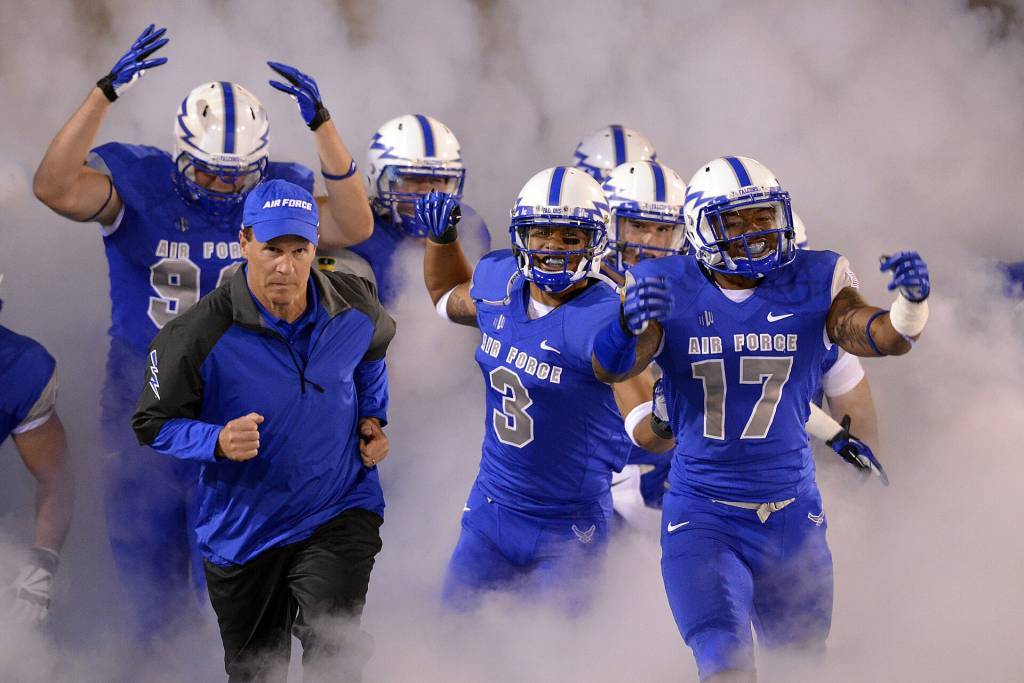
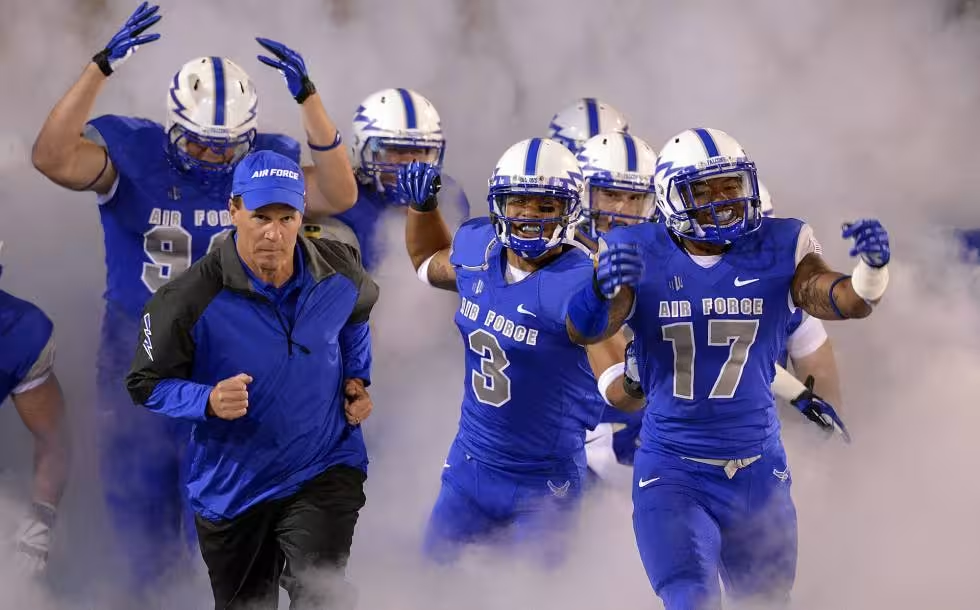
We have written many stories about colleges and universities whose football programs sprang to life in the late 19th century; however, we haven’t talked much about those that may have emerged mid-century, like the Air Force Academy’s program.
The United States Air Force Academy football program emerged from rapid institution-building in the mid-1950s, launching on the gridiron just months after the Academy welcomed its inaugural class of cadets.
Founding and the Falcons Nickname
Authorized by Congress in April 1954, the Air Force Academy admitted its first class of 306 cadets—the Class of 1959—in July 1955 at its temporary campus at Lowry Air Force Base in Denver, Colorado. Even before the cadets arrived, Academy leadership prioritized intercollegiate athletics to build esprit de corps and national visibility. In the spring of 1955, a committee chaired by Captain Harrison Haberg Jr. evaluated several potential mascots—including the lion, tiger, bear, eagle, and falcon—and recommended the falcon in a June 29 report. On September 25, 1955, the inaugural cadet wing voted to officially adopt the Falcons nickname, choosing the bird of prey to symbolize the speed, courage, agility, and aerial dominance expected of future military aviators. Just weeks later, on October 5, 1955, the Academy received its first live peregrine falcon mascot, named “Mach I” after the speed of sound.
The First Game and Early Coaches
Because the Academy initially consisted solely of freshmen, its first varsity schedule in 1955 was played exclusively against collegiate freshman squads. Air Force did not yet have its own stadium—Falcon Stadium would not open until 1962—so the team played home contests at the University of Denver’s DU Stadium.
On October 8, 1955, before a crowd of 17,785 fans at DU Stadium and under the watchful eye of Academy Superintendent Lt. Gen. Hubert Harmon, Air Force played its first-ever football game, defeating the University of Denver first-year students 34–18. Air Force Colonel Robert V. Whitlow, the Academy’s first Director of Athletics, coached the team during that 1955 campaign and guided the squad to a 4–4 finish.
To elevate the program to major-college competition, the Academy hired Lawrence “Buck” Shaw in January 1956. A former Notre Dame All-American under Knute Rockne and the inaugural head coach of the NFL’s San Francisco 49ers, Shaw brought instant national credibility. He coached Air Force during its transition to varsity-level play in 1956 and 1957, compiling a 9–8–2 record before departing to coach the Philadelphia Eagles.
In 1958, the Academy turned to Ben Martin, a former Navy player and University of Virginia head coach. Martin transformed Air Force into a national contender overnight. In his debut season—when the Academy’s first class were seniors—the 1958 Falcons went undefeated (9–0–2), tying No. 13 Iowa 13–13 in Iowa City and holding TCU to a scoreless 0–0 tie in the 1959 Cotton Bowl Classic. Air Force finished ranked No. 6 in the final AP Poll, and Martin went on to coach the program for 20 seasons (1958–1977), establishing enduring rivalries with Army (first played in 1959) and Navy (1960).
Early Stars
Air Force’s rapid rise relied on standout athletes from its founding Class of 1959 who balanced rigorous military and academic demands with major-college football:
- Brock Strom (Offensive Tackle): A team captain on both the 1955 and 1958 squads, Strom anchored the offensive line during the undefeated 1958 campaign and became the Air Force Academy’s first consensus All-American. He later earned a Ph.D. and served as Director of Engineering for the Air Force’s Global Positioning System (GPS).
- Larry Thomson (Fullback): A powerhouse runner in the backfield, Thomson captained the 1956 squad and earned Little All-America honors in 1956 as the Falcons transitioned against varsity opponents.
- Rich Mayo (Quarterback): Leading Ben Martin’s offense during the historic 1958 undefeated run, Mayo passed for over 1,000 yards—an impressive figure for service-academy football in that era—and orchestrated the upset tie against Iowa and the Cotton Bowl berth.
- George Pupich & Dave Phillips (Linemen): Alongside Strom, defensive lineman Dave Phillips and standout lineman/kicker George Pupich gave Air Force the physical toughness required to hold perennial powerhouses like Iowa and TCU in check despite being significantly outweighed on the line of scrimmage.
From a first-year team playing in borrowed stadiums in 1955 to a top-ten bowl participant within four seasons, the Falcons quickly forged an identity defined by discipline, agility, and competitive grit.